Is Moissanite an Investment - HOLYCOME
People ask us, sometimes, whether they should buy moissanite as an investment. They have read somewhere that it holds its value, that it is a smart asset, that it is like buying gold. As a factory that produces the stuff, we have to be straight with you: it is not. Moissanite is a beautiful, durable, affordable stone, and it is a wonderful thing to wear, but it is not an investment. It will not appreciate, it will not pay dividends, and if you sell it you will get back a small fraction of what you paid. This guide explains why, from the manufacturing economics up, and it explains what you should actually think about if you are trying to build wealth through jewelry. We are not going to sell you a fantasy, because that is not how factories talk. We will tell you what moissanite is, what it costs, and what it is for, so you can buy it for the right reasons and not the wrong ones.
The short answer is this: an investment asset is something that becomes scarcer or more useful over time, and that other people will pay more for later. Moissanite is the opposite. It is manufactured in a factory, we can make more every year, and the price has been falling, not rising. So buying moissanite as an investment is like buying a new phone as an investment: it depreciates the day you open the box, and it will be worth less next year, not more. Buy moissanite because you want to wear a beautiful ring at a fair price, not because you think it will make you money. If you want an investment, we will point you toward gold or index funds, and we will mean it.
We cover the resale side in our guide on what a used moissanite ring actually sells for, which is the practical proof of this article. We also cover the diamond comparison in our guide on why moissanite is cheaper than diamond, which explains the supply side. This article is specifically about the investment question, and we will answer it directly: no, it is not, and here is why.
What Makes Something an Investment Asset
To understand why moissanite is not an investment, you have to understand what makes something an investment in the first place. An investment asset is something you buy today because you expect it to be worth more tomorrow. That expectation rests on two things: scarcity and utility. Gold is scarce, and it has industrial and monetary utility, so people pay more for it over time. A share of a profitable company is a claim on future earnings, so it rises as the company grows. A rare painting is scarce, and people want it, so it appreciates. In every case, the asset either becomes scarcer, or it produces something valuable, and the market prices that in.
Moissanite has neither. It is not scarce, because we grow it in a furnace, and we can grow more tomorrow. It does not produce anything; it just sits on a finger. It does not have industrial utility that drives demand, because its main use is jewelry. And because we can manufacture as much as the market wants, the price has gone down over the years, not up. There is no reason to expect a moissanite stone you buy today to be worth more next year, because we will be able to sell you a new one for the same price or less. That is the definition of a depreciating manufactured good, not an investment.
This is not a criticism. Most things people buy are not investments, and that is fine. A sofa, a dinner out, a vacation, a ring: these are consumption goods, bought to be enjoyed, not to be flipped. Moissanite is a consumption good. The mistake is treating it like gold or a diamond, because the marketing sometimes implies that. We think the honest framing is the only one that serves customers, so we repeat it: buy moissanite to wear, not to invest. If you want an investment, look elsewhere. This is the factory talking, and we have no incentive to sugarcoat it, because the people who come back to us are the ones who bought for the right reason.
Why Manufactured Goods Depreciate
Any manufactured good depreciates the moment you buy it, because the manufacturer can always make another one. A car loses twenty percent of its value the day you drive it off the lot, because a new identical car is available at the dealer. A phone loses value within months, because a newer model comes out. A moissanite ring loses value the day you wear it out of the store, because we can make a new one for the wholesale price, and the retail markup you paid is gone. This is not a moissanite problem; it is a manufactured-goods problem, and it applies to everything we make.
The only manufactured goods that hold value are limited editions, vintage pieces, or items with a strong brand following. A Rolex holds value because the brand controls supply and creates desire, and because vintage Rolexes become collectible. A no-name watch does not. A moissanite ring from a mass-produced line will never be a collectible, because there are millions of them. Even a moissanite ring from a known brand will not appreciate, because the brand can always make more. The only exception might be a limited-edition piece from a famous designer, in gold, decades from now, when it becomes retro. But that is a speculative bet, not an investment, and we would not advise buying one for that reason.
We cover the resale numbers in our guide on the used moissanite market, and the numbers tell the story: a ring you buy for eight hundred resells for eighty to one hundred and sixty. That is a ninety percent loss, which is the opposite of an investment. Even if you hold it for ten years, it will not recover that loss, because we keep making new ones. The gold in the band holds some value, but the stone and the setting depreciate. This is the reality, and we would rather tell you now than have you discover it when you try to sell.
Gold, Diamonds, and Real Assets: What Actually Holds Value
If your goal is to hold value, there are real assets that do it, and we will name them. Gold and platinum hold value because they are commodities with finite supply and industrial use. When you buy a gold ring, the gold itself is worth something, even if the ring is never sold as jewelry. We cover this in our guide on the setting cost versus the stone value, and the point is that the metal is the part that holds worth. A platinum ring always has the melt value of the platinum, which tracks the commodity price. The stone on top does not.
A natural diamond holds some resale value, because it is rare and has a trade market, though even diamonds lose money when you resell, because the retail markup is large. We compare this in our guide on lab-grown diamond versus moissanite value retention, and the honest answer is that both hold very little, but a natural diamond holds more than either manufactured option. Still, a diamond is not a great investment, because the retail markup is so high. If you want to invest in diamonds, you buy them at wholesale, not at retail, and almost no consumers do that.
The best investment, for most people, is not jewelry at all. It is a low-cost index fund, which grows with the economy over decades. It is a house, which is a real asset. It is gold bullion, which is a commodity hedge. Jewelry, at retail, is almost never an investment, because the retail markup is huge and the resale market is thin. We say this plainly, because we would rather a customer put their savings into an index fund and buy a moissanite ring for wearing, than blow their savings on a ring they think will appreciate. The ring is for wearing; the fund is for the future. Keep those separate, and you will be happier.

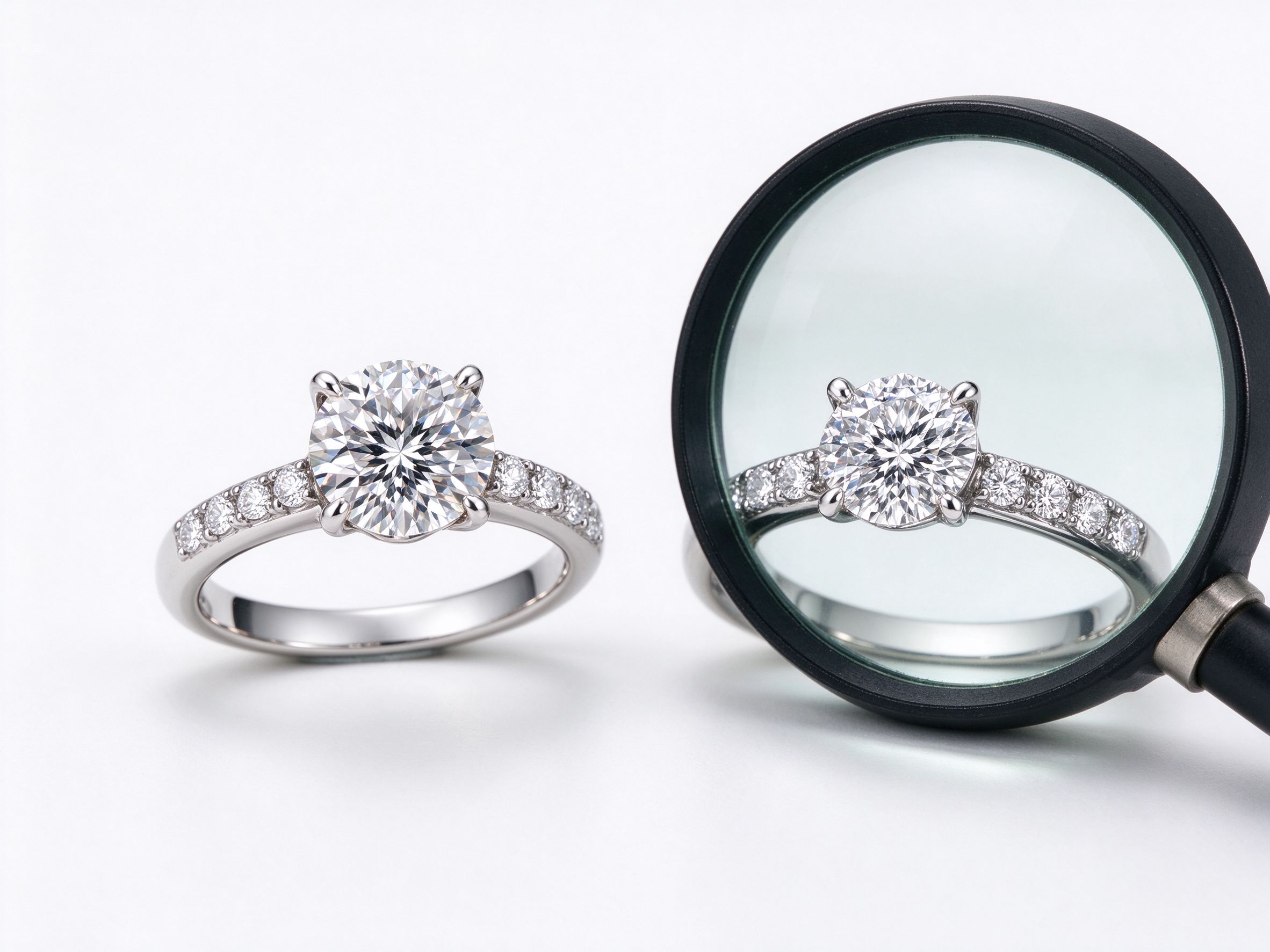
A finished ring. It is a beautiful thing to wear, but it is a consumption good, not an investment asset.
The Factory Perspective: We Make More Every Year
From where we stand, the investment question is almost funny, because we see the supply growing every year. Every quarter, we produce more moissanite stones than the last, because the furnaces run, the cutting lines improve, and the cost falls. If moissanite were an investment, you would be betting that we somehow stop producing it, which we will not. We are in business to make more, cheaper, every year. That is what a factory does. The supply curve slopes down, not up, which means the price of moissanite will likely keep falling, not rising. This is the opposite of what an investor wants.
We are not complaining about this. Falling prices are good for customers, because more people can afford a beautiful ring. We are pointing it out because it settles the investment question. If the manufacturer is actively driving the price down, the product is not going to appreciate. You are not buying into a limited supply; you are buying into a growing one. This is great for wearers, terrible for investors. We love that moissanite is affordable, because it means a couple on a budget can have a gorgeous engagement ring without going into debt. But that affordability comes from a supply that grows, which is the same reason it is not an investment.
For wholesale brands, this means moissanite is a product line, not an asset. Brands buy it from us at a wholesale price, mark it up, and sell it to customers to wear. The brand makes money on the margin, not on holding inventory for appreciation. In fact, holding moissanite inventory is risky, because the price falls over time, so a brand that buys a lot and sits on it loses money. The smart brand turns inventory fast, not slow. This is the opposite of how you manage an investment, and it confirms that moissanite is a fast-moving consumer good, not a store of value.
What Moissanite Is Actually For
So if it is not an investment, what is it for? It is for wearing. It is for a couple who wants a diamond-like ring without spending five thousand dollars. It is for a person who wants a big, bright stone on a budget. It is for someone who cares about ethics and wants a lab-grown stone without the mined-diamond cost. It is for daily wear, for anniversaries, for proposals, for treating yourself. In these uses, moissanite is excellent, because it is hard, it is brilliant, it lasts, and it costs a fraction of a diamond. The value is in the daily joy of wearing it, not in reselling it.
We cover this in our guide on cost per wear, which is the right way to value a ring. A two-hundred-dollar ring worn every day for ten years costs about five cents a day. That is a bargain for ten years of wearing something beautiful. Compare that to a five-thousand-dollar diamond worn for ten years, which costs about a dollar and forty cents a day, and the moissanite is the smarter buy on pure value. The point is not that diamonds are bad; it is that the value of jewelry is in the wearing, not in the reselling. Judge the ring by how much you enjoy it, not by what you can sell it for.
This is the mindset we want every buyer to have. Buy the ring because you love the way it looks on your hand, because it fits your budget, and because you will wear it every day. Buy it from us because we price it honestly, cut it well, and stand behind it. Do not buy it because you think it will fund your retirement, because it will not. If you want a ring that holds some value, buy one in solid gold, because the metal is a real asset. But even then, the gold value is a bonus, not the reason to buy. The reason to buy is the wearing, and on that measure, moissanite is a tremendous value.
The Ethics Angle: A Different Kind of Value
One thing moissanite does offer, that has nothing to do with money, is ethical value. Moissanite is lab-grown, so there is no mining, no environmental destruction, and no conflict supply. For many customers, that is a real value that money cannot measure. They want a ring they can feel good about, and moissanite delivers that. This is not an investment in the financial sense, but it is a value in the personal sense: you are buying a clear conscience along with the ring. We think this is worth more than any speculative resale gain, because it is something you actually feel every time you look at the stone.
We cover the manufacturing side in our guide on the Wuzhou manufacturing cluster, and the point is that moissanite is made in a controlled factory, under safe conditions, with no mine involved. For customers who care about that, the ethical value is real, and it is part of why moissanite is worth the price even if it never appreciates. You are not just buying a pretty stone; you are buying a stone that did not require digging up the earth. That is a value, and it is the kind of value that actually matters in daily life, unlike a speculative resale price.
This is the value proposition we believe in. Moissanite is affordable, beautiful, durable, and ethical. It is not an investment, and we will not pretend it is. But it is a wonderful thing to wear, and it lets people who could not afford a diamond have the ring they want. That is enough. We do not need to oversell it as a wealth-building asset, because the product stands on its own. Buy it because you want to wear it, enjoy it, and feel good about how it was made. That is the right reason, and it is the one we build for.
The Psychology of the Investment Claim
We have thought about why people want to believe moissanite is an investment. Part of it is that jewelry has always been marketed as a store of value, and people carry that assumption into every purchase. Part of it is that the word investment makes a purchase feel more responsible, less like an indulgence. But buying a ring because you want a ring is not irresponsible; it is just a purchase. The investment framing is a way to justify the spending, and it leads people to buy more than they would otherwise, on the theory that they are not spending, they are investing. We want to break that frame, because it serves no one. Buy the ring you can afford, enjoy it, and save separately. There is no virtue in paying two thousand dollars for a ring you would have bought for two hundred, on the theory that it is an investment. It is not, and the extra money is better saved.
This is also why we price transparently. When you can see the stone cost, the metal cost, the setting labor, and the margin, the investment illusion collapses, because the numbers are small. A diamond retailer hides those numbers behind a showroom and a story, and the story is that the stone holds value. We show you the bill of materials, and you can see that the stone is a few dollars and the gold is what it is. There is no hidden value waiting to be unlocked, because the value is the ring itself, on your hand, today. That is the honest way to buy jewelry, and it is the way we do business. We would rather sell you one ring at a fair price than ten rings on a fantasy.
Frequently Asked Questions
Is moissanite a good investment?
No. It is a manufactured stone with scalable supply, and the price has been falling over time, not rising. If you sell a moissanite ring, you will get back a small fraction of what you paid. Buy it to wear and enjoy, not to flip for profit.
What jewelry actually holds its value?
The metal does. Gold and platinum have melt value that tracks commodity prices, so a ring in solid gold always has some residual worth. Natural diamonds hold some resale value, though the retail markup is large. Moissanite stones themselves have almost no resale value, because we can make more at low cost.
Should I buy gold or moissanite if I want to hold value?
If holding value matters to you, buy the ring in solid gold, because the gold is a real asset. The moissanite stone on top will not hold value, but the gold band will. This way you get the beautiful stone on a band that retains some worth, which is the best compromise.
What is the best way to invest in jewelry?
Honestly, for most people, jewelry is not an investment. Put your savings into a low-cost index fund or a house, and buy jewelry to wear. If you want a commodity hedge, buy gold bullion. Do not expect a retail-bought ring to fund your retirement, because the markup is too high and the resale market is too thin.
Buy Moissanite to Wear, Not to Flip
We make moissanite rings for people who want to wear something beautiful, not for people who want to speculate. We will quote you an honest factory price, we will cut and set the stone to a high standard, and we will stand behind the ring with certificates and service. Whether you are a wholesale brand or a direct customer, we will tell you the truth about what the ring costs, what it is worth when you are done with it, and why it is a smart wearing choice. Contact us at service@holycome.com with your design, and we will build you a ring that you will love wearing for decades. That is the value we deliver, and we think it is enough.