Ring Size for Manual Work - HOLYCOME
If you work with your hands—construction, mechanics, welding, gardening, cooking, gym training, any job where gloves go on and off all day—the ring you buy should be sized for that work, not for a relaxed office hand. A ring that fits a desk worker perfectly will pinch on a manual worker, whose fingers are thicker, whose knuckles are larger from grip, and who slips gloves on and off all day. As a factory that produces plain bands for wholesale brands, including many workwear and men's lines, we have sized hundreds of these rings, and the rules are different. This guide explains how manual labor changes finger size, why gloves matter, what width and fit to choose, and how to size a ring that stays on through a workday without catching, pinching, or getting damaged.
The short answer is this: manual workers should size a half to a full size larger than their measured finger, choose a comfort-fit band with a rounded inner edge, and keep the band under four millimeters wide if they wear gloves all day. A narrow, comfort-fit, slightly loose band slides over a work-swollen knuckle, sits comfortably under a glove, and will not catch or pinch. A wide, tight, flat-inner band is the wrong choice for hands that labor, and it will either be uncomfortable or get damaged on the job. This is the sizing logic we build into our workwear bands, and it is the one we recommend to every customer who tells us what they do for a living.
We cover the daily finger swing in our guide on why fingers change size through the day, and manual labor amplifies that swing dramatically. A construction worker's finger at the end of a twelve-hour day is noticeably thicker than the same finger at seven in the morning. Sizing that finger at the wrong time produces a ring that pinches by lunch. This guide is about how to measure and choose for hands that work, so the ring fits the whole shift, not just the fitting room.
Why Manual Work Changes Your Finger Size
Hands that labor are thicker than hands that type. Grip work builds the muscles and tendons in the forearm and hand, and over years those muscles thicken the fingers, especially around the knuckles. A carpenter or mechanic does not have the same finger as an office worker with the same body weight. The knuckle is the giveaway: manual workers often have knuckles that are half a size larger than the finger base, because the grip motion enlarges the joint. We cover this knuckle-versus-base problem in detail in our guide on sizing for large knuckles, and manual workers are the population where it shows up most. The finger base may measure a 9, but the knuckle measures a 9.5, and the ring has to clear the knuckle, which means it will be slightly loose at the base. That is normal, and it is the correct fit for a working hand.
Manual work also swells the finger during the day. Gripping tools, operating machinery, and working in heat all drive blood flow into the hands, and by mid-shift the finger is a half size thicker than it started. We explain this in our guide on how weight and activity move finger size, and the effect is large for manual workers. A ring sized to a morning finger will feel tight by the afternoon, when the hand has been working for hours. So manual workers should size for the end of the day, not the beginning. Measure the finger after a shift, not before breakfast, because that is the size the ring has to live in for most of its working life.
The work environment matters too. A worker in a hot factory or a kitchen has permanently warm, slightly swollen hands, and sizes up a half. A worker in a cold warehouse has cold, contracted hands in the winter, and may size down. A mechanic who uses hand tools all day has knuckles that are the limiting size, regardless of temperature. Each of these conditions moves the target, and the right answer is to measure the finger in the actual work condition, not in a comfortable fitting room. We tell every manual worker to measure after a real shift, because a ring sized on a rested hand is a ring that pinches on the job.
The Glove Problem: Why Narrow Bands Work Better
If you wear gloves at work, the ring under the glove has to be flat and narrow. A wide band under a glove creates a bump, which presses on the finger, wears through the glove, and catches on the glove lining. A six-millimeter comfort band under a tight work glove is uncomfortable within an hour; a three-millimeter band under the same glove disappears. This is why we recommend narrow bands—three to four millimeters—for workers who wear gloves all day. The narrow band sits under the glove without creating pressure points, and it does not wear a hole in the glove lining the way a wide band does.
The inner edge of the band matters as much as the width. A flat-inner band has a sharp inside edge that digs into the finger when the glove presses on it, especially after a long shift. A comfort-fit band, with a rounded inner edge, distributes the pressure and slides under the glove without binding. We produce all our workwear bands in comfort fit for exactly this reason: the rounded inside feels smooth against the finger under a glove, and it goes on and off a swollen knuckle without the fight that a flat-inner band gives. This is a small design detail, but manual workers feel it immediately, and it is the difference between a ring they wear every day and one they take off in the morning.
We also recommend a low-profile, flush setting for workers, if they want a stone. A high-set stone under a glove catches on the lining, presses into the finger, and is vulnerable to being knocked. A flush or bezel-set stone, level with the band, sits flat under the glove and survives the workday. We cover the durability side of this in our guide on whether moissanite can handle daily wear, and the short answer is that moissanite is hard enough for manual work, but the setting has to be low and protected. A bezel-set moissanite in a narrow comfort band is the work ring we build most for tradespeople.
How Much to Size Up for a Working Hand
For a manual worker, size up by a half to a full size from the resting finger measurement. The half size up covers the daytime swelling, and the full size up covers large knuckles that the ring has to pass. If you measure your finger base at 9 but your knuckle is 9.5, you size the ring to the knuckle, which means it will be a half size loose at the base. That looseness at the base is correct, because the knuckle is the gate. Do not size the ring to the base, because then it will not clear the knuckle on and off, and you will fight it every morning. Size to the knuckle, and let the base be a little loose.
This is the same logic we use for any large-knuckle customer, but it is amplified for manual workers because the knuckle-base gap is larger. A manual worker with a 9 base and a 9.75 knuckle needs a 9.75 ring, which will spin on the base during the day. The solution is not to size smaller, which would trap the ring on the knuckle, but to add a sizing bead inside the band, which holds the ring in place at the base while still letting it pass the knuckle. We build sizing beads into workwear bands for exactly this reason: the ring is sized to the knuckle, the bead takes up the slack at the base, and the ring stays put without binding. It is the standard solution for working hands.
Do not size the ring too loose, though. A ring that is a full size larger than the knuckle will slide off the finger when the hand is cold, even if it passes the knuckle. The right fit is a ring that passes the knuckle with a little resistance, sits at the base with a slight turn, and cannot slide off over the knuckle on its own. That is the working fit, and it is a half size looser than an office fit, not a size and a half. We size every workwear band to this standard on the mandrel, and we test the knuckle clearance by fitting the band over a knuckle gauge before it ships, so the customer gets the right clearance out of the box.

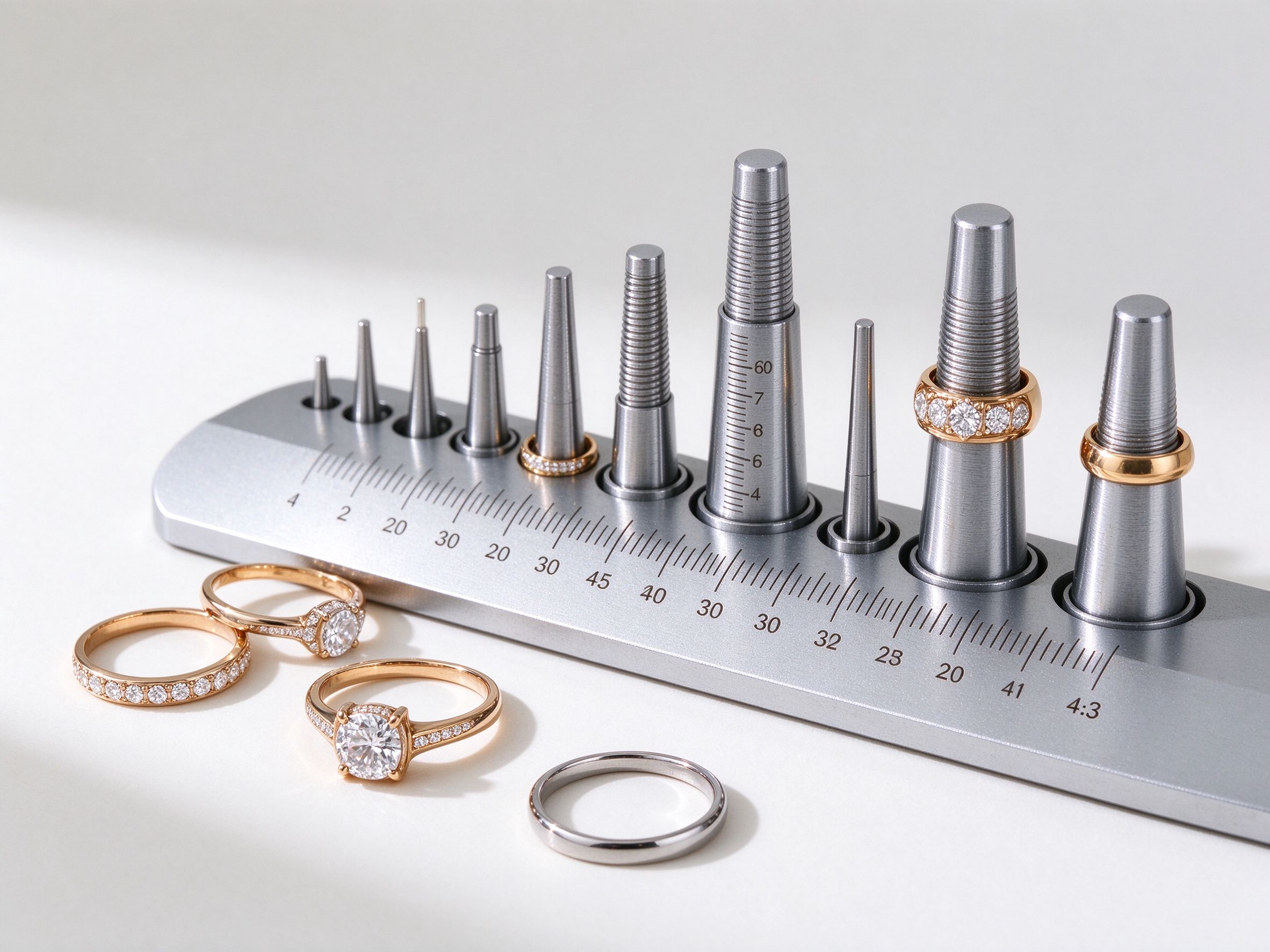
A three-millimeter comfort-fit band, narrow enough to sit flat under a work glove, sized to clear a working knuckle.
Dominant Hand: Size the Ring Hand, Not the Other One
Manual workers have an even bigger gap between their dominant and non-dominant hands than the rest of us, because the dominant hand is the one that grips tools all day. We cover this in our guide on why your dominant hand is a different ring size, and for manual workers the gap is often a full size, not a half. A right-handed mechanic wears his wedding band on his left hand, but his right ring finger is a full size larger than his left, because the right hand is the one that does the gripping. So measure the hand you actually wear the ring on, not the other hand, and do not assume the two hands match. For most people, the wedding band goes on the left ring finger, and that finger is slightly smaller than the right. For a manual worker, it is a half to a full size smaller, and sizing the left ring to a right-hand measurement gives a ring that spins.
This is a common mistake. A manual worker comes in, measures the finger he uses to grip (the dominant hand), and orders that size for the wedding band on the non-dominant hand. The ring arrives and it spins, because the non-dominant finger is smaller. The fix is simple: measure the actual ring finger, on the actual hand, after a shift. Do not guess, and do not measure the wrong hand. We see this error constantly, and it is an easy one to avoid by just measuring the finger the ring will live on. For a right-handed worker who wears the ring on the left, the left ring finger is the one that matters, and it is usually a half size down from the right.
The dominant-hand effect also means that if you switch jobs or stop heavy grip work, your fingers may shrink back. A carpenter who retires may find his wedding band loose, because the grip muscles that thickened his knuckles have softened. This is the reverse of weight gain, and we cover it in our guide on how weight and activity move ring size. If your work changes and your fingers change with it, the ring can be resized down. As a factory, we resize bands for this reason all the time, because working hands change shape when the work stops. It is a normal part of owning a ring for a working life.
Ring Width for Glove Wear: Why Less Is More
We touched on width, but it is worth stating clearly for glove wearers. A work glove is tight, and any ring under it creates pressure. A narrow band—two to four millimeters—creates almost no pressure, because it is thin and sits flat. A wide band—six to ten millimeters—creates a firm ridge under the glove, which presses on the finger and wears a groove in the glove lining within weeks. For workers who wear gloves eight hours a day, the narrow band is the only comfortable choice. Wide bands look great, but they are for office hands, not gloved hands.
The width also changes the effective size, as we explain in our guide on sizing for band width and knuckle. A wide band feels tighter than a narrow one on the same finger, because it covers more skin. So if you choose a narrow band for glove work, you do not need the half-size-up correction that wide bands require. The narrow band fits true to the finger, with just the half-up for swelling and the knuckle clearance. A wide band would need more. This is another reason narrow bands are the right choice for manual workers: they fit true, they sit flat under the glove, and they do not require the size-up that wide bands demand.
For workers who want a wider look on the weekend, the answer is two rings: a narrow comfort band for the workday, and a wider fashion ring for evenings and days off. We see this all the time. The work ring stays on the hand through the shift, and the fashion ring comes out when the gloves come off. Trying to wear a wide ring through a work shift is a recipe for discomfort and damage, and most manual workers end up with a dedicated work band anyway. We produce these as cheap, plain comfort bands, sized for the knuckle, and they last for years through the gloves.
Durability: What Happens to a Ring on the Job
A ring on a working hand takes a beating. It gets banged on machinery, scraped against concrete, exposed to grease and chemicals, and slammed in drawers. We cover the care side in our guide on how sports and impact affect a ring, and manual labor is the same problem at higher intensity. A high-set stone on a working hand will catch and loosen, which is why we recommend low bezel settings. A plated band on a working hand will wear through the plating within months, which is why we recommend solid gold or sterling silver for work rings, not plated fashion pieces. We cover plating wear in our guide on caring for rhodium and plating finishes, and the short version is that a work ring will strip plating fast, so buy the solid metal.
We also recommend against wearing pavé or micro-pavé on a working hand, because the tiny stones catch and fall out under glove friction and impact. A single flush-set stone, or a plain band with no stones at all, is the workwear standard. We produce plain bands and single-stone bezel-set bands for this market, and we leave the pavé and halo designs to the office and evening crowd. A ring for manual work is a tool, and it should be built like one: simple, low, strong, and sized to survive. The fancy designs come out on the weekend.
Grease and oil are another work hazard, and they get into the prongs and under the stone. We cover the cleaning side in our guide on how to clean moissanite at home, and for a work ring the cleaning routine is simpler: take it off at the end of the day, wash it with soap and warm water, and let it dry. Do not leave grease caked in the setting for months, because it builds up and dulls the stone. A work ring that is cleaned weekly lasts years; one that is never cleaned looks dull within months. This is the same care logic we apply to all jewelry, just turned up for the conditions.
Paper Sizers on a Working Hand: Why They Fail
A paper strip sizer, which we explain in our guide on why paper sizers are inaccurate, is especially bad for manual workers. Paper sizers measure the finger base at rest, on a relaxed hand, and they do not account for the knuckle or the daytime swelling. On a working hand, where the knuckle is half a size larger than the base and the finger swells by lunch, the paper sizer gives you a number that is a full size too small. The ring arrives, you fight it over the knuckle in the morning, and it pinches by afternoon. This is the most common sizing mistake we see from manual workers, and it is entirely avoidable by using a proper metal mandrel, ideally measured after a shift.
We recommend that manual workers measure with a reusable metal ring sizer, the kind that clicks to size over the knuckle, and measure at the end of a workday when the hand is warm and swollen. That measurement is the real working size. If you do not have a metal sizer, borrow a ring that already fits a working hand and measure it on a mandrel, rather than using a paper strip. The knuckle clearance is the whole game on a working hand, and paper strips do not capture it. Spend five minutes with a proper sizer after a shift, and you avoid the ring that does not fit.
For wholesale brands, this means the product description for a workwear band should tell customers to measure at the end of the day and to size to the knuckle. We write these instructions into the product cards for our workwear lines, because a ring sized wrong by a manual worker comes back as a return. Sizing instructions are not optional on a workwear band; they are part of the product. The right band, measured the right way, is a band that fits for years and never comes back. That is the goal.
Frequently Asked Questions
What ring width is best for manual work?
Three to four millimeters, in a comfort fit. A narrow band sits flat under a work glove without creating a pressure ridge or wearing through the glove lining. Wide bands look great but are uncomfortable under gloves and should be saved for days off.
Should I size up for working hands?
Yes, by a half to a full size. The half size covers daytime swelling from grip and heat, and the full size covers a large working knuckle that the ring has to pass. Size to the knuckle, use a sizing bead at the base if needed, and do not size to the rested finger base.
Can I wear a moissanite ring to work?
Yes, if the setting is low and protected. A flush or bezel-set moissanite in a narrow comfort band survives manual work, because moissanite is hard and the setting is low enough not to catch. Avoid high prong settings and pavé, which catch and loosen on the job.
What metal holds up best for a work ring?
Solid gold or sterling silver. Plated bands will strip plating within months on a working hand, and fashion metals can cause skin reactions under a sweaty glove. We recommend solid, non-plated metal for work rings, because it survives the grease and the gloves without needing re-plating.
Build Your Work Ring With Us
We produce narrow comfort-fit bands and low bezel-set moissanite rings for tradespeople, mechanics, builders, and anyone who works with their hands. We size every band to clear a working knuckle, we build sizing beads where needed, and we sell at wholesale prices to brands that serve the workwear market. If you are a customer who needs a ring that survives a shift, or a brand building a workwear jewelry line, contact us at service@holycome.com. We will recommend the right width, the right comfort fit, and the right size for your hands, and we will build it to last. A work ring is a tool, and we build tools that hold up.