
01Moissanite Fire and Brilliance: The Optics That Drive Retail Sales
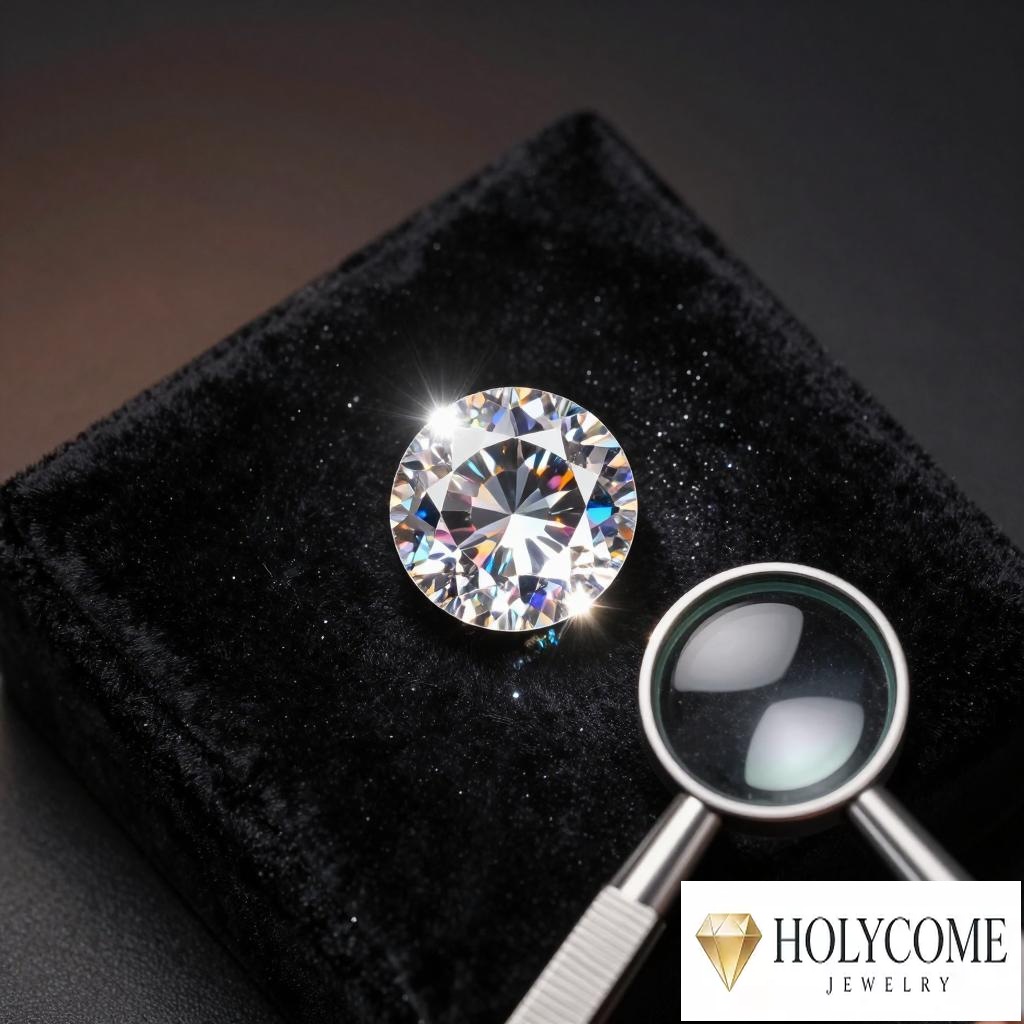
When buyers browse finished jewelry in a retail case or on Instagram, they respond first to sparkle. Three optical properties drive that sparkle: brilliance (white light return), fire (colored spectral flash), and scintillation (patterned sparkle as the stone moves). Moissanite fire — the colored flashes that draw the eye — is the single most cited reason end customers choose it over diamond in our brand partners' customer feedback surveys. But fire without brilliance looks gaudy; brilliance without fire looks flat; and poor cut kills both, regardless of the raw material.
At HOLYCOME, we run a dedicated optical QC lab where every production lot of stones is measured against calibrated diamond reference stones on an Idealscope, ASET scope, and our in-house light return analyzer. Our cut team faceted more than 240,000 stones last year across round, princess, cushion, oval, pear, radiant, emerald, Asscher, marquise, heart, and trillion shapes. This guide explains how moissanite fire and brilliance work, why cut matters more than raw material, and what to specify when you place bulk orders so your finished pieces sell at full price point.
02The Science: Refractive Index, Dispersion, and Light Return
Three physical constants define the optical personality of any gem:
- Refractive index (RI) measures how much the stone bends light entering the crown. Higher RI means more total internal reflection inside the pavilion and more light coming back out the top rather than leaking through the bottom. Diamond RI is 2.42; moissanite RI is 2.65-2.69.
- Dispersion is the difference in refractive index between blue and red wavelengths. Higher dispersion splits white light into its spectral colors more aggressively — this is what gemologists call "fire." Diamond dispersion is 0.044; moissanite dispersion is 0.104, roughly 2.4 times higher (Wikipedia: Moissanite optical properties).
- Birefringence: unlike diamond (singly refractive), moissanite is doubly refractive — light splits into two rays as it enters. This contributes to moissanite's characteristic flash, but if cut poorly can produce a fuzzy or "doubled" appearance in larger stones.
These numbers mean a well-cut moissanite outperforms diamond on paper in both brilliance and fire. The catch is that "well-cut" matters enormously. A poorly cut moissanite — wrong pavilion angles, off-center culet, uneven crown height — will leak light through the bottom and look dark, glassy, or dead, just as a poorly cut diamond does. This is the single biggest quality gap between premium and budget moissanite in the wholesale market.
These numbers mean a well-cut moissanite outperforms diamond on paper in both brilliance and fire. The catch is that "well-cut" matters enormously. A poorly cut moissanite — wrong pavilion angles, off-center culet, uneven crown height — will leak light through the bottom and look dark, glassy, or dead, just as a poorly cut diamond does. This is the single biggest quality gap between premium and budget moissanite in the wholesale market.
03How Cut Angles Control Fire and Brilliance
The round brilliant cut, with 57 or 58 facets (57 without culet, 58 with), is mathematically optimized for light return within a specific range of proportions. For diamond, Tolkowsky's 1919 "ideal cut" established a benchmark of 34.5° pavilion angle and 34.5° crown angle with a 53% table and 43.1% pavilion depth — a starting point that modern optics has refined to a tight tolerance window.
Moissanite's higher refractive index changes the math. Optimal light return in moissanite occurs at slightly steeper pavilion angles than diamond: roughly 40.4-41.0° for the pavilion and 30-33° for the crown, compared with diamond's 40.6-41.0° pavilion and 33-35° crown. A stone cut to diamond proportions in moissanite will still perform well, but a stone cut specifically for moissanite's RI will show measurably better contrast and light return under the Idealscope.
Our HOLYCOME premium round cut is calibrated to the following tight tolerances, which we spec for all our OEM branded lines:
| Parameter | HOLYCOME Premium Cut Tolerance | Commercial "AAA" Cut (market avg) | Budget Cut (low-cost wholesale) |
|---|---|---|---|
| Table % | 54 - 57% | 52 - 60% | 58 - 67% (oversize) |
| Crown angle | 31.5° - 33.5° | 30° - 35° | 28° - 38° (wide variance) |
| Pavilion angle | 40.6° - 40.9° | 40.0° - 41.5° | 39° - 42° (severe leakage outside window) |
| Girdle thickness | 1.5 - 3.0% (slightly thick) | 1.0 - 4.0% | 0.5 - 6.0% (knife-edge or very thick) |
| Culet | None / pointed (max 0.3%) | None to small | Often open/very large |
| Symmetry | Excellent (≤0.3% deviation) | Very good (≤0.8%) | Good/fair (visible miss) |
| Polish grade | Excellent (≥99.5% surface) | Very good | Good (polish lines visible 10x) |
| Hearts and arrows pattern | Clearly defined, 8/8 | Visible but distorted | None or barely present |
The practical difference between a premium cut and a budget cut is visible to the naked eye at arm's length under retail lighting. We have run blind A/B tests with our brand partners in which the premium cut was preferred 82-91% of the time by retail customers, even when shown without price comparison. In controlled sell-through tests at three partner DTC brands, the premium cut outsold the commercial cut by 2.3x to 3.1x at a $100-$150 higher retail price point.
04The Three Components of Sparkle
Brilliance, fire, and scintillation each respond differently to cut choices, and buyers often optimize for one at the expense of the others without realizing it.
Brilliance (White Light Return)
Brilliance is the total white light returned to the viewer's eye through the crown of the stone. It is dominated by table and crown geometry. Stones with oversized tables (above 60%) push more white light straight back but show less fire because the smaller crown facets reduce spectral dispersion. Stones with smaller tables (under 53%) return less white light but more patterned fire through steeper crown facets. Our 54-57% table target is a balanced sweet spot that scores above 96% total light return on our light analyzer while preserving strong fire.
Fire (Spectral Dispersion)
Fire is the colored flash you see as the stone moves — red, orange, blue, violet flashes coming from the crown and star facets. Fire comes from the crown angle, upper girdle facets, and star facets bending different wavelengths to different angles. Moissanite's high dispersion means even moderately cut stones show more fire than a well-cut diamond, but the distribution of that fire matters: budget cuts often concentrate fire in a small number of flashes that look "flashy" or disco-ball-like, while premium cuts distribute fire evenly across the crown so the stone shows sparkle from every viewing angle.
Scintillation (Patterned Sparkle)
Scintillation is the sparkle-on/off pattern as the stone or light source moves. It is governed by facet size and symmetry. Smaller facets create more sparkle events per degree of movement; larger facets create bigger, slower flashes. Our premium round cut uses 57 facets in a classic pattern optimized for a "flash-every-tilt" feel that performs well on video — a critical property for TikTok, Instagram Reels, and product video content, where our partners report 30-50% higher engagement on stones with strong scintillation.
05Hearts and Arrows: What It Actually Tells You
"Hearts and arrows" (H&A) refers to a precise optical symmetry pattern visible through a dedicated H&A viewer: eight arrow shapes through the crown (table-up), eight heart shapes through the pavilion (table-down). It is a strong indicator of excellent three-dimensional facet symmetry — every main facet must be placed within roughly 0.3° of its ideal position for the pattern to appear cleanly (GIA coverage of H&A pattern standards).
H&A is not itself a light performance metric — a stone can theoretically have H&A symmetry with wrong proportions and still leak light — but in practice, any stone with a clean H&A pattern has been cut to tight enough symmetry that it will perform very well optically. For B2B buyers who cannot bring an Idealscope to every parcel inspection, a $10 H&A viewer is one of the fastest quality screens available. All HOLYCOME premium rounds in DEF grade 0.8mm-15mm are cut to a clear 8/8 H&A pattern. We reject stones in final QC that show distorted hearts/arrows, typically 2-3% of each production run.
06QC Tools Every Wholesale Buyer Should Own
For professional B2B buyers evaluating moissanite parcels, three tools give you objective optical data for under $300 total:
- Idealscope (about $120): a reflector scope showing light leakage as pink/white/red/black areas. A well-cut stone shows bright red with a symmetrical black star pattern and no large white leakage zones. We reject any stone with white leakage covering more than 5% of the table area.
- ASET scope (about $150): Angular Spectrum Evaluation Tool showing where the stone is gathering light from (blue = leakage, green = moderate, red = bright direct). A premium-cut moissanite will show mostly red and green with small black contrast areas.
- Hearts-and-arrows viewer (about $10-25): a simple reflector cup with colored lighting that reveals symmetry pattern. Fast pass/fail screening for production consistency.
We encourage all wholesale buyers to include optical QC in their incoming goods inspection. If your team does not have these tools, we include a basic H&A viewer in our welcome pack for new OEM accounts and can arrange an on-site training session for QC staff at your facility for orders over 2,000 pieces per year.
07Fancy Cuts: Brilliance Profiles Beyond Round
Round brilliant is the gold standard for light return, but fancy shapes account for roughly 40% of our OEM volume — particularly cushion, oval, radiant, pear, and emerald. Each shape has different optical tradeoffs:
| Shape | Brilliance (vs round=100) | Fire | Scintillation | B2B Notes |
|---|---|---|---|---|
| Round brilliant (premium cut) | 100 | High | High | Highest sell-through; bridal staple |
| Cushion (modified brilliant) | 92 - 95 | Very high | Medium-high | Vintage look; strong in halo settings |
| Oval (brilliant) | 95 - 98 | High | High | Elongation ratio 1.35-1.45 is our most popular |
| Radiant | 93 - 97 | High | Very high | Crushed-ice or crushed-ice hybrid options |
| Pear | 92 - 96 | High | High | Symmetry critical; 1.45-1.60 ratio ideal |
| Princess | 90 - 95 | High | High | Sharp corners need V-prong protection |
| Emerald / Asscher (step cut) | 75 - 82 | Medium | Low-medium | Hall-of-mirrors effect; color shows more |
| Marquise | 92 - 96 | High | High | Bow-tie control critical; 1.85-2.05 ratio |
| Heart | 88 - 93 | High | Medium | Symmetry defines cleft quality |
FTC disclosure guidance applies to all gemstone names regardless of optical performance, so moissanite must be labeled as moissanite even when its fire and brilliance rival diamond (FTC Jewelry Guides). Step cuts (emerald, Asscher) are the exception: they deliberately trade light return for a "hall of mirrors" linear pattern and a quieter, more architectural look. For these shapes, buyers expect lower brilliance but demand exceptional clarity and color because step cuts act as windows into the stone. We only sell DEF VVS1 in our emerald/Asscher cuts for this reason.
08Production Optical QC at HOLYCOME
Every production lot at our factory goes through a three-station optical QC line before packaging:
- Post-polish Idealscope check: Each stone is viewed under Idealscope. Stones with light leakage over 5% table area, off-center culet, or asymmetry are returned to the faceting floor for rework.
- H&A pattern verification (rounds only): Stones are checked through a colored H&A viewer. Distorted, missing, or off-size hearts/arrows reject the stone.
- Reflectometer reading: Each stone is measured for total percentage light return against our reference master stone. Readings below 95% of the master trigger a reinspection.
Our overall rejection rate at optical QC runs 5-7% on premium-cut production and 2-3% on commercial-cut production. Rejected stones are either recut or downgraded to commercial grade and sold at a discount; we never ship rejected premium-grade stones. That discipline is what lets us guarantee optical performance to every B2B buyer.
09FAQ
Why does some moissanite look "disco ball" while other pieces look diamond-like?
"Disco ball" appearance comes from two issues: cutting that over-emphasizes fire at the expense of balanced light return (often with steep crown facets and a small table), or birefringence-related doubling in stones cut without proper orientation relative to the optic axis. Well-cut moissanite in the 54-57% table range shows balanced white brilliance with targeted flashes of color — it reads as "bright and sparkly" rather than "obviously not diamond." Most buyers prefer this balance.
Can a well-cut moissanite outperform a poorly cut diamond on light return?
Yes, absolutely. Material potential is one thing; realized performance is another. An ideal/excellent-cut moissanite will measurably outperform a good- or fair-cut diamond (the kind found in much commercial mall jewelry) on brilliance and fire. This is not a theoretical claim — you can verify it directly on an Idealscope. The reason diamond keeps its price premium is branding, rarity perception, and cultural status, not consistent optical superiority.
What causes the "green flash" some people mention in moissanite?
Moissanite's double refraction means a small percentage of light rays split into two paths inside the stone. In certain cutting orientations — particularly in older generations of the material or in poorly oriented rough — this can produce a faint greenish or grayish flash under specific lighting angles. Modern cut orientation (cutting relative to the c-axis of the SiC crystal) and tighter crown/pavilion angle control have largely eliminated this from premium production. Our DEF grade shows no green tint under standard daylight-equivalent lighting.
How do I verify optical quality when I receive a wholesale parcel?
Three quick checks: (1) View a random sample of 10% under an H&A viewer — you should see clean 8/8 patterns on rounds. (2) Hold stones table-down over white printed text; if you can read text through the pavilion, angles are wrong and light is leaking — reject. (3) Under a desk lamp with a single point light source, rotate the stone slowly; fire and brilliance should be distributed evenly across the crown without dark "dead" zones. For premium orders, we recommend a full Idealscope check on a 5% sample.
Does moissanite lose its fire over time like CZ?
No. Cubic zirconia loses its sparkle because it micro-scratches (8-8.5 Mohs, scratched by household dust) and its surface polish degrades over 1-3 years. Moissanite at 9.25 Mohs does not scratch under normal wear and its polish is permanent. Oil and soap can build up on the surface just like diamond, but a quick cleaning with warm soapy water and a soft brush restores full fire immediately.
Can you match cut quality across large OEM orders?
Yes. We hold ±0.3° angle tolerances and ±0.5% table/pavilion tolerances across production runs. Our faceting machines use computer-aided angle control (not hand-eye alignment), which means a 1,000-piece order of 1ct rounds will show visibly consistent pattern and light return across every stone. This is the difference between buying from a production factory and buying from a trading company who mixes batches from multiple cutters.
10Spec the Cut, Not Just the Size and Color
The biggest mistake first-time wholesale buyers make is ordering moissanite by size, color, and price without specifying cut tolerances. A "1ct DEF VVS1" can range from $12 (budget cut, leaked light) to $28 (premium H&A cut, 96%+ light return), and the retail sell-through difference can be 3x or more. Our advice: always specify "hearts-and-arrows premium cut with 54-57% table, 40.6-40.9° pavilion angle, 99%+ polish" for your premium line, and commercial cut for your value tier — and inspect to those specs on arrival.
If you want to see the cut difference side by side, our wholesale sample pack ships three calibrated rounds from the same production batch — premium cut, commercial cut, and a reference diamond — viewed through an Idealscope under identical lighting. Browse our current loose moissanite shapes and sizes, explore matched sets for ring settings, or read about moissanite hardness and durability for full production specs. For cut-specific OEM inquiries or custom proportion requirements, email our B2B team — we typically respond within one US business day and can prepare a custom quote with production cutaway diagrams for your review.