Lab Diamond vs Moissanite Value - HOLYCOME
When someone decides to skip a natural diamond, they usually land on one of two stones: a lab-grown diamond or a moissanite. Both look like a diamond, both cost a fraction of a natural one, and both are sold with claims about value. But which one actually holds its worth? As a factory that cuts and sells both, we have an honest answer, and it is probably not what the marketing says. The short version is that neither one holds much resale value, but lab-grown diamonds used to hold more, and now they hold almost none, because the manufacturing cost has collapsed. Moissanite has always held very little, because it was always a cheap manufactured stone. So the comparison is not which one appreciates; it is which one costs less upfront for the same wearing experience, and that is almost always moissanite. This guide walks through the value retention question, stone by stone, so you can choose based on facts, not marketing.
The short answer is this: lab-grown diamonds were once sold as a cheaper version of a real diamond, with a story that they held value like natural diamonds. That story collapsed between 2020 and 2024, when lab-grown diamond prices fell by eighty percent or more, because factories scaled up and supply exploded. Today, a lab-grown diamond resells for almost nothing, same as moissanite. The only difference is that a lab-grown diamond still costs more to buy in the first place. So if resale is your concern, both are bad, but if value is your concern, moissanite wins, because you lose less money up front. This is the honest comparison, and we will explain why.
We cover the related question of why moissanite is cheaper than a diamond, and the resale question in the used moissanite market. This article is specifically the head-to-head: lab-grown diamond versus moissanite, on value retention. Read on, and the choice will be clear.
The Lab-Grown Diamond Price Crash
To understand the value comparison, you have to understand what happened to lab-grown diamonds. Around 2018, lab-grown diamonds were a novelty, sold at a premium over natural stones, with the story that they were real diamonds, ethically made, and would hold their value. By 2024, that story was gone. The factories that grow lab diamonds scaled up dramatically, especially in China and India, and the price of a one-carat lab-grown diamond fell from thousands to a few hundred. The supply exploded, the price collapsed, and anyone who bought a lab diamond at the 2021 price found that their stone was worth a fraction of what they paid. This is the classic manufactured-goods price curve: as production scales, the price falls, and early buyers take the loss.
We watched this happen from the factory side, because we are part of the same manufacturing ecosystem. We saw the lab-grown diamond prices drop quarter by quarter, and we saw the resale market for them dry up, because a buyer could get a brand-new lab diamond from a factory for less than a used one. There is no reason to buy a used lab diamond when a new one is cheaper and under warranty. So the resale market for lab-grown diamonds collapsed, just like the resale market for any manufactured stone collapses when supply scales. This is the same reason moissanite has always had weak resale value, and it is now the reason lab-grown diamonds do too.
This matters for your purchasing decision. If you were told, in 2021, that a lab-grown diamond held value like a natural one, you were misinformed. The market has now proven that lab-grown diamonds are a manufactured commodity, just like moissanite, and their price is set by factory production, not by scarcity. So the value-retention advantage that lab-grown diamonds used to claim is gone. Today, both stones depreciate fast, and the question is simply which one costs less to buy in the first place. That is the comparison that matters, and it is the one we will make.
Moissanite: The Cheap, Durable Alternative
Moissanite has always been the cheaper option, and it has always been the honest one about value. We never told customers moissanite would hold its value, because we knew it was a manufactured stone with scalable supply. What we told them was that it looks brilliant, it is hard, it lasts, and it costs a fraction of a diamond. That is the value proposition, and it has held up. A moissanite stone costs a small fraction of a lab-grown diamond, because the crystal growth and cutting are cheaper and more established. It is also harder than a lab-grown diamond on the Mohs scale, and it sparkles more, because of its higher refractive index. So on pure aesthetics and durability, moissanite is competitive with, and in some ways better than, a lab-grown diamond.
The resale value of moissanite has always been low, as we cover in our guide on the used moissanite market. A used moissanite ring resells for ten to twenty percent of retail, because the stone is cheap to replace. The resale value of a lab-grown diamond today is similarly low, because the stone is also cheap to replace, post-crash. So on the resale side, they are now tied: both resell for almost nothing. The difference is on the buy side: moissanite costs a hundred or two for a stone, while a lab-grown diamond still costs a few hundred for the same carat. So the total loss when you resell is smaller with moissanite, because you spent less up front. That is the value advantage.
This is the key insight. If both stones resell for almost nothing, then the one you should buy is the cheaper one, because you lose less money. There is no reason to pay three hundred dollars for a lab-grown diamond stone when you can pay fifty dollars for a moissanite stone that looks as good or better, lasts just as long, and resells for about the same. The only reason to pay more for the lab-grown diamond is if you specifically want the chemical identity of diamond, or if the lab-grown diamond has a brand or certification story you care about. For most people, those reasons are not worth the extra money, and moissanite is the smarter buy.

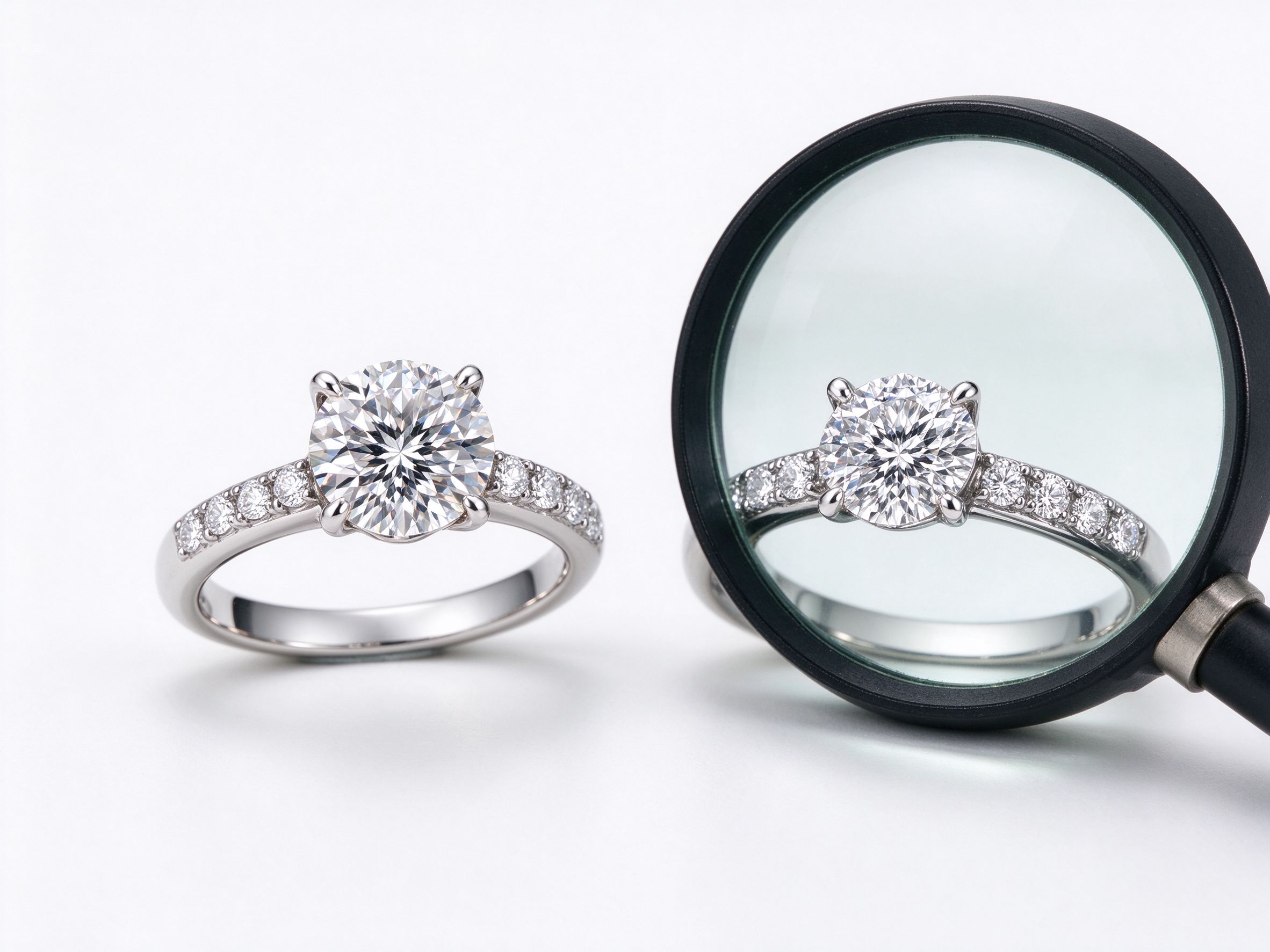
A precision-cut moissanite. It costs a fraction of a lab-grown diamond, sparkles more, and resells for about the same amount.
The Difference: Chemical Identity and Perception
There is one real difference between the two stones, and it is not value retention; it is perception. A lab-grown diamond is chemically and physically a real diamond, made of carbon, and it tests as diamond on a tester. A moissanite is silicon carbide, and it tests as moissanite on a diamond tester. If you care about the chemical identity, if you want a stone that is literally a diamond, then a lab-grown one is the way to go, even though it costs more. If you do not care what the stone is made of, as long as it looks brilliant and lasts, then moissanite is the cheaper, brighter choice. This is the real decision, and it has nothing to do with investment.
There is also a perception difference with other people. Most people cannot tell a lab-grown diamond from a moissanite by eye, because both look like a diamond. But if you tell people you have a diamond, and it is actually a moissanite, some people will care, while others will not. If you want to say you have a diamond, a lab-grown one lets you say that truthfully. If you are comfortable saying you have a moissanite, then you save the money. This is a personal choice, and we do not judge either way. We just want you to make it with the facts, not with the belief that the lab-grown diamond is a better investment, because it is not.
We cover the moissanite versus cubic zirconia comparison in our guide on the value difference between moissanite and CZ, and the principle is the same: choose the stone that fits your budget and your preferences, not the one with the best marketing. Moissanite is the budget, high-sparkle, durable choice. Lab-grown diamond is the diamond-identity choice, at a higher price. Both are manufactured, both depreciate, and neither is an investment. Pick based on what you want on your hand, and you will be happy.
Why Both Depreciate: The Manufacturing Truth
The reason both stones depreciate is the same reason we have been explaining throughout this guide: they are manufactured, and the supply is scalable. We can grow more moissanite, and the lab-grown diamond factories can grow more diamonds. As long as more can be made, the price will stay low, and resale will stay weak. There is no scarcity story left in either stone. The lab-grown diamond industry tried to tell one, but the price crash proved that story false. Moissanite never tried, so it has nothing to unlearn. This is why we respect moissanite as a product: it is honest about what it is, and it prices accordingly.
We cover this manufacturing logic in our guide on why moissanite is cheaper than diamond, and the same logic applies to lab-grown diamonds. A lab-grown diamond is cheaper than a natural one for the same reason moissanite is cheaper: it is made in a factory, not mined. The difference is that a lab-grown diamond is still marketed as a diamond, so it carries a higher price, even though the manufacturing cost is low. Moissanite is marketed as moissanite, so it carries a low price. The physical product is similar; the marketing is different. When you buy a lab-grown diamond, you are paying partly for the diamond label. When you buy moissanite, you pay only for the stone.
This is why we think moissanite is the better value, even setting resale aside. You are not paying a premium for a label; you are paying for the stone and the setting. At the same budget, a moissanite ring from us will have a nicer band, better setting work, and a more brilliant stone than a lab-grown diamond ring, because more of the budget went into the construction and less into the label. This is the same point we make in our guide on setting cost versus stone value: the stone is the cheap part in a moissanite ring, so the money goes into what you wear. In a lab-grown diamond ring, more money goes into the stone label, and less into the band. That is the real value difference.
What Happens When You Resell Either
Let us put numbers on it. A moissanite engagement ring that retails for three hundred dollars, in silver or light gold, will resell for thirty to sixty dollars. A lab-grown diamond engagement ring that retails for two thousand dollars will resell for two hundred to four hundred dollars. In percentage terms, both resell at ten to twenty percent of retail. In absolute terms, the lab-grown diamond resells for more dollars, but you spent six times as much to buy it. So your total loss is much bigger with the lab-grown diamond. If you spend two thousand and get back three hundred, you lose seventeen hundred. If you spend three hundred and get back forty, you lose two hundred and sixty. The moissanite is the smaller loss, by a wide margin.
This is the number that settles the argument. People think a lab-grown diamond holds more value because it resells for more dollars, but they forget how much they spent to buy it. On a total-loss basis, the cheap stone is always the smaller mistake. If resale matters to you at all, buy the cheaper stone, because the absolute loss is lower. And if resale does not matter, because you plan to wear the ring forever, then the cheaper stone is still the better buy, because you have more money left over for the setting, the wedding, or savings. Either way, moissanite comes out ahead, because the upfront cost is lower and the wearing experience is excellent.
We cover the used market mechanics in our guide on what a used moissanite ring sells for, and the same mechanics apply to lab-grown diamonds. A dealer who takes in a used lab diamond cannot resell it for much, because a new one is cheap and available. So the dealer offers you the scrap value of the metal plus a small amount for the stone, which is low. This is unavoidable, and it is why we say that buying either stone as an investment is a mistake. Buy them to wear, accept that you will not recoup the cost, and choose the one that fits your budget and your taste. That is the rational approach, and it is the one we recommend.
The Future: Which Way Will Prices Move?
Looking forward, lab-grown diamond prices will probably keep falling, as more factories come online and the supply chain matures. The crash of the last few years is not over; it is still working through the system. Moissanite prices will probably fall too, but more slowly, because the market is smaller and the crystal growth is more specialized. Both stones will get cheaper over time, which is good for buyers but bad for anyone who bought early and hopes to resell. If you buy a lab-grown diamond today expecting it to hold value, you might find that in two years a new one costs half what you paid, and your used one is worth even less. This is the manufactured-goods trap, and it is happening to lab-grown diamonds right now.
We are on the factory side of this, so we see the cost curves. Moissanite production is stable, and the price moves slowly. Lab-grown diamond production is scaling fast, and the price moves fast. If you are choosing between them today, the moissanite is the safer buy, because the price is already low and unlikely to drop much further. The lab-grown diamond might be cheaper next year, which means buying one now is a bit like buying a new phone: it will be worth less in a year. We are not telling you this to scare you away from lab-grown diamonds; we are telling you this so you buy with eyes open. If you want a lab-grown diamond, buy it because you want it, not because you think it will hold value.
For wholesale brands, this means moissanite is the more stable product line. We can supply moissanite at a predictable price, year after year, because the market is mature. Lab-grown diamond prices are volatile, because the supply is scaling fast, and a brand that buys a lot of lab diamonds today might find them cheaper to restock next quarter. This price volatility is a risk for inventory planning, which is why many brands keep their lab-grown lines small and their moissanite lines steady. We see this in our order book, and it confirms that moissanite is the reliable value product, while lab-grown diamonds are the volatile one. This is another reason to choose moissanite: the price is stable, and you are not buying in at the top of a crash.
The Bottom Line: Buy for the Wearing
After all of this, the bottom line is simple. If you are choosing between a lab-grown diamond and a moissanite, stop thinking about resale value, because neither one has any. Think about what you want to spend, what the stone looks like on your hand, and whether the diamond identity matters to you. If you want the cheapest brilliant stone that lasts for decades, moissanite wins. If you want to say you have a diamond, and the budget allows, a lab-grown one is fine, but go in knowing it will not hold its value. We sell both, and we will not steer you wrong, because our business is built on honest comparisons. The ring is for your hand, not for your investment portfolio, and buying it that way keeps the decision simple and the regret low.
Frequently Asked Questions
Which holds value better, a lab-grown diamond or moissanite?
Neither, really. Both are manufactured stones with scalable supply, and both resell for ten to twenty percent of retail. Lab-grown diamonds used to hold more value, but their price crashed after 2020, and now they resell for almost nothing. On a total-loss basis, moissanite is the better choice, because you spend less up front.
Is a lab-grown diamond a better investment than moissanite?
No. Both depreciate, and lab-grown diamonds have been falling in price fast as factory supply scales. Moissanite is cheaper to buy, so the absolute loss when you resell is smaller. If you want an investment, buy gold bullion or index funds, not either stone.
Can people tell the difference between a lab-grown diamond and moissanite?
Not by eye, usually. Both look like a diamond. A diamond tester will tell them apart, because moissanite is silicon carbide and a lab-grown diamond is carbon. If chemical identity matters to you, choose the lab-grown. If you just want a brilliant stone on a budget, moissanite looks as good and costs less.
Which should I buy for an engagement ring?
If you want the diamond identity and can afford it, buy a lab-grown diamond. If you want the brightest, most durable stone at the lowest price, buy moissanite. Both are beautiful, both last, and neither holds investment value. Choose based on your budget and what you want to say about the ring, not on a resale story.
Choose the Value Stone, Not the Marketing Story
We cut and sell both moissanite and lab-grown diamonds, and we will tell you honestly which one fits your budget and your goals. If you want a brilliant, durable, affordable ring, moissanite is the smart choice, and our factory prices reflect that. If you specifically want a lab-grown diamond, we can supply that too, but we will tell you that it depreciates like any manufactured good. Contact us at service@holycome.com with your design, and we will quote you on the stone that fits your budget. We are a factory, so we price transparently, and we will not sell you a value story that the market has already disproven. Choose the stone you will love wearing, and buy it at a price that makes sense.