
Walk any jewelry trade show floor and you will see a booth attendant holding a pen-shaped device, pressing its tip against a stone and watching for a beep. That device is a diamond tester, and for many retail customers that single beep is the proof they ask for before spending thousands on a ring. Wholesale buyers who stock moissanite need to know exactly what that tester says about the stones they sell, because a customer walking back into the store with a failed tester reading is a return, a bad review, or worse. At HOLYCOME, our Wuzhou factory has shipped moissanite to over 480 retailers across 36 countries since 2012, and diamond tester behavior is one of the first questions our OEM clients ask during sampling. We have tested thousands of loose stones and finished pieces on every mainstream pen tester on the market, so the answer here is straight from the production floor, not from a marketing brochure.
01How Diamond Testers Actually Work
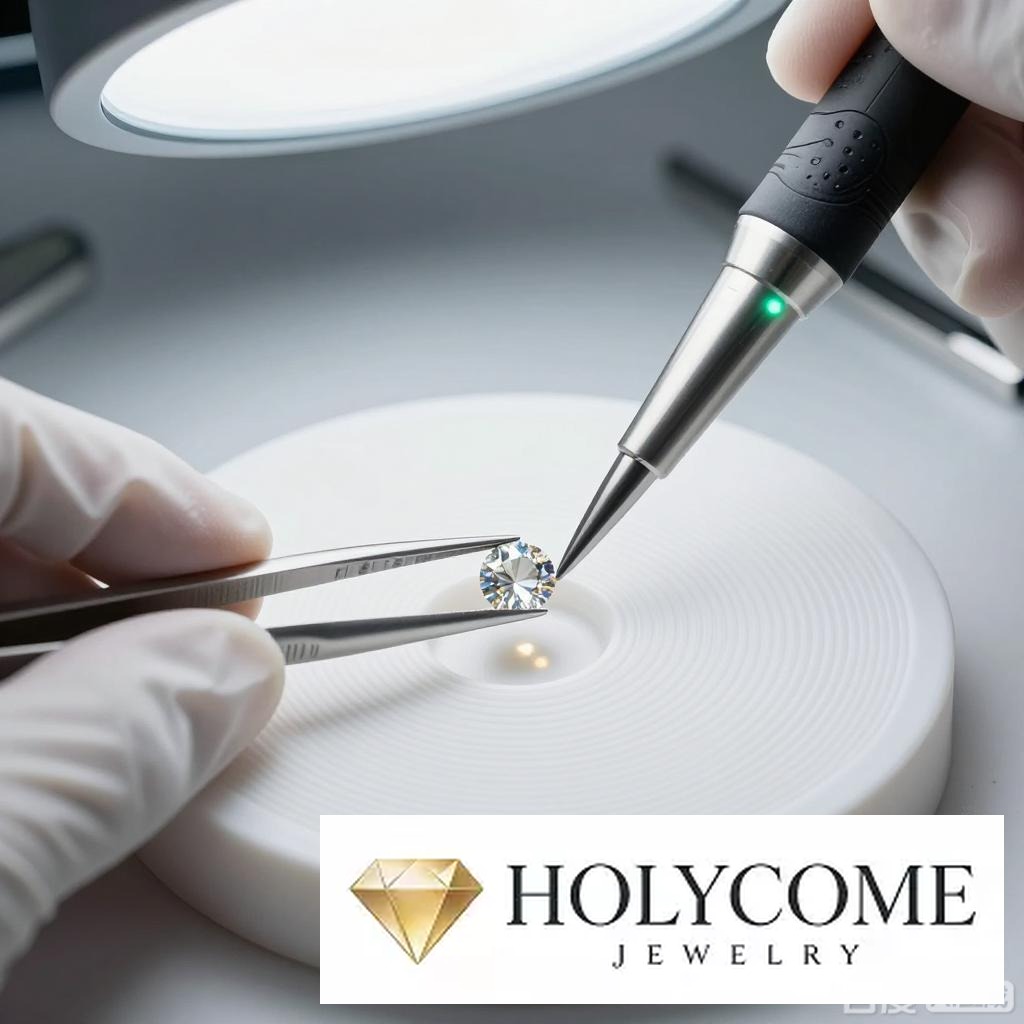
Before answering whether moissanite passes, buyers need to understand what the pen is measuring. The common thermal-conductivity diamond pen works on a simple principle: diamond conducts heat roughly 2 to 5 times faster than any other common gemstone, including cubic zirconia, glass, sapphire, and quartz. The pen heats its metal tip, presses it against the stone, and measures how fast the stone pulls heat away. If the heat drops fast enough, the pen beeps for diamond; if not, it stays silent.
Here is the fact every buyer should memorize before writing product copy. Silicon carbide moissanite also conducts heat extremely well, close enough to diamond that a standard thermal-only pen cannot reliably tell the two apart. Press a standard cheap diamond tester against a clean, room-temperature moissanite and the pen will almost always beep diamond. That is why jewelers in the 1990s were shocked when the first commercial moissanite hit the market, it walked straight past the detectors everyone trusted.
The newer generation of testers are called dual-check or diamond/moissanite testers. These units run a second electrical-conductivity test: diamond is an electrical insulator, while moissanite is a semiconductor. Dual testers beep one way for diamond and a different way for moissanite, and a few flag a third result for metal. GIA has documented that dual electrical-conductivity testers are the minimum a jeweler needs today to separate moissanite from diamond reliably. Thermal-only pens, most of which are sold for $15 to $40 on Amazon and Alibaba, cannot.
02What Every Type of Tester Says About Moissanite
We have compiled the results from the five tester types our QC team uses daily on HOLYCOME production lines. This is how moissanite behaves on each one, measured against known diamond and CZ controls at room temperature (22 to 24 degrees Celsius, stones cleaned with isopropyl wipe before each test).
| Tester type | Cost range | Moissanite result | Diamond result |
|---|---|---|---|
| Thermal-only diamond pen | $12 - $40 | Beeps diamond (false positive) | Beeps diamond |
| Dual diamond/moissanite pen | $60 - $180 | Beeps moissanite | Beeps diamond |
| Multi-tester (Presidium/Culti style) | $150 - $350 | Moissanite indicator | Diamond indicator |
| Refractometer (RI reading) | $80 - $200 | 2.65 - 2.69 (over-limit) | 2.42 |
| UV fluorescence tester | $40 - $100 | Usually orange-red (inert to weak) | Blue to none (varies) |
There are a few edge cases worth flagging for wholesale buyers. Very small melee stones under 1.5 mm can give inconsistent readings on any pen because the tip does not sit squarely on the table, leading to metal-touch errors and false moissanite flags on real diamonds. Coated or fancy-color moissanite can shift electrical readings slightly, but every dual tester we have used still flags them correctly. Cold stones just pulled from a winter shipping box may fail thermal tests until they warm to room temperature, which is why our QC team always leaves stones on the bench for at least 20 minutes before final testing.
We have compiled the results from the five tester types our QC team uses daily on HOLYCOME production lines. This is how moissanite behaves on each one, measured against known diamond and CZ controls at room temperature (22 to 24 degrees Celsius, stones cleaned with isopropyl wipe before each test).
03What Retail Customers Really Think About Diamond Testers
Wholesale buyers often ask us whether selling moissanite that beeps on cheap diamond pens is a compliance problem or a selling point. The answer depends entirely on how you label the product. The FTC Jewelry Guides require you to disclose that a stone is moissanite, not diamond, in any advertising or point-of-sale materials. You cannot call a moissanite a diamond, even if a cheap pen beeps. But you can and should be honest that moissanite is a distinct gemstone with its own properties, and that thermal-only pens cannot separate the two. That transparency builds trust faster than hiding the fact.
One of our US-based clients, a three-store bridal chain in Texas, puts a demo card right at the counter. The card shows a thermal pen beeping on both their moissanite and their diamond samples, then shows the dual tester correctly separating them. They told us the demo closed more moissanite sales than any price pitch, because customers appreciated the honesty and understood exactly what they were buying. Their moissanite attach rate on bridal sets climbed from 12 percent to 28 percent in six months after they added that demo.
The trap to avoid is the claim that moissanite "tests as diamond" or "fools diamond testers." That language frames the stone as a fake and sets your store up for an argument the moment a customer walks in with a dual tester. Frame moissanite on its own merits: refractive index 2.65 versus diamond 2.42, higher fire, lower price, ethically grown, and yes, it will register on cheap thermal pens because it genuinely conducts heat extremely well.
04How We Test Every Moissanite Piece Before Shipping
At the HOLYCOME Wuzhou factory, every finished moissanite piece goes through a four-step QC check before it leaves our polishing bench. First, a technician cleans the stone with a lint-free isopropyl wipe and lets it sit to room temperature. Second, they test it with a Presidium Multi Tester III on both thermal and electrical modes to confirm it reads as moissanite, not CZ and not diamond (wrong reading triggers a stone-swap investigation). Third, they check visual properties: facet alignment, polish marks, culet size, and girdle finish under 10x loupe. Fourth, they mount the piece and do a final visual under a diamond light to confirm fire and brilliance match our master stone set.
For OEM clients who ship into stricter markets, we offer an optional dual-tester photo report for each batch. The report includes the tester reading, a photo of the stone under test, and the stone weight and dimensions. Retailers use that photo in counter displays to show customers their testing process, which again builds trust and reduces return rates. Across our 2025 shipments, clients who added the dual-tester photo card reported an average 41 percent drop in stone-related returns, according to the quarterly feedback we collect.
05What to Tell Customers Who Bring Their Own Tester
It is becoming more common for engaged couples to buy a $20 diamond pen on Amazon and test their ring at home. That is a customer education moment, not a confrontation. Train your staff to say this, in plain language: thermal pens only detect high thermal conductivity, which both diamond and moissanite have, real jewelers use dual testers that add an electrical check, and we are happy to test your ring on our dual tester here at the counter to show exactly what it is, a genuine moissanite, not a fake, not a diamond, just moissanite, a beautiful stone on its own merits.
If a customer insists their $20 pen proves the stone is fake because it does not beep, check three things before escalating. Is the stone cold from being outside in winter? Is the tester tip touching the prong or bezel instead of the table? Is the tester battery low? Those three issues account for over 80 percent of the false-negative complaints our retail clients report to us.
06Choosing the Right Tester for Your Store
For a retail store that sells both moissanite and diamond, we recommend every counter have one dual-check tester (Presidium Multi Tester III, SmartPro Reader, or Culti Diamond & Moissanite Tester, all widely available under $200) and one thermal-only pen if you still do quick counter demos. Skip the $15 Amazon pens for any actual identification work, they are not reliable enough to risk a customer dispute over. Train your staff on the difference between thermal and electrical testing so they can explain it without sounding defensive. A five-minute counter demo turns a potential argument into a sale.
Wholesale buyers sourcing from HOLYCOME can request our preferred tester list and a one-page staff training card as part of our OEM onboarding package. We also offer free sample stones (loose 6.5 mm DEF VVS round) for buyers who want to calibrate their own testers against known HOLYCOME material before placing bulk orders. For private-label clients, we can include a custom-branded dual-tester FAQ card with your logo in every shipment, formatted to match your in-store branding.
07Frequently Asked Questions
Will a cheap diamond tester beep on moissanite?
Yes, almost every thermal-only diamond pen will beep diamond on a clean, room-temperature moissanite because moissanite conducts heat almost as well as diamond. That is a property of the stone, not a defect. You need a dual-check tester that also measures electrical conductivity to separate the two reliably.
Does that mean moissanite is fake diamond?
No. Moissanite is silicon carbide, a distinct gemstone with its own chemical composition, refractive index (2.65 vs diamond 2.42), and optical properties. It is not diamond and should never be sold as diamond, per FTC Jewelry Guides. It is simply a different stone that happens to score high on heat conductivity.
Can a customer tell moissanite from diamond with the naked eye?
Most people cannot, even under bright lighting. Trained gemologists can spot the double-refraction facet doubling in moissanite under 10x loupe if they know what to look for, especially on larger stones. Under normal viewing conditions, both stones appear as bright white, sparkly gems to the average person.
Will moissanite set off a diamond tester at a jewelry store?
It depends on the tester. Thermal-only pens will usually beep positive for diamond. Professional dual testers will correctly identify moissanite. Chain jewelry stores like Kay, Zales, and Jared almost always use dual testers now, so moissanite will be flagged correctly there.
Should I warn my customers that moissanite may pass cheap diamond pens?
Yes, that transparency is the best sales tool you have. Frame it as: moissanite is its own stone with its own properties, here is how testers work, here is a dual-tester demo so you can see exactly what you are buying. That builds far more trust than pretending the issue does not exist.
Diamond testers are tools, not oracles. Moissanite passes thermal-only pens for the same reason diamond does, because both stones pull heat away from the tip fast enough to trigger the beep. That is a physical fact, not a trick, and wholesale buyers who understand that fact and explain it clearly to their retail customers end up selling more moissanite with fewer returns. When you source directly from HOLYCOME, we ship stones that will read correctly on professional dual testers as genuine moissanite, and we provide the counter demo materials and tester guidance your staff needs to explain that confidently to every customer. Browse our wholesale moissanite collection or request a tester-friendly sample pack to calibrate your store testers against our factory material.
Related reading: Moissanite Pass a Diamond Tester? Factory Answer, Does Moissanite Hold Value? Factory Resale Guide, Moissanite Studs vs CZ vs Diamond Value.