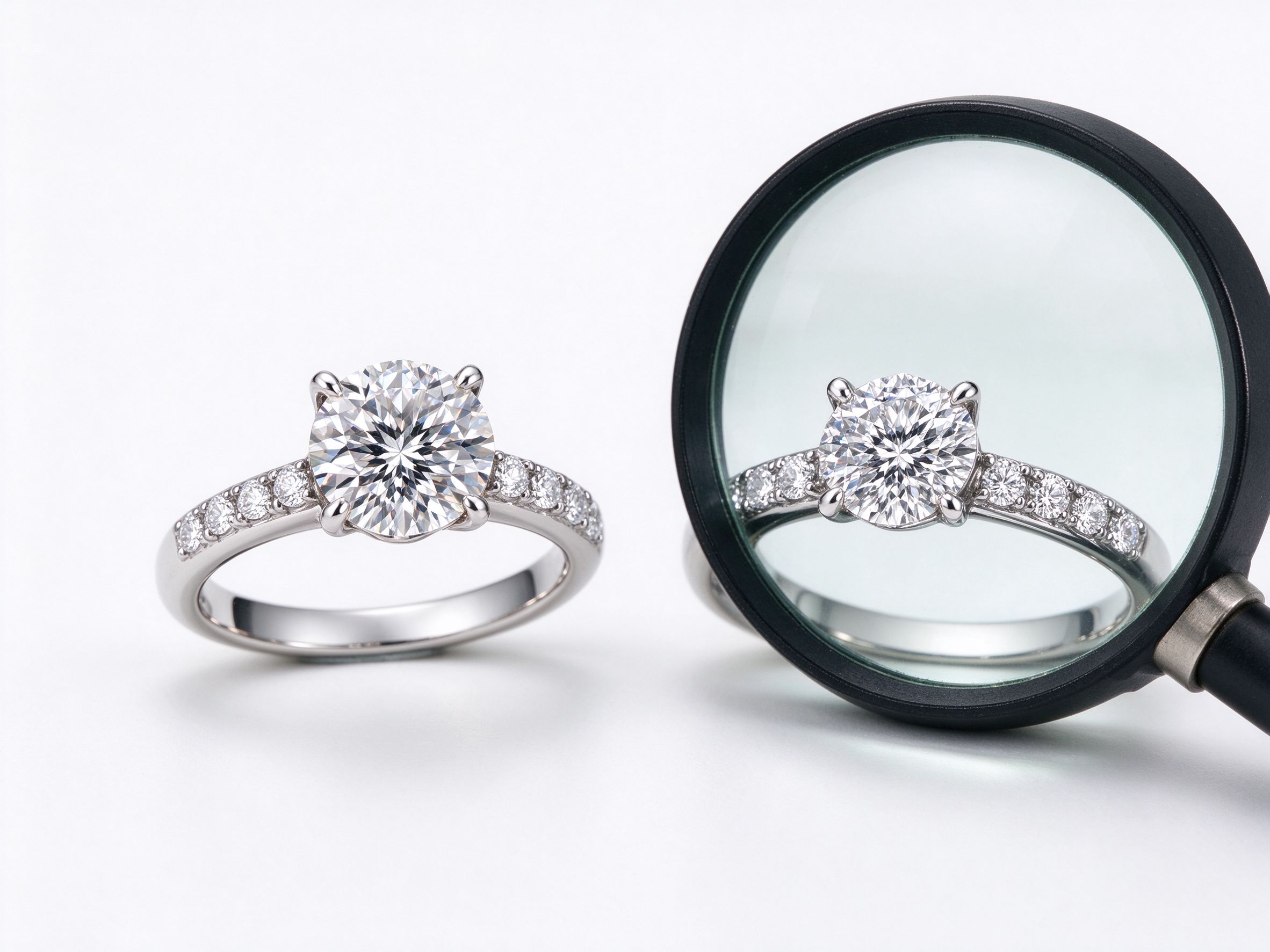
Moissanite has transformed the jewelry industry. What began as a rare meteorite discovery has become the fastest-growing gemstone category in wholesale jewelry, with global sales increasing 35% year-over-year according to industry reports. For wholesale buyers, understanding moissanite means understanding the future of affordable luxury. In this guide, we draw on Holycome's 10+ years of moissanite manufacturing experience to answer the questions that matter most to retailers and brands.
What Is Moissanite?
Moissanite is a naturally occurring mineral (silicon carbide) first discovered in 1893 by Nobel Prize-winning chemist Dr. Henri Moissan in a meteorite crater in Arizona. Natural moissanite is extremely rare — so rare that all commercial moissanite today is lab-created.
Lab-grown moissanite replicates the exact crystal structure of natural moissanite using a process called sublimation. Silicon carbide powder is heated to over 2,000°C in a controlled environment, allowing crystals to form over several weeks. The result is a gemstone with identical physical and optical properties to natural moissanite.
Key properties: - Hardness: 9.25 Mohs (second only to diamond at 10) - Refractive Index: 2.65-2.69 (higher than diamond's 2.42, meaning more brilliance) - Dispersion: 0.104 (higher than diamond's 0.044, meaning more fire/color flashes) - Specific Gravity: 3.22 (lighter than diamond's 3.52)
Moissanite vs Diamond: The Complete Comparison
| Property | Moissanite | Diamond |
|---|---|---|
| Hardness | 9.25 Mohs | 10 Mohs |
| Refractive Index | 2.65-2.69 | 2.42 |
| Dispersion (fire) | 0.104 | 0.044 |
| Color Range | D-K (colorless to near-colorless) | D-Z |
| Clarity | VS-VVS (eye-clean standard) | Flawless-I3 |
| Cost per carat | $30-150 | $2,000-20,000+ |
| Origin | Lab-created | Mined |
| Environmental Impact | Minimal | Significant |
The most striking difference is price. A 1-carat colorless moissanite retails for $50-200, while a comparable diamond costs $3,000-10,000. For customers who want the look of diamond without the price, moissanite is the clear choice.
Importantly, moissanite is NOT a diamond simulant in the traditional sense — it's a distinct gemstone with its own gemological properties. It will test as moissanite on electronic diamond testers, not as diamond.
Grading and Quality
Moissanite is graded using similar criteria to diamonds, with some important differences:
Color: Graded on the D-K scale (D-F = colorless, G-I = near-colorless, J-K = faint yellow). Holycome only uses D-F color grade moissanite in our wholesale pieces.
Clarity: Most moissanite is VS to VVS clarity (eye-clean). Lower grades may have visible inclusions under magnification.
Cut: The most important factor for brilliance. Round brilliant cut with 57-58 facets is standard. Poorly cut moissanite can look glassy or have a "bowtie" effect.
Carat: Moissanite is lighter than diamond, so a 6.5mm moissanite (1ct diamond equivalent) weighs approximately 0.88ct. We list both actual carat weight and diamond equivalent size in our wholesale catalog.
GRA Certification
The Gemological Research Association (GRA) is the leading certification body for moissanite. Every Holycome moissanite piece over 0.5ct comes with a GRA certificate that includes: - Stone measurements and weight - Color and clarity grade - Cut grade - Unique serial number (laser-inscribed on the girdle) - QR code for online verification
For wholesale buyers, GRA certification adds value and consumer trust. We include certificates in individual packaging at no extra cost.
Wholesale Pricing Structure
Moissanite pricing follows a per-carat model with volume discounts:
| Size | Per Carat (1-99pcs) | Per Carat (100-999pcs) | Per Carat (1000+pcs) |
|---|---|---|---|
| 0.5ct | $80 | $60 | $45 |
| 1.0ct | $60 | $45 | $35 |
| 2.0ct | $50 | $38 | $28 |
| 3.0ct | $45 | $34 | $25 |
Pricing also varies by color grade (D color commands 20-30% premium over F color) and cut quality. Holycome offers factory-direct pricing with MOQ of just 1 piece per style.
Market Trends and Consumer Demand
2025 data shows: - 68% of millennial engagement ring buyers consider moissanite - Moissanite sales grew 42% in the US market in 2024 - Average ticket price for moissanite jewelry: $250-500 (vs $3,000+ for diamond) - Top markets: US, UK, Australia, Canada, UAE
For wholesale buyers, the fastest-growing categories are: 1. Moissanite engagement rings (solitaire and halo settings) 2. Moissanite stud earrings 3. Moissanite tennis bracelets 4. Moissanite pendants and necklaces
FAQ
Does moissanite look different from diamond?
To the naked eye, most people cannot tell the difference. Under magnification, moissanite shows more fire (color flashes) due to its higher dispersion.
Will moissanite cloud or fade over time?
No. Moissanite is chemically stable and will not cloud, fade, or change color with age or exposure.
Can moissanite be set in any metal?
Yes. Holycome sets moissanite in 925 sterling silver, 10K/14K/18K gold, and platinum.
Is moissanite ethical?
Absolutely. Lab-created moissanite has zero mining impact, no conflict concerns, and a fraction of the carbon footprint of mined diamonds.
Conclusion
Moissanite represents the future of affordable luxury jewelry. Its exceptional brilliance, durability, and ethical sourcing make it an increasingly popular choice for consumers who want beauty without compromise. At Holycome Jewelry, we manufacture moissanite jewelry from rough stone to finished piece under one roof. Our wholesale partners enjoy factory-direct pricing, GRA certification, and MOQ starting at 1 piece. Contact service@holycome.com for our current wholesale catalog.