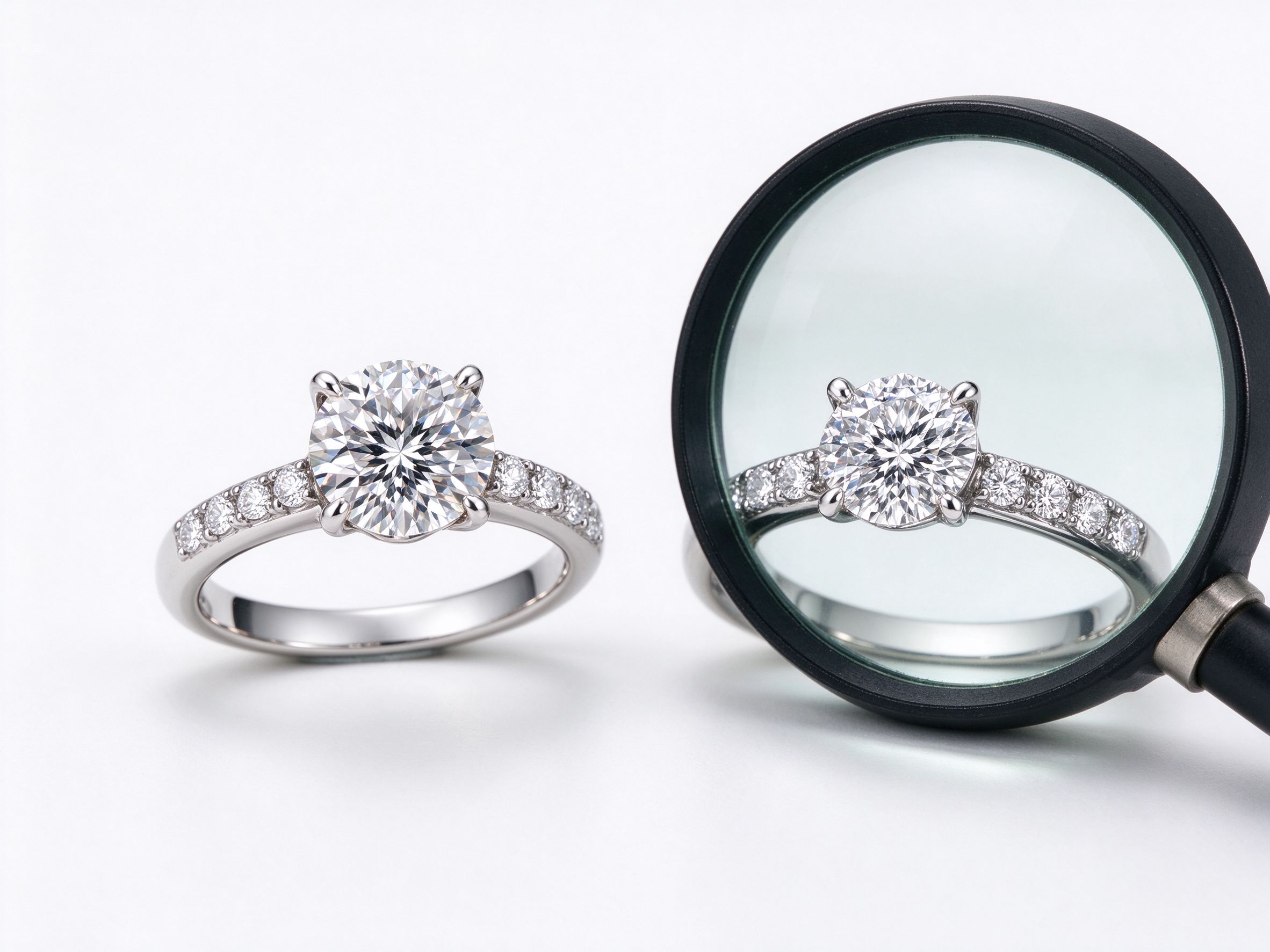
Matching Moissanite Across a Necklace Collection: Factory Lot Control
A necklace collection is never just one pendant. It is a pendant, matching earrings, often a bracelet, and reorders that arrive months later. When the stones in those pieces do not match in color, fire, and table height, the collection reads as disjointed, even though each piece alone looks fine. This article explains how our factory controls stone lots to keep a whole collection coherent, and why reorder continuity is a separate operational problem.
Why Matched Sets Need Lot Control
Loose moissanite varies subtly in tone and fire even within a grade. A pendant from one parcel and earrings from another can look like different stones under retail lighting, even though both are graded the same. The eye compares them directly when they are worn together.
We sort every incoming parcel by color temperature and light performance before it reaches the setter. For a collection order, we reserve enough stones from a single matched lot to fill all pieces, so the pendant, earrings, and bracelet share one sparkle signature.
This sorting step is labor that discount factories skip. Their matched sets look acceptable in a bag but diverge when worn, which is why customers complain that the earrings do not match the necklace.
Table Height and Setting Depth
Two stones of the same grade can sit at different depths in their settings, which changes how proud they sit and how they catch light. Across a collection, we select stones with matching table heights so every piece sits at the same relative level.
The setter machines each seat to the measured stone, rather than forcing all stones into identical seats. This is why matched pieces from our line look coherent: each stone is seated to its own geometry, but the stones are pre-selected for consistency.
For reorders, we match table height to the original lot so a pendant bought a year later sits the same depth as the first one. This continuity is invisible until it is missing, and then it is obvious.
Reorder Continuity: The Harder Problem
Matching stones within a single order is manageable; matching stones to a reorder six months later is harder, because the original parcel is gone. We solve this by buying stone lots with enough reserve for expected reorders and archiving the lot specifications.
When a reorder comes in, we pull stones from the same color family and compare them to a sealed reference sample under standardized lighting. If the new lot drifts, we tell the brand before production rather than shipping a subtly different stone.
Factories that buy stones order by order cannot offer this. Their reorders show a slightly different moissanite, and customers who bought two pieces at different times notice. Lot control is the operational difference.
Halo and Accent Stone Matching
Halo pendants and accent stones add a second matching problem: the center stone and the surrounding accents must harmonize. We select accents from the same lot family as the center so the halo reads as one bright circle rather than a collection of unrelated points.
For pave and accent work, tiny stone size variation is normal, but color must stay consistent. We grade accents in bulk by color and use them only where the center stone matches their family.
A halo where the accents are cooler than the center is a visible defect that studio photos hide. We inspect halos under side lighting to confirm the stones fire together.
How Brands Should Specify Matching
A PO that lists stone grade without lot or matching requirements leaves the factory to grab whatever is on the shelf. To get a coherent collection, brands should specify that all pieces draw from a single matched lot and that reorders must reference the original sample.
We recommend sealing one reference pendant with the factory and using it as the QC benchmark for every future run. Physical continuity beats any spec sheet.
Brands that build a collection around a single stone lot also simplify their photography, because all pieces share the same light signature. This consistency shows in the catalog as well as on the shelf.
Pendant Tooling and Bail Engineering
Pendant bails are the single most failure-prone part of a necklace, because they take all the swinging, catching, and pulling of daily wear. A bail that is soldered rather than integrated into the casting will eventually fatigue open. We size the bail wire and test its opening against the chain width so the pendant glides freely but cannot jump the chain under stress.
Chain sourcing is a supply chain decision that affects necklace cost more than the pendant itself. We buy chain by the meter in standard finishes and gauges, which keeps necklace OEM pricing predictable, but a custom chain weave or a non-standard length triggers a separate sourcing lead time that brands often forget to budget.
Pendant stones sit vertically against the chest, so their cut must be optimized for the angle people actually view them from, which is from above at roughly forty-five degrees. A stone cut for top-down brilliance on a ring can look dark in a pendant. Our stone matching for pendants weights table-up and oblique viewing rather than ideal-front brilliance.
The bail-to-pendant joint is where pendants either survive or snap. A thin cast bridge between the stone setting and the bail will shear open if the chain catches. We reinforce high-tension designs with a separate soldered reinforcement ring, and we test pull load on sampled pieces before approving the production model.
Necklace length is a specification, not a guess. A pendant that lands at the wrong collarbone point reads as awkward regardless of how beautiful the stone is. We produce in standard lengths with adjustment rings so a single SKU fits most necklines, and we quote custom length as a small added operation rather than a separate tooling event.
Casting a pendant in a way that leaves the back open versus closed changes both cost and comfort. Open-back settings let light through and show more brilliance but are less comfortable against the skin and collect lotion; closed-back settings are smoother but reduce stone life. We select the back style by design rather than default, and price the difference accordingly.
Every price we quote as a factory is really three numbers stacked on top of each other: the cost of the rough moissanite, the cost of the metal and findings, and the cost of the labor that turns both into a finished setting. Buyers who compare only the final unit price rarely realize how much of that number is process rather than material. A shop that undercuts by ten percent is usually skipping one of those three layers, and the layer it skips is almost always the labor that controls fit, polish, and stone security.
Chain Sourcing and Lot Matching
Tooling amortization is the quiet number behind any custom order. When we cut a new wax mold or machine a custom die, that cost has to be spread across the first production run. This is why the minimum order quantity exists at all: it is not a hurdle we invented, it is the break-even point on engineering time. Reorders after the first run are dramatically cheaper because the tooling is already paid for and the line is already tuned.
Our quality control bench is where ninety percent of defective units would actually have been caught if the upstream process were perfect, but perfection upstream is expensive. The practical factory model is to inspect at three gates: after casting, after stone setting, and after plating. Each gate catches a different failure mode, and routing a unit backward when a gate fails is far cheaper than catching it after packaging.
Moissanite is harder to set than cubic zirconia, and that difference shows up in the reject rate. The stone is more brittle along its pavilion facets, so a prong pushed too hard will chip the girdle instead of bending. Our setters are trained to seat the stone dry first, check that it rocks evenly, and only then close the prongs with small repeated taps rather than one aggressive squeeze. This discipline is invisible in the final product but it is why our breakage rate stays below one percent.
Capacity planning is the difference between a two-week lead time and a six-week one. A factory that quotes you four weeks when its floor is already full is guessing. When we accept an OEM order, we reserve actual bench slots and plating-bath time against it before we confirm the date. If a slot slips, the customer knows before the shipment date, not after.
Plating thickness is where factories either save you money or cost you a sale later. A one-micron rhodium flash looks perfect on day one and wears through in weeks of retail handling. Our standard retail-grade finish is a measured three to five microns, verified by X-ray fluorescence on sampled pieces from every batch. The cost delta is small per piece; the cost of a return is not.
When a brand asks for private labeling, the work starts long before the first stone is set. We map their packaging, their insert card, their logo placement, and their target retail price against our production cost structure. A price point that looks comfortable at sample stage can become unprofitable at volume once packaging and inspection are added, so we price the full landed kit, not just the loose jewelry.
Grading loose moissanite into the settings we have produced is a matching exercise, not a grab bag. We sort every parcel by color, cut, and light performance before it reaches the setter, and we pair stones so that a matched pair of earrings or a full tennis bracelet reads as one continuous sparkle rather than a set of unrelated stones. This sorting step is labor that discount factories usually skip, which is why their matched sets show obvious stone-to-stone variation.
Custom Necklace OEM Workflow
Lead times for repeat orders are always shorter than for first samples, and this is a signal you should use when evaluating a supplier. The first run includes sampling, mold approval, and line tuning. Once those are done, reorders flow through a stable process. A factory that cannot quote a meaningfully shorter reorder lead time has not actually industrialized your product, it is still hand-making each unit as a fresh project.
Welding and soldering are where a bracelet or chain either becomes durable or becomes a return. A cold joint that looks fine at inspection will flex open after a month of wear. Our welders use controlled heat, flux, and a post-weld pickle bath, and every structural joint is stress-tested by hand before polishing. We do not rely on the polish step to hide a weak solder seam.
The gap between a sample and mass production is where many OEM projects fail. A beautiful handmade sample that cannot be repeated at fifty or five hundred units is a marketing photo, not a product. We design every sample with the production line in mind: standard prong sizes, available stone dimensions, and findings we already stock. If a design cannot scale, we tell the brand before tooling is paid.
Surface preparation decides plating adhesion more than the plating chemistry itself. A piece that is not properly pickled, ultrasonic cleaned, and copper-flashed before rhodium will shed its finish regardless of how thick you plate it. Our pre-plating process is a fixed sequence because it is the single most common cause of jewelry that looks dull within its first retail season.
Consignment versus firm purchase is a commercial decision as much as a production one. For established brands we can split a larger order into staged shipments, which reduces their inventory risk and our working-capital strain. For new brands, the first run is usually firm because we have no sales history to underwrite the risk. This is normal factory economics, not a negotiation tactic.
Stone weight and metal weight are two different profit levers. We can hit a target retail price by under-sizing the stones or by under-using metal, and buyers should know which lever a factory pulled. Our quotes break out carat weight and gram weight separately so a brand can see exactly where the cost sits. A price that looks too good usually corresponds to a thinner shank or smaller-than-advertised stones.
Certification paperwork is part of manufacturing, not an afterthought. For lab-grown diamond orders routed through IGI, the stone serial numbers are recorded at intake, matched to the setting before assembly, and re-verified at final QC so the certificate number traveling with the finished piece is the one actually in the jewelry. Mixing stones between batches during production is the leading cause of certificate mismatch.
Batch Consistency Across Reorders
Polishing is the step most likely to be cut when a factory is behind schedule. A rushed polish leaves prong tips rounded, internal corners dull, and a surface that rhodium will not fully brighten. Our polishing schedule is a fixed labor budget per piece type because we learned the hard way that skimping here destroys the perceived value of even perfect stones.
The most profitable OEM relationships are the ones where the brand shares its sell-through data. When we know which sizes, metals, and stone grades reorder fastest, we pre-stage findings and rough stones, which shortens lead times and reduces defect rates. Treating the factory as a black box costs you money even if the unit price is nominally lower.
Tolerance creep is the slow enemy of consistent jewelry. First-piece inspection compares every critical dimension to the approved sample: post gauge, prong count, bail inner diameter, clasp tension. When a dimension drifts by a fraction of a millimeter across a production run, the factory corrects the bench before more units are made rather than at the end of the run. Catching drift late means scrapping a whole batch.
We price in the metal market, not against a competitor's poster price. Sterling silver and brass substrate costs move with commodity markets, so a quote held for ninety days is a promise we can only honor if the metal is locked at order confirmation. Brands that want price stability ask us to lock metal at PO; brands that chase a low number months later usually get a re-quote.
Accessibility of design changes matters at volume. A small redesign that takes ten minutes on one sample becomes a significant per-unit cost at two thousand units. When we evaluate a custom request, we estimate the change in cycle time, not just the change in material. A design that looks slightly different can quietly double the setter's time per piece.
Our reject rate is a number we track weekly, not per order. A factory that only hears about quality problems from customer returns has already lost control. Internal rejection at each gate gives us leading indicators: if stone-set rejects rise, the setter's fixture needs adjustment; if plating rejects rise, the pre-clean sequence is drifting. Catching the trend beats reacting to the complaint.
Packaging is integrated into the production schedule on purpose. The jewelry and the box, the pouch, and the thank-you card are assembled together at the end so a delayed box never holds up a finished shipment. Brands that source packaging separately often discover this mismatch at the worst possible time, when the goods are already in transit.
Frequently Asked Questions
Why do my necklace and earrings look like different stones?
They likely came from different parcels. We reserve stones from one matched lot for a whole collection so color and fire stay consistent across pieces.
Will reorders match the original stones?
If we archive the lot and reserve reference stock, yes. We compare new stones to a sealed reference sample before production. Order-by-order factories cannot promise this.
How do you match halo accent stones?
Accents come from the same color family as the center stone, so the halo fires as one bright circle rather than a set of unrelated points.
What should I put in my PO to ensure matching?
Specify that all pieces draw from one matched lot and that reorders reference the approved sample. A bare grade number leaves too much to chance.
Why is lot matching expensive?
It is labor: sorting and reserving stones by hand. Skipping it lowers unit cost but creates the mismatch complaints that erode brand trust.
Conclusion
A coherent necklace collection is a lot-control problem, not a design problem. Reserving one matched parcel for all pieces, archiving the reference for reorders, and matching halo accents to the center is what keeps a collection looking like one collection across orders and months.