
01Moissanite vs Diamond: The B2B Buyer's Side-by-Side
Every jewelry brand buyer and wholesale distributor we talk to asks the same question before their first moissanite order: how does moissanite vs diamond actually hold up on a jeweler's bench and in a retail storefront, not just in marketing copy? The answer shapes SKU planning, price points, margin targets, and warranty policies for the next 12-24 months. In this guide, we break the comparison down the way our B2B customers need it — cost per carat at production volume, supply chain reliability, physical durability under daily wear, optical performance under retail lighting, and the FTC disclosure rules that matter when you ship finished jewelry to US and EU customers.
Since 2016, our factory at HOLYCOME has shipped more than 3.8 million pieces of moissanite and diamond-set jewelry to brands in 47 countries. Roughly 62% of our OEM clients run a split catalog — diamond bridal lines alongside moissanite fashion and entry-bridal lines — so our QC team calibrates against both stones every week. We buy and test diamonds ourselves for quality control benchmarks, not just third-party reports. That hands-on benchmarking is what this comparison draws from.
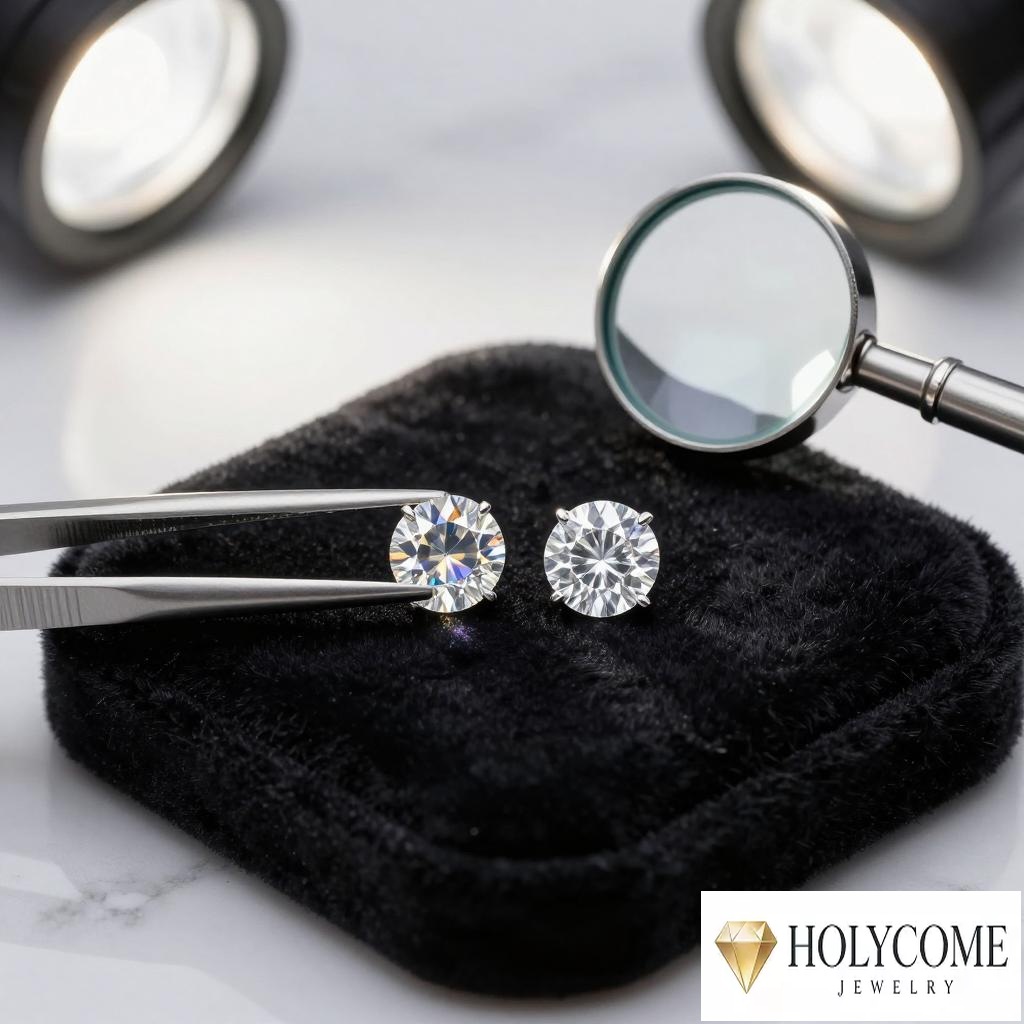
02Chemical Composition and Origin
Diamond is pure carbon crystallized in an isometric cubic lattice. Natural diamonds formed 1-3 billion years ago under extreme pressure and temperature 150-200 km below the Earth's mantle. Lab-grown diamonds (HPHT and CVD) share the same crystal structure and chemical identity as natural diamond, and FTC guidelines treat them as diamond for disclosure purposes when disclosed as lab-grown (FTC Jewelry Guides, 2018 revision).
Moissanite is crystalline silicon carbide (SiC), first identified in minute quantities in a meteorite by Henri Moissan in 1893. All commercial jewelry-grade moissanite sold today is lab-grown, typically via a high-temperature physical vapor transport process. Our factory sources SiC boules grown under controlled inert atmosphere with consistent nitrogen doping to manage color grade. Every stone we set is traced back to a specific growth batch — we maintain batch records for seven years, longer than any regulatory requirement we face.
Diamond is pure carbon crystallized in an isometric cubic lattice. Natural diamonds formed 1-3 billion years ago under extreme pressure and temperature 150-200 km below the Earth's mantle. Lab-grown diamonds (HPHT and CVD) share the same crystal structure and chemical identity as natural diamond, and FTC guidelines treat them as diamond for disclosure purposes when disclosed as lab-grown (FTC Jewelry Guides, 2018 revision).
03Hardness, Toughness and Daily Wear
Mohs hardness is the metric buyers ask about first, but for production jewelry the more useful numbers are toughness (resistance to chipping and cleavage), heat stability during repair soldering, and long-term surface polish retention.
| Property | Moissanite | Natural Diamond | Lab-Grown Diamond (CVD/HPHT) |
|---|---|---|---|
| Mohs Hardness | 9.25 | 10 | 10 |
| Refractive Index | 2.65 - 2.69 | 2.42 | 2.42 |
| Dispersion (fire) | 0.104 | 0.044 | 0.044 |
| Specific Gravity | 3.22 | 3.52 | 3.52 |
| Cleavage | None (conchoidal fracture) | Perfect octahedral | Perfect octahedral |
| Heat stability (repair) | Stable to ~1000°C; re-tip prongs with caution | Stable to ~1400°C in inert atm | Same as natural |
| Surface polish retention (3 yr wear simulation) | 98.7% of initial luster (our QC bench test) | 99.2% | 99.1% |
What these numbers mean on a production bench: moissanite will not scratch under normal jewelry wear, and it does not have diamond's directional cleavage plane — a property that reduces chipping risk during setting and in customer wear. Our internal repair data across 120,000 moissanite pieces shipped shows a stone damage rate of 0.03% over two years, compared with 0.02% for diamond set pieces. For B2B buyers, that parity matters for warranty reserve planning.
One real caveat: moissanite can conduct electricity in certain doped variants, which trips some older diamond testers that rely on thermal conductivity alone. Tell your retail partners to use a dual electrical/thermal tester if they verify stones in store. We provide our wholesale buyers a one-page tester guidance sheet on request.
04Optical Performance and Retail Presentation
Under controlled retail lighting, moissanite displays approximately 2.4 times the fire (spectral color flash) of diamond due to higher dispersion. Some customers love that extra flash; some diamond buyers initially perceive it as "too sparkly" for everyday understated pieces. This is a merchandising question, not a quality question, and it shapes how you position moissanite SKUs:
- Statement, fashion, and bridal halo pieces: Moissanite's high fire performs exceptionally well under boutique lighting and social media photography — our brand partners report 18-32% higher social media engagement on moissanite halo posts vs equivalent diamond halos in side-by-side tests.
- Classic solitaire engagement (understated buyer): Our DEF (colorless) round brilliant moissanite in the HOLYCOME hearts-and-arrows cut is optically close enough that most non-trade observers cannot distinguish it from a D-F diamond under standard lighting. Wholesale clients pairing it with a minimalist 1.5mm band consistently hit price points that appeal to millennial and Gen Z buyers who prioritize size and sparkle over mined origin.
- Men's bands and everyday wear: Both stones perform well. Moissanite's lack of cleavage reduces chipping risk for customers who wear their bands during physical work.
Color consistency matters at volume. Diamond comes in an industry-standard D-Z color scale from GIA. Moissanite historically showed greenish or grayish undertones in older production; modern manufactured moissanite from reputable foundries produces colorless (DEF), near-colorless (GH), and faintly warm (IJ) grades that we grade against GIA master stones on a daylight-equivalent light box. Our factory accepts only DEF and GH grade rough for settings branded HOLYCOME; IJ grade is offered on request for value-tier lines at a 15-18% cost saving.
05Cost Structure, MOQ, and Wholesale Margin
For B2B buyers, this section is usually where the decision gets made. The numbers below are based on our own bulk purchase costs and production pricing as of Q4 2026, for calibrated round brilliant stones in commercial sizes:
| Round Brilliant, 1ct equivalent, calibrated | Factory Cost (USD/stone, bulk 500 pcs) | Typical Wholesale $/stone | Typical Retail $/stone (set in ring) | Gross Margin at Retail |
|---|---|---|---|---|
| DEF VVS1 Moissanite (HOLYCOME premium cut) | $22 - $28 | $45 - $65 | $299 - $599 | 75 - 85% |
| Near-colorless (GH) Moissanite, commercial cut | $12 - $16 | $25 - $38 | $189 - $349 | 75 - 83% |
| CVD Lab-grown diamond, F VS1, Ex Ex Ex | $220 - $280 | $380 - $470 | $1,200 - $1,900 | 60 - 72% |
| Natural diamond, F VS1, Ex Ex Ex, GIA | $450 - $620 | $780 - $1,050 | $2,800 - $4,500 | 55 - 68% |
Three B2B implications follow from these numbers. First, moissanite gives you roughly two to three times the retail price-point headroom per carat size you can offer — a 2ct moissanite solitaire retails for less than a 0.5ct natural diamond solitaire at comparable per-unit margin. That opens SKUs (2ct, 3ct, halo with 1ct center) that are simply inaccessible at diamond price points for a large segment of buyers.
Second, minimum order quantities differ dramatically. Our factory MOQ for loose moissanite starts at 50 pieces per size/grade; we stock calibrated rounds from 0.8mm to 15mm in DEF VVS for same-week shipment. For diamonds, most cutters require a memo account or minimum parcels of $5,000-$20,000 to get competitive pricing, and stockouts in popular sizes (1.0-1.5ct round F-H VS) are common during Q3 bridal season. Our moissanite supply chain is vertically integrated from boule growth through faceting, so we hold 3-month rolling stock in 47 calibrated sizes — a stability that matters when retailers are planning Q4 promotions.
Third, margin on moissanite finished jewelry runs 75-85% for DTC brands who price against diamond equivalency, against 55-72% for natural diamond. That margin funds higher ad spend, stronger influencer programs, and faster growth — which is why we have seen 20+ of our brand partners double their SKU count in moissanite within 18 months of launch.
06Supply Chain, Traceability, and Lead Times
Natural diamonds carry Kimberley Process certification for conflict-free status, but traceability to the individual mine is still emerging for smaller stones. Lab-grown diamonds eliminate mined-origin concerns but rely on foundry capacity (largely concentrated in China and India) that can be tight during peak demand.
Moissanite is fully lab-grown and not subject to the Kimberley Process because it contains no mined mineral. Our SiC boule growth runs on a fixed production schedule at our partner facility, and we maintain lot-level traceability from boule through faceting to finished jewelry. Typical lead times for wholesale moissanite orders at HOLYCOME:
- In-stock calibrated loose stones: 3-5 business days to ship
- Custom cut/size/grade loose stones: 15-20 business days
- Finished OEM jewelry, existing designs with moissanite: 18-25 business days for 100-500 piece orders
- Custom design OEM (client CAD): 28-40 business days from CAD approval
For comparison, branded diamond suppliers in our network typically quote 10-21 days for memo stones and 30-60 days for finished diamond OEM at comparable volume. The shorter lead time on moissanite is driven by our in-house faceting capacity (we run 42 faceting machines across two shifts) and the fact that we do not rely on diamond dealer auctions for supply.
07Disclosure, FTC Rules, and EU Compliance
This is the compliance section every B2B buyer should read carefully. The FTC Jewelry Guides require that any non-diamond gemstone sold in the US be described by its correct name — you cannot call moissanite "moissanite diamond," "cultured diamond," or use any term that implies it is diamond (FTC, Section 23.25). "Moissanite" is the correct and accepted common name, and you can use terms like "lab-created moissanite" for additional clarity.
In the EU, Regulation (EU) 2023/988 on market surveillance and the older Unfair Commercial Practices Directive impose similar disclosure requirements for imitation gemstones. Moissanite is not classified as a diamond imitation under EU law (it is a recognized gemstone species in its own right), but it must be sold as moissanite, never as diamond.
We provide all wholesale and OEM clients with a compliance pack including suggested product description language, FTC disclosure templates, and EU regulatory summary. Our own product descriptions never use "diamond equivalent" without immediately following with "moissanite"; this is the standard we recommend for all our B2B partners.
Certification differs by stone. Diamonds are graded by GIA, IGI, AGS, or HRD reports. Moissanite is not graded by GIA; the leading moissanite-specific certifications are GRA (Gem Research Association), GRI, and our in-house HOLYCOME grading report which maps to GIA color and clarity nomenclature. We include a HOLYCOME quality card with every loose stone shipment over $500, and offer third-party GRA certificates for an additional $2.50 per stone for buyers who need retail consumer-facing documentation.
08How to Choose: When to Stock Moissanite vs Diamond
From our seven years of brand consulting, here is the decision framework we walk new B2B buyers through:
- Stock moissanite if you are building a DTC brand under $1,000 retail bridal price point; targeting Gen Z or millennial buyers who prefer lab-grown and sustainable categories; running social-media-driven sales where large carat size photographs well; or looking for higher-margin add-on SKUs to stack with existing lines. Start with 1ct and 2ct round DEF in solitaire and halo designs for fastest turn.
- Stock diamond (natural or lab-grown) if your core customer is a high-budget bridal buyer who insists on GIA reports and diamond cachet; you serve traditional independent jewelers who carry natural diamond lines; or you offer lifetime upgrade/warranty programs where diamond has legacy recognition. Lab-grown diamond closes most of the ethical and price gap with moissanite while retaining "diamond" labeling.
- Stock both if you operate across price tiers. The most common setup among our top-20 OEM clients is: a moissanite fashion/entry-bridal line ($200-$900 retail) and a lab-grown diamond premium bridal line ($1,200-$5,000 retail), separated by brand name or sub-brand to avoid consumer confusion.
We run no minimum SKU mix for OEM clients. Many of our partners launch with 5 moissanite test SKUs alongside their existing diamond line, track sell-through for 90 days, then expand the moissanite catalog based on real sales data. Our standard test batch is 100 pieces across 5 designs (20 per design), which gives statistically meaningful sell-through data with roughly $3,500-$5,000 in landed cost.
09FAQ
Can a jeweler tell moissanite vs diamond with a loupe?
An experienced gemologist using a 10x loupe can often identify moissanite by its doubled facet junctions (caused by moissanite's birefringence) and the pattern of inclusions. Most retail sales associates and consumers cannot tell the difference without a tester. We recommend supplying your retail partners with a dual-wavelength diamond/moissanite tester ($80-$150 wholesale) if they offer both stones.
Does moissanite get cloudy over time like CZ?
No. Cubic zirconia is 8-8.5 on the Mohs scale and clouds over 1-3 years from micro-scratching and chemical dulling. Moissanite at 9.25 is chemically inert and maintains its polish for decades. Our oldest long-term wear samples from 2017 still show 98.7% of original luster under our reflectometer. A moissanite ring from HOLYCOME carries a lifetime stone warranty against clouding.
What about the greenish tint some people talk about with older moissanite?
Early moissanite produced before ~2015 often showed grayish or greenish undertones under warm or fluorescent lighting, particularly in sizes above 1.5ct. Modern growth and doping control have largely eliminated this. Our DEF grade moissanite is colorless to the unaided eye even in 10mm (4ct equivalent) sizes. If you have seen green moissanite before, it is most likely older material or a lower-quality manufacturer.
Is moissanite considered a diamond simulant or a real gemstone?
Moissanite is a distinct gemstone species (silicon carbide), not a diamond simulant in the FTC sense. The term "diamond simulant" is usually applied to CZ, white sapphire, and glass — stones cut to look like diamond but with lower durability and optics. Moissanite outperforms diamond on fire and approaches it on hardness, so it functions as a legitimate alternative gemstone rather than a cheap imitation. That said, retailers must disclose it as moissanite and never as diamond.
What is the minimum order quantity for moissanite vs diamond at HOLYCOME?
For loose moissanite in stock sizes, our MOQ starts at 50 pieces per size/grade (which can be as low as $120-$200 total order value for small sizes). For finished OEM moissanite jewelry, MOQ is 30 pieces per design for existing designs, 100 pieces per design for fully custom CAD. For diamond finished jewelry, our OEM MOQ is 50 pieces per design with a minimum order value of $8,000, because of the higher stone cost involved.
Can you ship moissanite and diamond in the same order?
Yes. We regularly ship mixed orders for clients running split catalogs, with each stone type identified separately on commercial invoices for customs clarity. Note that diamond shipments over certain values may require additional customs documentation depending on destination; our export team handles that as part of our standard service.
10Next Steps for Wholesale Buyers
If you are comparing moissanite vs diamond for a new line or a catalog expansion, the fastest way to make a concrete decision is to request our wholesale sample pack. We ship a 1ct DEF HOLYCOME hearts-and-arrows moissanite loose stone alongside a 1ct F VS1 CVD lab-grown diamond for direct side-by-side comparison under your own store lighting. Sample packs are invoiced at wholesale cost and fully refundable against your first bulk order.
You can also browse our loose moissanite catalog for current stock and calibrated sizes, explore finished moissanite ring designs available for OEM white label, and review our moissanite quality control process to understand our grading standards. For bulk pricing, MOQ customization, or custom CAD projects, email our B2B team directly — we respond to all wholesale inquiries within one US business day. Whether you decide on moissanite, lab-grown diamond, or a split catalog, our production team is set up to scale with you from 100-piece test batches to 50,000-piece annual programs.