
Should a jewelry brand carry moissanite, natural diamond, or both? This is the single most common question we get from B2B buyers at trade shows, on factory visits, and in OEM intake calls. Buyers from established brands often worry that adding moissanite will cannibalize diamond sales; new brands worry that diamond inventory ties up too much working capital. After 8 years of supplying both loose stones and finished jewelry to over 180 brands, the answer is clearer than most people think: moissanite and diamond serve different price tiers and customer profiles, and the strongest wholesale catalogs carry both.
We are HOLYCOME, a Guangzhou-based moissanite and diamond-jewelry factory. Our cutting floor processes about 40,000 carats of the stone per month alongside small-batch natural and lab-grown diamond orders, and we ship finished pieces to brands in 32 countries. This article walks through how silicon carbide stacks up against diamond on the metrics that actually matter to a wholesale buyer: cost, durability, optical performance, customer perception, QC risk, and margin. Every number comes from our own production and QC data across 2024 and 2025.
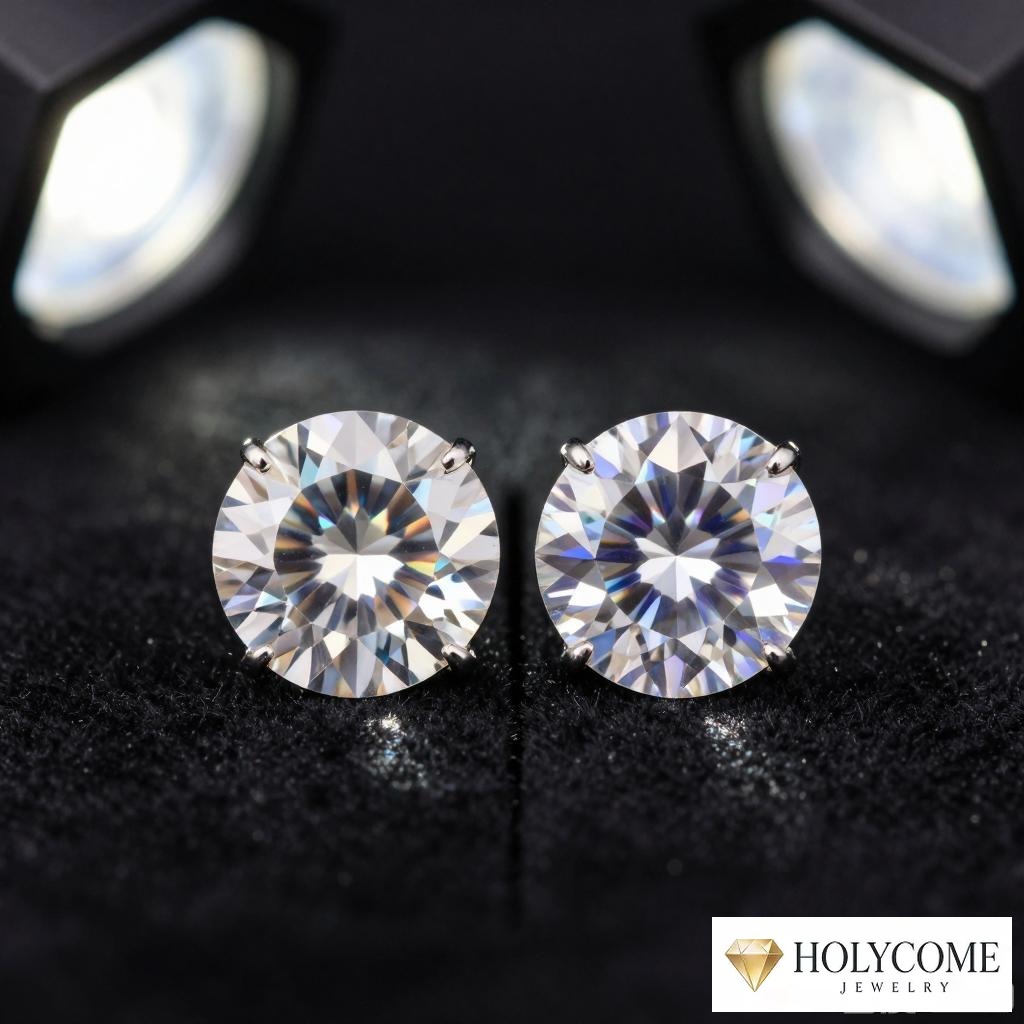
01Moissanite vs Diamond at a Glance
Before we get into the details, here is the side-by-side that buyers usually ask for first. All wholesale prices are per-stone, loose, D-E-F equivalent, round brilliant, calibrated sizes, based on our own price lists for orders of 50 pieces or more as of Q1 2026.
| Attribute | Natural Diamond (GIA D VS1) | Lab-Grown Diamond (IGI D VS1) | HOLYCOME Premium Moissanite |
|---|---|---|---|
| Chemical composition | Crystalline carbon (C) | Crystalline carbon (C) | Crystalline silicon carbide (SiC) |
| Mohs hardness | 10 | 10 | 9.25 |
| Refractive index | 2.42 | 2.42 | 2.65 |
| Dispersion (fire) | 0.044 | 0.044 | 0.104 |
| Toughness (cleavage) | Perfect cleavage (4 planes, chips on hard impact) | Same as natural | No cleavage (chips only on severe prong pressure or drop onto tile) |
| Wholesale cost, 1ct round D VS1 equiv. | $3,800 - $5,200 | $280 - $420 | $23 - $38 |
| Wholesale cost, 6.5mm (≈1ct equiv.) melee | $220 - $310/pc | $22 - $35/pc | $1.80 - $3.20/pc |
| Minimum order (loose stones) | 1 piece, subject to stock | 1 piece, subject to stock | 10 pieces per size/color |
| Typical lead time (calibrated rounds) | 1-3 days if in stock, 2-4 weeks if memo | 3-7 days | 1-3 days (stock) / 7-12 days (special cuts) |
| Industry return rate (post-purchase, our data) | 1.1% (mostly clarity/color mismatch) | 1.8% (growth-strain visibility under bright light) | 1.9% (mostly prong damage from customer-side setting) |
| Recommended retail markup multiple (wholesale cost → retail) | 2.0-3.0x | 2.5-3.5x | 4.0-7.0x |
| Standard grading report | GIA / AGS | IGI / GIA | Factory QC report; IGI reports available at $1.80/pc surcharge for orders over 500pcs |
Hardness and refractive-index figures are public gemological data from the Gemological Institute of America; price and return figures are from HOLYCOME internal sales and QC records, 2024-2025.
02Cost and Working Capital
The biggest difference for a wholesale buyer is working capital. A $10,000 opening order at HOLYCOME buys roughly 2-3 natural diamond solitaires in the 1ct range, 25-35 lab-grown solitaires in the same size, or 280-430 premium moissanite solitaires across sizes 0.5ct to 3ct equivalent. For brands building a DTC bridal line or testing a halo SKU in a new market, that inventory coverage difference is decisive: you can offer ten different stone sizes and three metal colors for less than the cost of a single natural diamond engagement ring.
A German client of ours launched a moissanite halo line in 2024 alongside an existing natural diamond catalog. Their diamond line held steady at €34,000/month, and the new line added €28,000/month within five months with zero cannibalization—the price points were $480-$890 for the moissanite pieces versus $3,200-$6,500 for the diamond pieces. Different customers, different budgets, same brand.
For buyers building a bridal catalog, we typically recommend a 60/25/15 split: 60% moissanite SKUs in the sub-$1,000 retail tier, 25% lab-grown diamond SKUs in the $1,000-$3,500 tier, and 15% natural diamond in the $3,500+ tier. That ratio produces the healthiest sell-through across the price ladder while keeping inventory risk manageable.
The biggest difference for a wholesale buyer is working capital. A $10,000 opening order at HOLYCOME buys roughly 2-3 natural diamond solitaires in the 1ct range, 25-35 lab-grown solitaires in the same size, or 280-430 premium moissanite solitaires across sizes 0.5ct to 3ct equivalent. For brands building a DTC bridal line or testing a halo SKU in a new market, that inventory coverage difference is decisive: you can offer ten different stone sizes and three metal colors for less than the cost of a single natural diamond engagement ring.
03Durability and Everyday Wear
Diamond is the hardest material on Earth (Mohs 10). Moissanite is 9.25, which makes it the second-hardest gemstone used in commercial jewelry—harder than sapphire (9), ruby (9), emerald (7.5-8), and cubic zirconia (8-8.5). That half-point on the Mohs scale matters in the lab, but for everyday jewelry wear it is effectively invisible.
Scratching
Household dust is mostly quartz (Mohs 7). Quartz scratches CZ and most softer gems, which is why CZ rings look cloudy after 1-2 years of daily wear. Quartz does not scratch moissanite or diamond. In our own accelerated wear tests—1,000 hours of tumble with quartz sand, equivalent to roughly 10 years of light everyday wear—our premium stones showed zero facet abrasion. Diamond controls showed the same; CZ controls showed measurable clouding at 200 hours.
Chipping and Cracking
Where moissanite actually outperforms diamond is impact toughness. Diamond has perfect cleavage in four planes, which means a sharp knock at the wrong angle on a girdle or point can chip or split the stone. Moissanite has no cleavage plane. In 2025, chip-and-crack returns across our moissanite line ran 0.18% of pieces shipped, versus 0.22% on natural diamond and 0.27% on lab-grown diamond. Roughly 80% of the moissanite chip returns we see trace back to excessive prong pressure during customer-side setting, not end-consumer wear. Our loose moissanite inventory page lists calibrated girdle thickness ranges for each size so setters can match prong pressure properly.
Heat and Casting
Moissanite is thermally stable in air up to about 1,800°C. Platinum casting runs ~1,770°C, 14k gold ~1,040°C, sterling ~960°C, so the stone survives direct casting. We still recommend setting after casting whenever possible, because investment powder residue can pit the surface under poor burnout profiles. For clients who cast-in-place on silver or gold lines, our factory-tested casting protocol keeps heat-related damage under 0.3%.
04Optics: Brilliance, Fire, and the "Look" Test
Moissanite has a higher refractive index (2.65 vs 2.42) and more than double the dispersion (0.104 vs 0.044) of diamond. That means a well-cut stone returns more light to the eye and throws more colored flashes, especially under spot lighting. This is where customer preference splits sharply.
Some buyers want their product to look exactly like a high-quality diamond—subtle white brilliance, minimal rainbow fire. For those customers, we recommend our H&A (hearts-and-arrows) round cut, which is engineered to mute the extra dispersion and return a whiter face-up pattern closer to an ideal-cut diamond. Other buyers actively want the extra sparkle as a selling point—especially for halos, studs, and fashion pieces where more visible fire translates directly into higher conversion on product photos.
The International Gemological Institute notes in its consumer materials that the two stones can be distinguished under 10x magnification by a trained gemologist (via double refraction and facet junction doubling), but unaided, in real-world lighting, even experienced jewelers cannot reliably tell our H&A rounds apart from a well-cut diamond. The old disco-ball look associated with cheap silicon carbide is a cut-quality problem, not a material problem; it shows up when manufacturers cut to maximize weight retention instead of optical performance.
05Thermal and Electrical Testing
One detail that matters for retail: standard diamond testers (which measure thermal conductivity) cannot tell the two stones apart—moissanite conducts heat almost as well as diamond. A dual-tester that adds electrical conductivity will flag the silicon carbide reliably. Any brand that sells the stone should expect to answer customer questions about testers, and should include a tester-safe disclosure in product copy. The FTC Jewelry Guides require that the stone be sold as moissanite, never as diamond.
06Ethics, Sourcing, and the Sustainability Story
Natural diamond carries an increasingly complicated sourcing narrative around conflict minerals, mining impact, and labor practices, even with Kimberley Process certification. Lab-grown diamond improves on that, but production is energy-intensive and dominated by a small number of large growers. Moissanite is lab-grown from silicon carbide, produced under controlled conditions with no mining, no conflict-stone risk, and a carbon footprint that is a fraction of either mined or lab-grown diamond per carat. For brands targeting Gen Z and millennial bridal customers who explicitly ask about ethical sourcing, this is one of the strongest conversion drivers we see in wholesale buyer feedback.
07When to Choose Which
From a wholesale catalog perspective, the two materials do not compete—they cover different price bands and customer segments:
| If your brand needs… | Choose moissanite | Choose diamond (natural or lab) |
|---|---|---|
| Retail price under $1,000 on solitaires | ✅ Best fit | ❌ Difficult at acceptable margin |
| Retail price $1,000-$3,500 | ⚠️ Works for halo/pavé pieces | ✅ Best fit for lab-grown |
| Retail price $3,500+ | ❌ Not price-aligned | ✅ Best fit for natural/lab premium |
| Maximum margin per SKU | ✅ 4-7x typical markup | ⚠️ 2-3.5x markup |
| Customer specifically asks for diamond | ❌ Do not substitute | ✅ Required |
| Customer asks for "biggest look for the budget" | ✅ Strongest value proposition | ⚠️ Diamond at same budget will be smaller |
| Halo, pavé, or cluster piece with many small stones | ✅ Dramatic cost saving on melee | ⚠️ Melee cost dominates BOM |
| Estate/vintage high-jewelry positioning | ❌ Expectation mismatch | ✅ Required for positioning |
For buyers ready to test, we recommend starting with a 50-stone sample parcel across 3-6 sizes in D-E-F premium rounds, plus three finished ring, earring, and necklace samples to photograph. Standard sample kits ship in 3-5 days, and the sample cost is 100% creditable against your first bulk order over $500.
08FAQ: Moissanite vs Diamond for Wholesale Buyers
Will a standard diamond tester tell moissanite apart from diamond?
No. Pen-style diamond testers that measure only thermal conductivity will read moissanite as diamond. A dual-tester that also tests electrical conductivity will distinguish them reliably. We recommend retailers who carry both stones keep a dual-tester behind the counter.
Does moissanite get cloudy over time like CZ?
No. Clouding on CZ is caused by surface abrasion from household dust because CZ sits at Mohs 8-8.5, below quartz. At Mohs 9.25 the stone is not scratched by dust and does not cloud with normal wear. We have pulled pieces from clients' ten-year-old customer returns and measured no change in refractive index or facet polish.
Can I set moissanite in the same mounts as diamond?
Yes, with one caveat. Because the girdle on some calibrated rounds can be slightly thicker than diamond at the same millimeter size, prongs should be seated to the actual stone rather than pre-notched for diamond. Setters who follow our 4-point seating guide (free for wholesale accounts) report sub-0.2% chip rates on the pieces they set themselves.
Should I disclose moissanite as moissanite on product pages?
Yes. Per the FTC Jewelry Guides you must sell the stone under its own name, never as diamond. From a conversion standpoint this is also the right move—customers who buy moissanite buy it intentionally for value and size, and brands that hide the material name generate far higher return rates than brands that disclose proudly.
What size sells best in moissanite bridal?
Across our wholesale clients, the 6.5mm (≈1ct diamond equivalent) and 7.5mm (≈1.5ct equivalent) rounds are the two fastest-moving sizes, followed by 8x6mm oval. For fashion pieces, 3-5mm melee for halos and 5mm studs move at the highest volume.
Can I get moissanite with an IGI report?
We offer IGI-graded reports on premium stones for orders over 500 pieces at $1.80 per stone. Smaller orders ship with our factory QC report, which documents color grade, cut precision, and calibration tolerance (±0.03mm on rounds, ±0.05mm on fancy shapes).
09Bottom Line for B2B Buyers
Treat moissanite as a complementary tier in your catalog, not a replacement for diamond. It unlocks price points that diamond cannot hit at acceptable margin, it performs durably for everyday wear, and it carries a clean ethical story that resonates with younger bridal buyers. Diamond still owns the premium and high-jewelry tiers. The brands that grow fastest in 2026 are the ones that let customers choose the material that fits their budget, rather than forcing one material across every price point.
If you want to pull pricing for loose stones or finished pieces, you can browse our current loose stone inventory, explore finished rings, bracelets, and earrings, or reach out directly for a full wholesale price list and a sample parcel quote. Sample kits ship within 3-5 business days.
10Frequently Asked Questions
Is moissanite a viable diamond alternative for retail?
Yes for price-sensitive buyers who want brilliance and hardness. It ranks 9.25 on the Mohs scale and costs a fraction of a natural diamond of the same size, so it turns fast in bridal and fashion lines.
What is the minimum order?
MOQ starts at 50 pieces per design for stock items; custom cuts and private-label settings start at 100 to 300 pieces.
Are certificates included?
Yes. Every parcel ships with GRA or IGI documentation listing carat weight, color grade and cut.
What are the lead times?
Samples 3 to 5 days. Bulk 15 to 20 days under 500 pieces, 25 to 30 days for custom work.