
When American wholesale buyers start sourcing moissanite, they tend to ask the same questions in the same order: color first, then carat, then price, and only later — almost as an afterthought — clarity. The assumption is understandable. Moissanite is lab-grown silicon carbide, after all, not mined diamond pulled from the ground with natural mineral inclusions trapped inside over billions of years. How included can a lab-grown crystal really be? The answer surprises first-time buyers: moissanite clarity grades vary more than you might expect, and the grade you choose materially affects both your landed cost and how your customers perceive the stone face-up. After 18 years grading moissanite in our Wuzhou factory and shipping more than 230,000 carats per month to US retailers, I want to walk you through exactly how moissanite clarity grades work, what VVS, VS, and SI actually mean in moissanite (they are not identical to diamond), and how to spec the right grade for the right retail price point.
01First, a Quick Reality Check: Moissanite Clarity Is Not Diamond Clarity
The GIA diamond clarity scale — FL, IF, VVS1, VVS2, VS1, VS2, SI1, SI2, I1, I2, I3 — was developed for mined diamonds and is based on visibility of inclusions under 10x magnification by a trained grader. Moissanite manufacturers, including HOLYCOME, borrow the grade labels because US retailers and consumers understand them, but the scale is applied differently. There are two reasons for this.
First, moissanite is grown in a laboratory, not mined, so the types of inclusions are different. You do not see the mineral crystals, feathers, and naturals you see in mined diamond. What you do see in moissanite are tiny needle-like growth tubes, faint white clouding from silicon carbide polytype mixing, micro pinpoint inclusions from carbon residue, and occasional polish lines or surface graining from the cutting process. These are not "flaws" in the cheap sense — they are traces of how the crystal grew — but they do affect the 10x-loupe appearance.
Second, moissanite's higher refractive index (2.65 versus diamond's 2.42) and its double refraction mean that internal features can be harder or easier to see than the same features would be in diamond, depending on the viewing angle. A tiny pinpoint that would be VS in diamond might be nearly invisible in moissanite under normal lighting, while a faint needle that would be VS in diamond might show up more prominently because of double refraction. The grader adjusts for this when assigning a grade.
What this means for wholesale buyers: when a supplier offers "VVS moissanite," you need to know which standard they are using — GIA-style 10x grading applied to moissanite-grown features, or just a marketing label with no real grading behind it. At HOLYCOME our clarity grades are assigned by trained gemologists using 10x loupe inspection under standardized daylight-equivalent lighting, with each stone graded by two independent graders and a third senior grader resolving disagreements. Our GRA certificates reflect the grade we assign.
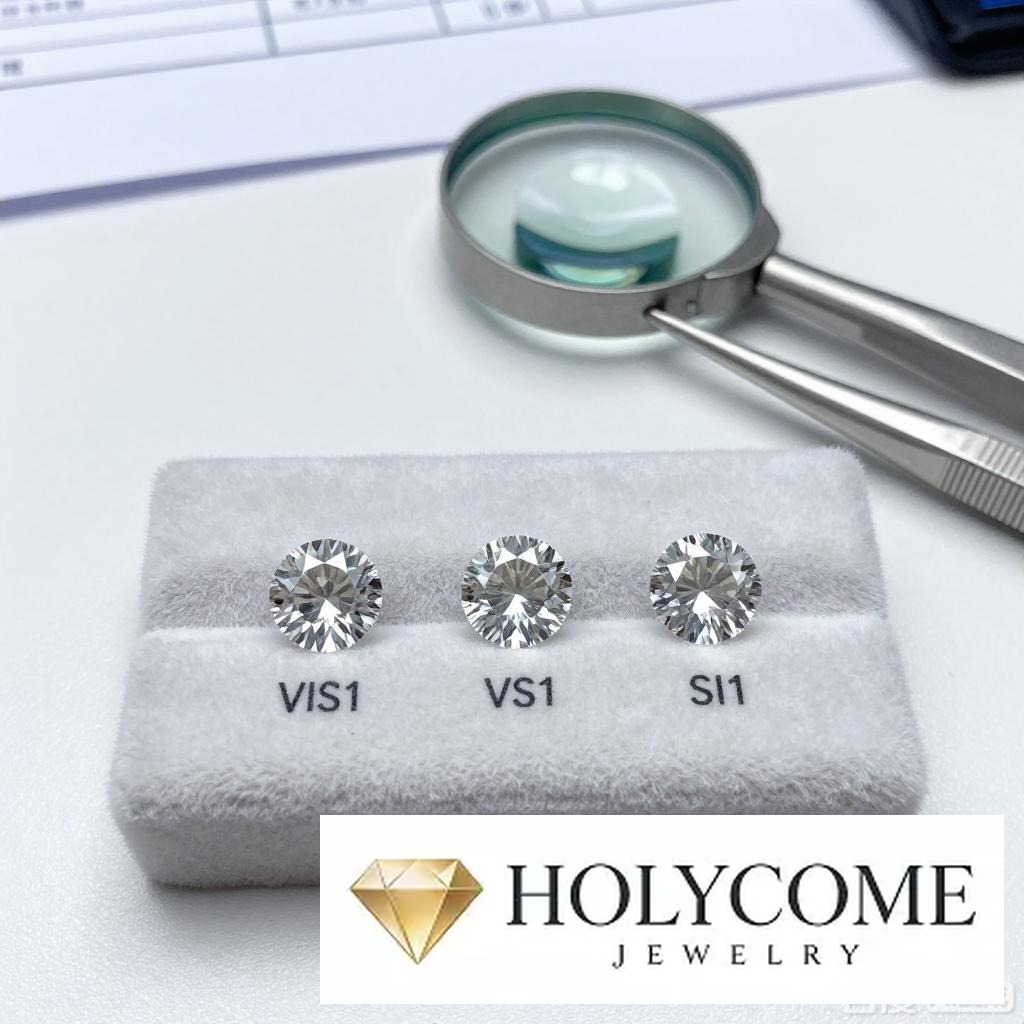
02VVS, VS, SI: What Each Grade Actually Looks Like in Moissanite
In practice, the moissanite that moves through our factory lands in three commercially meaningful grades. FL and IF (flawless and internally flawless) moissanite technically exist, but it is extremely rare to find a silicon carbide crystal larger than a few points without any trace of growth feature; claiming "IF" on larger stones is almost always marketing, not gemological reality. I1 and below are not stones we ship to retail partners. Here is how the three working grades compare:
| Grade | 10x Loupe Appearance | Eye-Clean (Naked Eye, 12 inches) | Typical Features | Wholesale Price Relative to VVS |
|---|---|---|---|---|
| VVS1–VVS2 | Inclusions extremely difficult (VVS1) or very difficult (VVS2) for a trained grader to see under 10x; even graders must search | Always eye-clean in all sizes up to 4 ct | Tiny isolated pinpoints, micro needles in pavilion away from table, faint surface graining only visible under specific lighting | 100% (baseline premium) |
| VS1–VS2 | Minor inclusions visible with some effort under 10x; not obvious to a casual observer | Eye-clean in stones up to 2 ct in normal lighting; some VS2 stones in 2.5 ct+ may show very faint features under bright spotlight | Small needles, faint cloud patches away from table, minor pinpoints, small polish marks | 85–90% of VVS pricing |
| SI1–SI2 | Inclusions obvious under 10x without significant searching; SI2 may have features visible from the crown side even at casual 10x viewing | Not guaranteed eye-clean above 1 ct; SI2 in 2 ct+ can show visible features to the naked eye in bright light | Larger cloud areas, needle clusters, carbon spots, surface-reaching feathers, minor chips/graining from rough handling | 65–75% of VVS pricing |
The critical line for most US bridal buyers is the VS grade. Our VS1–VS2 moissanite is reliably eye-clean in one-carat sizes and very close to eye-clean in two-carat sizes, which covers 80 percent of bridal retail sales. It is the grade we recommend for nearly all wholesale orders because the price savings over VVS are meaningful (10–15 percent per carat) while the visual difference to the end customer is effectively zero under normal wearing conditions.
The GIA's own diamond clarity 4C page notes that most of the inclusions in VS-grade diamonds are not visible to the untrained eye without a loupe — and the same is true, even more so, for moissanite because of the higher RI and stronger light return masking small features. In other words, paying a VVS premium for a stone that will be set in a solitaire ring and worn in everyday lighting is paying for a difference no one will ever see.
In practice, the moissanite that moves through our factory lands in three commercially meaningful grades. FL and IF (flawless and internally flawless) moissanite technically exist, but it is extremely rare to find a silicon carbide crystal larger than a few points without any trace of growth feature; claiming "IF" on larger stones is almost always marketing, not gemological reality. I1 and below are not stones we ship to retail partners. Here is how the three working grades compare:
03How Inclusions Form in Lab-Grown Moissanite
Understanding where inclusions come from helps wholesale buyers appreciate why different grades carry different price points. Moissanite crystals are grown using a sublimation growth process — silicon carbide powder is heated to over 2,000°C in an inert atmosphere, and single crystals condense and grow on a seed crystal over days to weeks. During this growth, several things can create internal features:
- Micro-tube inclusions: Thin hollow tubes that grow along the crystal's growth axis. These are the most common inclusion in moissanite. They look like tiny silver needles under 10x loupe. Cutters orient the rough to position these away from the table, pushing them into the pavilion where they are hidden by reflected light.
- Polytype mixing: Silicon carbide can grow in many crystal structures (polytypes). When two polytypes meet during growth, it creates faint cloud-like whitish areas. Premium-grade crystals minimize polytype boundaries; commercial-grade crystal may have larger cloud patches.
- Carbon residue: Tiny dark carbon spots from unreacted source powder. These are rare in premium crystal and are sorted out by visual inspection before cutting.
- Polish lines and surface graining: These come from the cutting and polishing process, not from the crystal itself. They are removed by re-polishing; stones that cannot be cleaned up are downgraded.
When a crystal boule comes out of the growth furnace, our cutting team maps every inclusion under a microscope before marking the saw lines. High-value rough is oriented to push every visible inclusion into areas that will be cut away during faceting or hidden by prongs in the final setting. A single crystal boule can yield VVS, VS, and SI stones depending on how the cutter maps it, and mapping skill directly affects what percentage of the rough ends up in which grade. That is why two factories cutting from the same crystal boule can produce very different clarity distributions.
04Which Grade Should You Stock for Which Price Point?
After working with hundreds of US retail buyers, we have a clear set of recommendations for parcel composition. These are not rigid rules — your local market and customer demographic may call for different assortments — but they are a starting point that has worked for dozens of independent jewelers and bridal chains:
- Flagship bridal / engagement rings ($2,000+ retail): VVS1–VVS2 DEF color. Your highest-price pieces justify the premium material cost, and VVS gives you full confidence for customers who inspect stones closely before buying, including those who bring their own loupe. Stock VVS in rounds in 1–2 ct sizes.
- Core bridal ($800–$2,000): VS1–VS2 DEF or GH color. This is your volume category. The savings over VVS translate to better margins for you and better price points for customers; eye-clean performance is excellent in these sizes.
- Fashion jewelry / earrings / pendants / everyday stacking rings ($200–$800): VS2–SI1 GH or IJ color. Customers buying these pieces are rarely examining stones with a loupe, and SI1 in smaller sizes (under 1 ct) is reliably eye-clean face-up. This grade opens strong margin opportunities for gifting and impulse-buy price points.
- Promotional / starter lines (under $200): SI1–SI2 IJ color. Be honest in your product copy about the grade, and price accordingly. There is a legitimate market for accessible moissanite, just do not misrepresent it as VVS.
Consider a real example. A bridal boutique in Denver that sources from us was previously stocking 100 percent VVS DEF across all sizes because "our customers expect the best." After analyzing 12 months of sales data with our team, they realized that 70 percent of their sales were in the $1,000–$1,800 range, where VS2 DEF priced 13 percent lower landed them a wider band of buyers without any customer noticing a clarity difference. They shifted to 60 percent VS / 40 percent VVS stock composition on their next order and reported a 21 percent increase in engagement ring sales in the following quarter, with zero clarity-related returns in six months. That is the clarity grade conversation in action.
05Why "Eye-Clean" Matters More Than the Grade Label
The single most important quality concept for moissanite retail is "eye-clean," meaning no inclusion is visible to an average observer with average vision looking at the stone face-up in normal indoor lighting from a comfortable viewing distance (about 12 to 18 inches). The grade on the certificate (VVS vs VS vs SI) is a grading detail — what the customer sees is whether the stone looks clean.
This is why every moissanite we ship to wholesale buyers, regardless of grade, undergoes an "eye-clean verification" step in our final QC. A grader with average (not gemologist-trained) vision holds the stone in a standard ring mount under diffuse 5000K daylight lighting at 15 inches and confirms no inclusion is visible. VVS stones always pass; VS stones almost always pass; SI stones are individually flagged on the packing list if any stone fails, so you can choose to have us replace it or have it set in a mounting (like pavé or halo) where the position hides the feature.
Moissanite's optical properties — particularly its high refractive index and strong brilliance — make it more forgiving of small inclusions than diamond is. A pinpoint that might be visible to the naked eye in a diamond can be completely washed out by light return in a well-cut moissanite. That is one reason VS-grade moissanite punches well above its weight in visual performance, and also why the jump from VS to VVS in moissanite delivers a smaller visible improvement than the same jump in diamond.
06Frequently Asked Questions
Are there truly flawless (FL/IF) moissanite stones?
Yes, but they are rare above half-carat sizes and are priced at a significant premium (often 40–60 percent above VVS). For most retail purposes they are not worth the cost — VVS already gives you a stone that looks flawless to the customer. We source IF-grade stones only on special request for collector pieces.
Can moissanite have black carbon spots like diamond?
Rarely, SI-grade moissanite can show small dark carbon spots from unreacted source powder during crystal growth. These are screened out of our VS and VVS grades; if they appear in SI parcels, they are listed on the QC report so retailers can make informed use of them.
Does clarity affect the sparkle or brilliance of moissanite?
Only at the SI2 level and below. VVS and VS stones cut to the same proportions will perform identically in terms of brilliance and fire — inclusions at those grades are too small and too few to interrupt light return. Heavily included SI2 or I-grade stones can show reduced brilliance in spots where a large inclusion blocks light paths.
How does moissanite clarity compare to cubic zirconia?
High-grade cubic zirconia is typically flawless to 10x, because CZ is a melt-grown material with essentially no growth features. But CZ is much softer (8–8.5 Mohs vs moissanite's 9.25) and clouds and scratches within months of wear, so its flawless factory appearance does not hold up. Moissanite's minor growth features are a trade-off for real durability that looks the same years later.
Can I order a mixed-clarity parcel from HOLYCOME?
Absolutely. Most of our wholesale buyers order mixed parcels — say, 30% VVS for flagship, 50% VS for core bridal, 20% SI for fashion — to hit multiple price points in a single shipment. We provide a per-stone clarity list with every mixed parcel so you know exactly what you received.
Do your GRA certificates show clarity grade?
Yes. Every GRA certificate that ships with our stones 0.30 ct and up lists the clarity grade (VVS1, VVS2, VS1, VS2, SI1, or SI2), color grade, cut grade, measurements, carat weight, and unique certificate number verifiable on the GRA database. Certificates are included free with the parcel.
Clarity grade is one of those quiet decisions that separates a thoughtfully curated moissanite program from a commodity pile. The right grade for each retail price point keeps your costs competitive, your margins healthy, and your customers happy with stones that look clean and brilliant for decades. At HOLYCOME, our gemologists grade every stone, our eye-clean QC filter catches anything a customer would see, and our sales team can help you design a clarity mix matched to your specific market. Browse our loose moissanite wholesale collection to see the VVS, VS, and SI grades we stock, or request a sample parcel — we always include two or three grades side by side so you can see the difference yourself before placing a larger order.
", "tags": "moissanite clarity, VVS VS SI moissanite, moissanite grades, wholesale moissanite"Related reading: Moissanite Clarity Grades: VVS, VS, Eye-Clean Guide, Moissanite Clarity VVS VS SI Eye Clean Guide, Moissanite Clarity Grades: B2B Wholesale Guide.