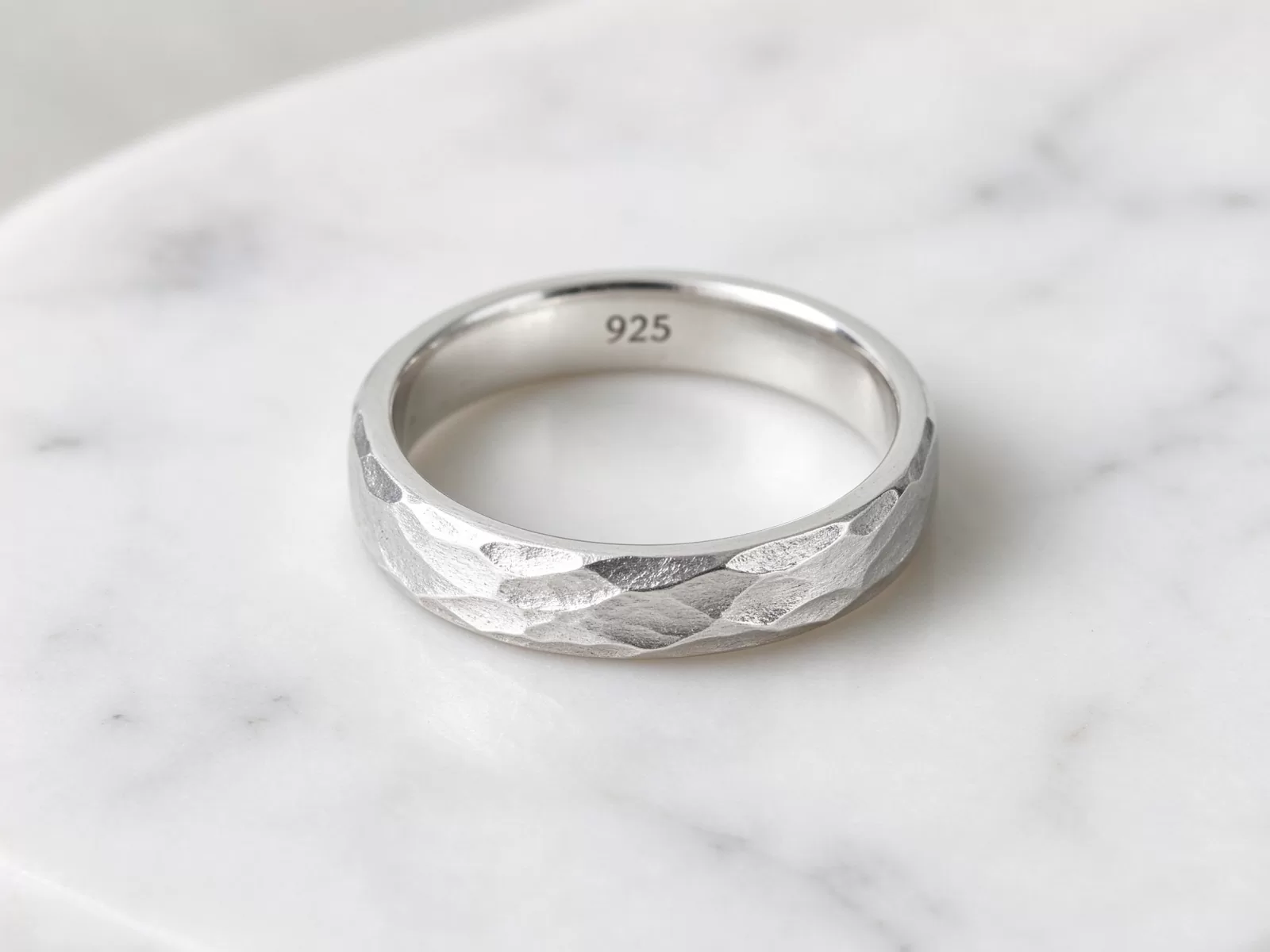
01Why the Unit Price You Were Quoted Is Not Your Cost
Twelve years on the floor taught me one thing about first orders: buyers rarely lose money on the silver. They lose it on the freight, the duty code, the payment fees, and the two kilos of pieces that failed the final AQL inspection at the last minute. The factory quote is only step one.
This is the math I walk every new buyer through before they wire a deposit. It is not a sales pitch. It is the arithmetic that decides whether your first 925 sterling silver wholesale order returns cash or sits in a warehouse.
02Line 1: Silver Content, Priced by the Gram
Sterling is 92.5 percent fine silver. The other 7.5 percent is copper, and it is there for hardness, not cost. When a factory quotes you, the metal line is almost always spot price plus a small fabrication premium. If someone quotes you a flat piece price with no gram weight attached, ask for the weight per piece before you compare anything else.
Practical example: a 3.2 gram ring at a spot price of roughly USD 1.00 per gram of fine silver carries about USD 2.96 of silver. A 2.1 gram pendant chain carries about USD 1.94. Multiply by 500 pieces and the silver line alone is a USD 500 swing between two suppliers who quoted the same "unit price."
- Ask for net silver weight per SKU, not gross shipping weight.
- Confirm whether the quote locks spot for 7 days or floats daily.
- Check whether findings, clasps, and posts are sterling or plated base metal. This is the most common hidden downgrade.
- Request the assay tolerance. Good factories hold 92.0 to 93.0 percent on a routine melt check.
Sterling is 92.5 percent fine silver. The other 7.5 percent is copper, and it is there for hardness, not cost. When a factory quotes you, the metal line is almost always spot price plus a small fabrication premium. If someone quotes you a flat piece price with no gram weight attached, ask for the weight per piece before you compare anything else.
03Line 2: Labor, Plating, and Setting
Labor is where two factories with identical silver costs diverge by 30 percent. A plain polished band and a prong-set moissanite halo can use the same 3 grams of silver and land 4x apart on price, because setting time, stone handling, and rhodium plating are manual steps.
At our facility, a stock SKU needs 1 piece minimum, while a custom design starts at 30 pieces. Custom tooling and CAD time get amortized across that 30, which is why the per-piece price drops sharply between 30 and 300. Production runs 12 to 18 days from deposit and approved sample.
Our cost, speed, and yield run about 20 percent better than typical trading companies on comparable orders. The reason is structural, not magical: we cut and set stones in the same building where the silver is cast, so there is no double handling, no export agent margin, and no second freight leg between the stone supplier and the setting bench.
04Line 3: Certificates and the QC Gate
Certificates are a real cost line and buyers routinely forget to budget for them. Moissanite and lab-grown stones ship with GRA certificates as standard, and IGI certification is available where the stone value justifies it. Budget per certified piece if you plan to resell on marketplaces that demand documentation.
Our three-stage QC is where the yield math pays for itself. Incoming stone check happens before anything is set. In-process inspection catches prong and solder faults while the piece is still on the bench. Pre-ship inspection runs to AQL sampling, so you get a defect rate, not a promise.
Every piece that fails our pre-ship gate is a piece that would have become your return, your chargeback, or your one-star review. The inspection cost is cheaper than any of those.
05Line 4: Freight, Duty, and the DDP Question
This is the line that surprises first-time importers. Air freight on 20 to 40 kg of silver jewelry is not trivial, and silver attracts duty in most destinations. A DDP quote bundles freight, duty, and clearance into one number and delivers in 5 to 8 days. A DAP quote looks cheaper until the broker invoice arrives.
Ask your supplier to quote both. If the DDP number is within 8 to 12 percent of DAP plus your own broker estimate, take DDP and stop managing customs paperwork on your first order. If it is 25 percent higher, something in the quote is padded.
06Line 5: Payment Fees and the Deposit Split
Our standard terms are T/T with 30 percent deposit and the balance against the pre-shipment inspection report. For samples, PayPal is fine because the amount is small and the speed matters more than the fee. On a USD 15,000 order, a 3 percent PayPal fee is USD 450 that buys you nothing.
Watch the currency pair as well. A quote in USD settled through a bank that converts twice can quietly cost another 1 to 2 percent. Confirm the settlement currency in writing.
07Putting the Numbers Together
Here is a worked example on a 500-piece first order, blended across a small ring and pendant assortment. The numbers are illustrative, but the structure is exactly how I build a real landed cost sheet.
| Cost Line | Basis | Amount (USD) | Notes |
|---|---|---|---|
| Silver content | Roughly 1,400 g net at spot plus premium | 1,550 | Confirm net weight per SKU |
| Labor, setting, plating | Per-piece assembly and rhodium | 2,100 | Drops above 300 pcs |
| Stones and certificates | GRA standard, IGI on selected SKUs | 1,300 | IGI priced per piece |
| Freight and duty (DDP) | Door delivery, 5 to 8 days | 620 | Compare against DAP |
| Payment and FX fees | T/T 30 percent deposit | 95 | PayPal only for samples |
| QC and packing | Three-stage gate, AQL pre-ship | 180 | Included in most quotes |
| Total landed | 500 pieces | 5,845 | About USD 11.69 per piece |
Notice what dominates. It is not the silver. Labor and stones together are more than half the landed cost. That is why negotiating the silver line down by 5 percent moves your total by less than 1.5 percent, while cutting defect rates and choosing the right MOQ tier can move it by 10 percent or more.
08The Three Mistakes That Break a First Order
- Ordering 500 pieces of a custom design before approving a physical sample. Approve the sample, then scale.
- Comparing factory quotes against trading company quotes without normalizing for certificate inclusion and DDP terms.
- Ignoring the pre-ship inspection report and letting the balance payment go out on faith.
If you want the arithmetic to work, treat the landed cost sheet as the contract. Every line should have a number, a basis, and a person who owns it.
09Frequently Asked Questions
What is the minimum order for 925 sterling silver wholesale?
Stock designs start at 1 piece, so you can test a style before committing. Custom designs start at 30 pieces per SKU, because tooling and CAD time need to amortize. Production runs 12 to 18 days after deposit and sample approval.
How is the price calculated on a first order?
Price is built from net silver weight at spot plus a fabrication premium, then labor, stone and setting cost, plating, and certificates. Freight and duty are quoted separately or bundled as DDP. Always ask for the gram weight per SKU so you can compare quotes on the same basis.
What certificates come with the stones, and what are the payment terms?
GRA certificates ship as standard on moissanite and lab-grown stones, with IGI available on higher-value pieces. Terms are T/T with 30 percent deposit and balance against the pre-ship inspection report. PayPal is accepted for samples, and DDP delivery takes 5 to 8 days.
Send your SKU list, target quantities, and destination country to service@holycome.com or WhatsApp +86 133 7744 7107, and I will return a landed cost sheet with silver weight, MOQ tier, certificate cost, and DDP freight broken out line by line. If you want to test us first, request a sample pack and I will include the pre-ship AQL report so you can see the QC gate before you place a bulk order.