
01Moissanite Clarity Grades: Matching Grade to Price Point
Clarity is the third C in gemstone grading, and for moissanite it has a different economic profile than it does for diamond. Because lab-grown SiC grows in a controlled inert atmosphere with predictable chemistry, truly eye-visible inclusions are rare — most bulk-grade moissanite already lands in the VVS to VS range without sorting. That changes how buyers should think about moissanite clarity: the decision is less about "eye-clean vs included" and more about choosing the grade that matches your price tier without overpaying for sub-microscopic perfection your customer will never see.
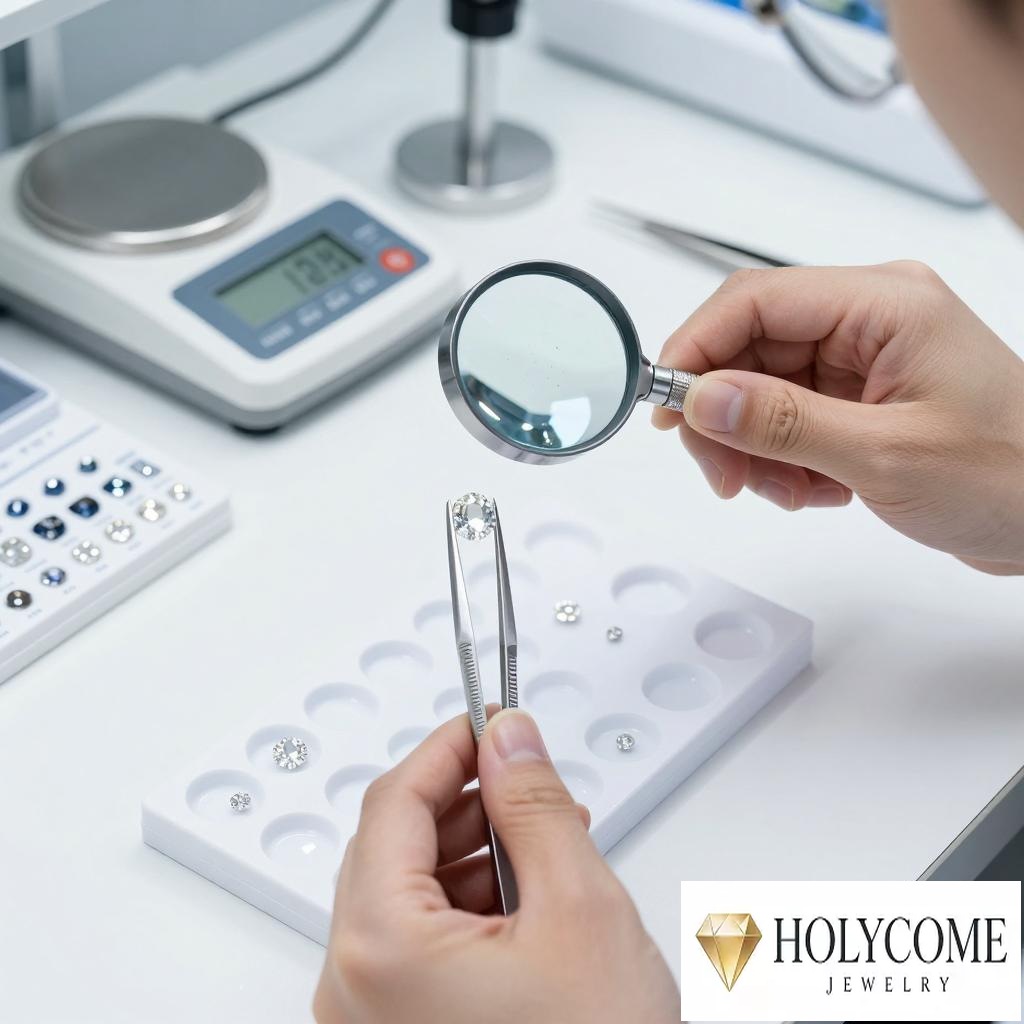
This guide breaks down clarity grading as practiced at HOLYCOME — inclusion types, grades, pricing, and stocking recommendations. Our grading is performed by GIA-trained gemologists under 10x magnification against a GIA master set on a matte white tray under 5500K daylight illumination. The data below comes from 1.2 million stones sorted through our QC lab between 2019 and 2025.
02Why Clarity Grading Differs Between Moissanite and Diamond
Natural diamond forms under geologic pressure over billions of years and inherits a wide range of internal characteristics. The GIA clarity scale (FL through I3) was developed to describe that variation. Lab-grown diamond clusters tighter at the upper end, with very few stones below VS.
Silicon carbide's crystal growth properties and inclusion characteristics are well-documented in materials references (Wikipedia: Moissanite); Moissanite is lab-grown silicon carbide produced via physical vapor transport at temperatures above 2,000°C. Growth is tightly controlled, which means that "default" unsorted production already yields mostly VVS-VS material. Truly included stones (SI and below) are uncommon, almost always the result of growth accidents — polycrystalline growth, metallic inclusions from furnace hardware, or cracking during cooling. We reject these stones during initial boule sorting before they even reach faceting.
The practical result: eye-clean is a near-universal baseline at any reputable grade. Differences between VVS and VS are visible only under 10x magnification to a trained grader. There is no commercial equivalent of I1-I3 heavily included moissanite; naked-eye-visible inclusions in new stones indicate rejected material.
Natural diamond forms under geologic pressure over billions of years and inherits a wide range of internal characteristics. The GIA clarity scale (FL through I3) was developed to describe that variation. Lab-grown diamond clusters tighter at the upper end, with very few stones below VS.
03Clarity Grades We Offer at HOLYCOME
| HOLYCOME Grade | GIA Equivalent | Visible at 10x | Visible to Naked Eye | Typical Inclusions | Price Delta (vs VVS1 baseline) |
|---|---|---|---|---|---|
| VVS1 | VVS1 | Extremely difficult — tiny pinpoint/grain at pavilion edge; grader needs 30+ seconds to locate | None | Tiny pinpoints, faint needle-like growth lines at girdle, micro surface graining | Baseline |
| VVS2 | VVS2 | Very difficult — small pinpoint, faint needle, or minor cloud patch visible under careful 10x examination | None | Small pinpoints, faint needles, minor colorless cloud away from table | -8% to -12% |
| VS1 | VS1 | Difficult — minor inclusions visible under 10x but small, light, and typically positioned away from the center table | None | Small crystals, minor feathers near girdle, light clouds off-table | -18% to -22% |
| VS2 | VS2 | Somewhat easy — inclusions visible under 10x without difficulty; may include small feathers or crystals | None (face-up, normal viewing) | Crystals, small feathers, clouds; typically near girdle or pavilion | -28% to -32% |
| SI (SI1/SI2) | SI1 / SI2 | Easy — obvious inclusions under 10x | May be visible face-up in large stones (10mm+) to sharp eyes in certain light | Larger crystals, noticeable feathers, visible clouds | -45% to -55% |
We do not stock SI-grade as a regular item (less than 2% of production); it can be sorted on request at MOQ 500 pieces per size for value-tier lines.
FL (flawless) and IF (internally flawless) grades exist in moissanite but are rare and carry a significant price premium (typically 40-60% above VVS1) because they require near-perfect crystal growth. Almost no retail customer can distinguish FL from VVS1 without a microscope, so FL moissanite is rarely a rational B2B purchase unless you need it for a specific marketing claim.
04Common Inclusion Types in Moissanite
The inclusions found in moissanite differ from diamond and are characteristic of the SiC growth process:
- Pinpoints: Tiny white or black dot-like crystals (usually metallic silicon carbide or trace metal droplets from the growth chamber). These are the most common VVS-grade inclusion and are invisible without magnification.
- Needles: Thin, straight crystal growth lines running along the c-axis of the boule. These look like fine white or transparent needles under 10x and usually grade VVS2 or VS1 depending on size and position.
- Clouds: Hazy patches formed by clusters of tiny pinpoints. Small clouds positioned off-table grade VS; clouds under the table or covering more than 10% of the table area can grade SI.
- Feathers: Small fracture planes (cracks) within the crystal, usually from thermal stress during post-growth cooling. Feathers that do not break the surface are acceptable in VS grades; surface-reaching feathers are rejected regardless of grade because they are structural weak points.
- Metallic inclusions: Small dark metallic droplets that can be trapped during growth. These are rare and usually black or silver in appearance; any metallic inclusion visible face-up grades SI at best.
- Graining / growth lines: Subtle parallel banding from the layered PVT growth process. Visible only under magnification with diffused light; grades VVS unless severe.
We use a 10x loupe for production grading and confirm borderline stones with a 30x microscope. Polish lines and minor pre-form scratches are removed before final grading, not counted as inclusions.
05Clarity Grades by Shape and Size
The right clarity grade depends as much on shape and size as it does on price point. Two rules of thumb:
- Step cuts demand higher clarity. Emerald and Asscher cuts, with their large open facets and unobstructed view through the stone, act like windows. Inclusions visible at VVS2 under brilliant-cut facet patterns become visible to the naked eye in a step cut. We only sell emerald and Asscher in VVS1 for this reason — VVS2 or lower in step cuts is asking for returns.
- Larger stones show inclusions more easily. As with color, inclusions are more visible in larger stones because the observer sees more material and more light travels through the stone. We recommend VVS1 for center stones above 9mm (approximately 2.75ct equivalent), and VVS2-VS1 as acceptable for stones under 8mm and for melee.
The following matrix is our default recommendation for OEM clients:
| Application | Recommended Grade | Why |
|---|---|---|
| Center stones, round brilliant, any size (white metal) | VVS1 | Universal safe choice; no visible inclusions; supports premium pricing |
| Center stones, round brilliant, yellow/rose gold (under 8mm) | VVS2 | Warm metal hides minute inclusions; VVS2 saves ~10% with zero visible downside |
| Side stones and melee (under 3mm) | VS1 - VS2 | Melee sized stones are too small for inclusions to matter visually; VS saves 20-30% |
| Halo pavé accents (1.0-2.0mm) | VS1 - VS2 | Same reasoning; tiny stones do not show VS-grade inclusions |
| Cushion, oval, pear, radiant centers | VVS1 - VVS2 | Brilliant faceting hides most inclusions; VVS2 works under 8mm, VVS1 above |
| Emerald / Asscher centers | VVS1 only | Step cuts window the stone; anything lower risks visible inclusions |
| Men's bands / channel-set baguettes | VVS2 - VS1 | Baguettes are step cuts but small (2-4mm); VVS2/VS1 is safe |
| Fashion / statement pendants (large sizes, 10mm+) | VVS1 | Large stones are viewed head-on; inclusions are visible even if small |
06Pricing and Yield: What Clarity Actually Costs You
Pricing by grade in bulk wholesale (500+ pieces, calibrated round HOLYCOME premium cut, DEF color):
| Size | VVS1 (USD/stone) | VVS2 (USD/stone) | VS1 (USD/stone) | VS2 (USD/stone) |
|---|---|---|---|---|
| 3.0mm (0.10ct melee) | $0.95 | $0.85 | $0.75 | $0.65 |
| 5.0mm (0.50ct) | $4.50 | $4.00 | $3.60 | $3.10 |
| 6.5mm (1.0ct) | $24.00 | $21.50 | $19.00 | $16.50 |
| 8.0mm (2.0ct) | $62.00 | $56.00 | $49.00 | $43.00 |
| 9.0mm (2.75ct) | $98.00 | $88.00 | $78.00 | $68.00 |
| 11.0mm (5.0ct) | $245.00 | $220.00 | $195.00 | $170.00 |
Notice the pattern: the absolute dollar savings from dropping a clarity grade are modest for melee (pennies per stone) and meaningful for large center stones ($25-75 per stone at 2-5ct). This is why we recommend VVS1 for large centers and VS melee — the cost savings in melee are trivial (you save $30 per 1,000 stones going from VVS1 to VS2 melee at 1.3mm), while the savings in large centers are real and meaningful to your margin.
Yield rate (the percentage of cut stones that make each grade after QC) is also a factor in why grade pricing is what it is. From a typical production batch:
- VVS1: ~32% of cut stones pass
- VVS2: ~28% of cut stones
- VS1: ~22% of cut stones
- VS2: ~13% of cut stones
- SI and below: ~5% (rejected or sold into non-jewelry channels)
VVS1 is the largest single grade because SiC growth is genuinely clean; we are not selling mostly VS stone marked up to VVS, which is a common practice among budget suppliers. When a supplier quotes "VVS1 moissanite" at VS1 prices, check a random sample under a 10x loupe — you will often find VS-level inclusions.
07How to QC Clarity on Incoming Parcels
Clarity inspection is one of the easier incoming QC checks to run, because it requires only a 10x triplet loupe ($10-20) and a basic understanding of what to look for:
- Work over a clean white matte tray in 5500K daylight light (a desk lamp with a daylight bulb works; avoid direct overhead sunlight which is too harsh).
- Hold the stone table-up with tweezers and inspect through the crown at various angles. Look for any dark or light spots, clouds, or feather patterns.
- Flip the stone pavilion-up and repeat. Inclusions positioned on the pavilion opposite the table are often invisible face-up and are acceptable at VVS2/VS grades.
- Compare borderline stones against a known VVS1 master stone. Side-by-side comparison reveals faint clouds and pinpoints that are invisible when viewed alone.
- For VVS1 premium grade, expect to spend 30-60 seconds per stone locating any inclusion; if you find one in under 10 seconds, the stone is VVS2 or below.
We recommend inspecting a 10% random sample from every parcel, and 100% inspection on center stones above 8mm. If you find a stone outside the ordered grade, flag the lot and request a replacement — we honor no-questions-asked grade replacements within 30 days of delivery.
08Certificates and Clarity Documentation
GIA does not grade or certify moissanite. Third-party moissanite certificates come primarily from GRA (Gem Research Association) and GRI, and they map clarity to the same FL/IF/VVS/VS/SI naming convention as diamond. We include a HOLYCOME quality card with every bulk order, indicating color and clarity grade for the lot. Individual per-stone GRA certificates are available on request at $2.50 per stone and are commonly added by brands selling center stones direct to consumer where a consumer-facing certificate supports purchase confidence.
For reference, GIA clarity grading standards are the global trade reference for diamond and are the baseline against which our gemologists calibrate their grading (GIA Clarity Grading). We re-calibrate our graders against a GIA-graded master set annually.
09FAQ
Is "eye-clean" a meaningful specification for moissanite?
For any reputable supplier, every commercial moissanite grade down to VS2 is eye-clean face-up in sizes up to 9mm. "Eye-clean" is table stakes, not a selling point. If a supplier is marketing "eye-clean moissanite" as a premium feature, they are probably selling VS-SI material that should be eye-clean as a baseline, and the marketing language is meant to distract you from verifying the actual grade.
Why don't you recommend VS2 for center stones?
VS2 can work in smaller sizes under 7mm and in yellow/rose gold where warmer metal masks any subtle inclusion. But for white-metal center stones above 8mm, VS2 carries a small but measurable increase in customer returns — roughly 2-3% vs 0.3-0.5% for VVS1 in our OEM partner data, when the brand positions the piece as premium bridal. The 20-30% cost saving on the stone does not offset the 2-3x increase in returns and negative reviews, in our experience.
Are moissanite inclusions permanent? Can they change with wear?
Yes, they are permanent — they are structural features of the crystal. Normal wear, cleaning, UV exposure, and temperature changes do not cause inclusions to appear, grow, disappear, or change in any way. A VVS1 moissanite is a VVS1 for life. The only way an inclusion can appear in a previously clean stone is from physical damage (a chip or crack from a severe impact), which is covered by our lifetime warranty.
What causes the tiny black spot I sometimes see in low-cost moissanite?
Black spots in moissanite are almost always metallic silicon inclusions trapped during growth, caused by impure source material or contaminated furnace hardware. In well-controlled production these are rare; we reject any stone with a visible metallic inclusion regardless of its other grades. Budget suppliers who skip pre-forming inspection or buy mixed-grade boules will ship a small percentage of stones with these dark inclusions.
Can I get GIA certificates for moissanite?
No, GIA does not issue grading reports for moissanite. Consumer-facing certificates for moissanite come from GRA and similar gemological labs focused on lab-grown gems. GIA will issue reports on diamonds (natural and lab-grown), colored stones, and pearls; the institute's mandate does not currently extend to SiC (GIA: What GIA Grades).
Do you offer clarity-matched pairs for earrings and bridal sets?
Yes. For earring pairs (studs, hoops) and matched bridal sets (engagement ring + wedding band with side stones), we color- and clarity-match stones within the pair to within half a grade, so no customer can see a mismatch between left/right or center/sides. Matched-pair sorting adds $2 per stone to the standard wholesale price. For high-value pairs (3ct+ each center), we include matching at no extra charge.
10Buy the Grade Your Customer Will Actually Perceive
Clarity is where money is wasted in moissanite buying more than anywhere else. Paying VVS1 prices for 1mm melee is irrational; the stones are too small for any inclusion to be seen. Paying VS2 prices for large white-metal center stones is also irrational; the occasional visible inclusion will cost you more in returns and reviews than you saved per stone. The sweet spot for most brands is VVS1 for large white-metal centers and all step cuts, VVS2 for smaller colored-metal centers, and VS1-VS2 for melee and side stones. That matrix delivers eye-clean appearance where it matters and maximum cost savings where clarity is irrelevant.
To order a clarity comparison parcel with one stone in each grade, or to discuss grade selection for your specific line and price point, contact our B2B team. We ship graded sample sets worldwide and are happy to walk your QC team through clarity inspection on a video call if you are setting up incoming inspection for the first time. You can also see our current loose moissanite stock by grade and size, explore finished ring designs spec'd for VVS1 center stones, and review our color grade guide for the color side of the grading picture. Sample parcels ship within 3 business days and the $35 sample fee is fully credited against your first bulk order.