01Returns do not start at the stone
Twelve years on the floor and I can count on two hands the number of genuine rough defects I have pulled from a finished setting. The returns that hurt a buyer are almost always mechanical: a prong that walked open, a melee stone sitting proud in a halo, a ring that came back because the size was off by half. None of that is a grading problem. It is a handling problem.
So when we quote lab grown diamonds wholesale, I do not lead with the certificate. I lead with what happens between the stone tray and the shipping carton. That is where your return rate is decided.
02Why lab grown stones need a tighter loop than mined
Chemically and optically the material is the same. Practically, a wholesale buyer handling lab grown goods runs a different risk profile. Order volumes are higher per style, restocks are faster, and the same design gets re-cut across many sizes. A prong issue that shows up once in a mined diamond run shows up eight times when you are pushing 200 pieces of the same halo through a holiday window.
Lab grown also arrives with more documentation attached: GRA for the melee and smaller goods, IGI for certified stones above the usual threshold. That paperwork is a selling point, but it is also a return liability if the cert number on the parcel does not match the cert on the invoice. Mismatched paperwork is a top-five return reason in this trade and it has nothing to do with the diamond.
Chemically and optically the material is the same. Practically, a wholesale buyer handling lab grown goods runs a different risk profile. Order volumes are higher per style, restocks are faster, and the same design gets re-cut across many sizes. A prong issue that shows up once in a mined diamond run shows up eight times when you are pushing 200 pieces of the same halo through a holiday window.
03The three-stage QC gate we run on every parcel
Our line uses three checks, and I will describe them the way I would explain them to a new inspector on a Monday morning.
Stage one: incoming stone check
Every stone lot is opened under the loupe before it goes anywhere near a bench. We verify measurement against the parcel sheet, check for internal fractures and graining, and confirm the cert number on the stone matches the paper. Melee lots are sampled to AQL, not eyeballed. If a lot fails here it goes back to the supplier, not onto a ring.
Stage two: in-process check
This is the one most trading companies skip. We check after setting but before polish, and again after polish but before final assembly. The first pass catches bent prongs, uneven beads on pavé, and stones sitting below the surface. The second pass catches heat damage and polish compound left in the gallery. Catching a loose prong here costs us minutes. Catching it after a customer opens the box costs you a refund, a return label and a review.
Stage three: pre-ship AQL
Before anything is boxed we run an AQL sample across the whole order: dimensions against the spec sheet, stone count, clasp function, plating thickness on silver, and a paperwork match. Anything out of tolerance goes back to the bench, not into the carton. This is the gate that keeps your receiving department quiet.
04Cleaning: what to tell your own customers
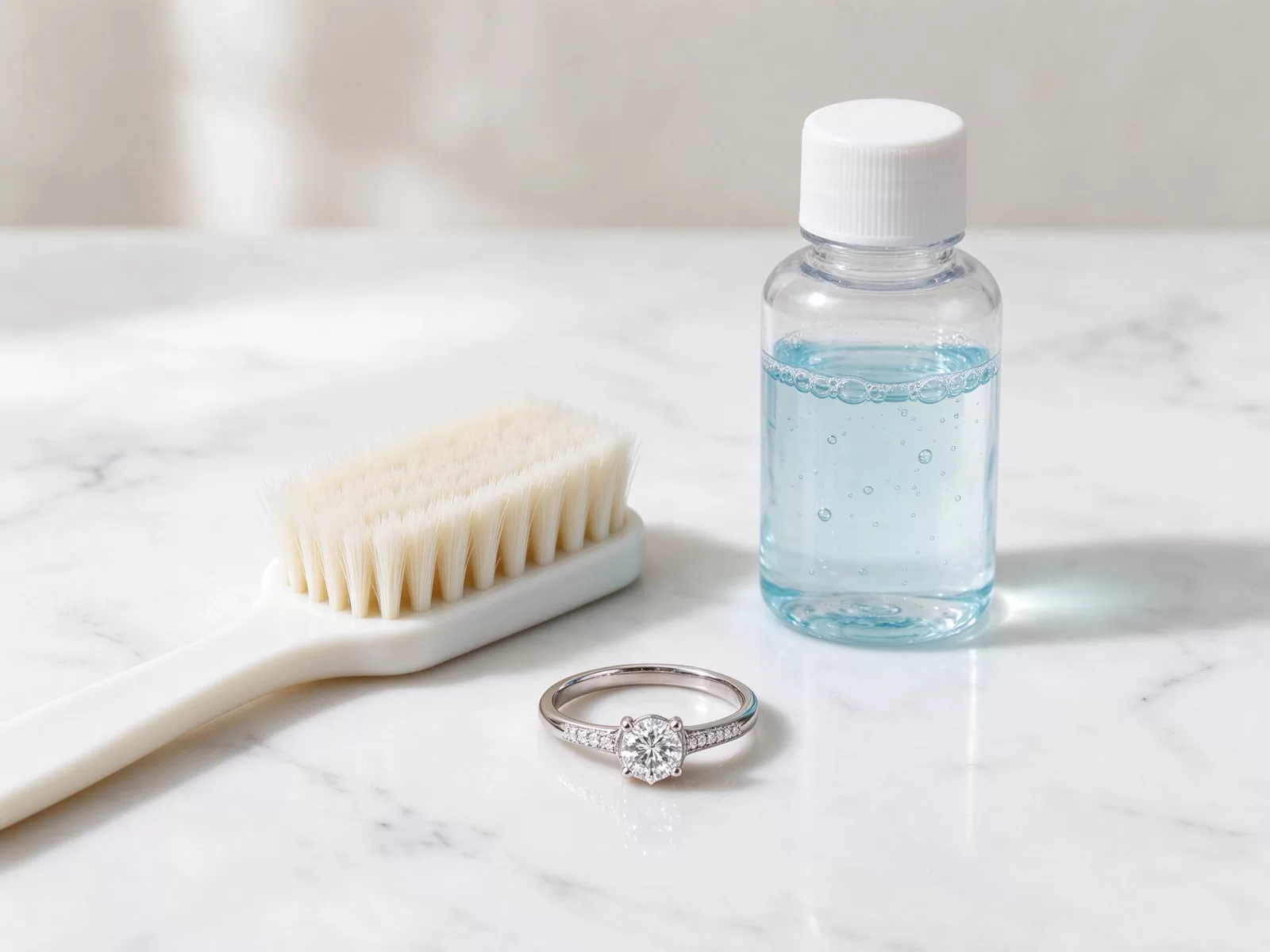
Half the complaints we see upstream are not defects at all. They are a stone that looks dull because it has a film of hand lotion and hairspray on the pavilion. Buyers who hand their retail accounts a cleaning card get fewer of those calls, and those calls are the ones that turn into returns when the customer does not believe you.
- Warm water, a drop of mild dish soap, and a soft brush. That is the whole kit.
- Clean under the stone, not just the crown. The pavilion is where the film sits.
- Skip ultrasonic cleaners on pavé and channel settings. Loose beads do not survive them.
- No chlorine, no bleach, no jewelry dip on silver. It attacks the rhodium and the alloy.
- Dry on a lint-free cloth and let it sit before it goes back in the pouch.
- For silver, a polish cloth once a month is enough. Over-polishing wears the plating.
Put that list on a card in the box. It costs almost nothing and it takes a whole category of complaint off your desk.
05Repair: the part that decides your margin
Repairs are where a wholesale relationship either pays for itself or quietly bleeds. A buyer needs to know what happens when three pieces out of a hundred come back with a bent prong or a snapped chain.
| Issue | Typical cause | Our handling | Turnaround |
|---|---|---|---|
| Loose or open prong | Setting pressure, shipping shock | Re-tip and re-tighten, re-check under loupe | 2-4 days |
| Cloudy pavé | Residue, not a stone fault | Steam clean and re-inspect | 1-2 days |
| Ring size off | Spec mismatch or customer change | Re-size within the alloy tolerance | 3-5 days |
| Plating wear on silver | Chlorine or friction | Strip and re-plate rhodium | 2-3 days |
| Cert or paperwork mismatch | Packing error | Re-verify against IGI or GRA record | Same day |
Two things make this work. First, we keep the setting spec and the stone cert on file, so a repair six months later does not need the original piece re-measured from scratch. Second, we do not charge a bench fee on defects traced to our own setting work. That is the honest way to run it, and it is why our return rate on repeat wholesale accounts sits well under what a pure trading desk sees.
On cost, speed and yield we run roughly 20 percent better than typical trading companies. The reason is simple: we own the bench. There is no middleman scheduling the setter, no third party holding the parcel while a question gets answered by email.
06Getting the loop right before the first order
Most buyers meet us at a trade show, ask for a price on a 1 carat stud, and never ask what happens after the sale. Ask instead. Ask who inspects the setting, what AQL you run, and what the repair policy is on a prong you did not touch.
For reference, here is how we work. Stock items ship from one piece. Custom designs start at 30 pieces. Production runs 12-18 days depending on the style and stone count. Payment is T/T with 30 percent deposit, and PayPal works for samples. Delivery is DDP, typically 5-8 days to a US or EU address. Certificates come from GRA and IGI depending on the goods.
07Frequently Asked Questions
What is the minimum order for lab grown diamonds wholesale?
One piece for anything in stock, and 30 pieces for a custom design or a new setting. Sample orders can be a single piece so you can inspect the setting and the paperwork before committing to a production run.
How long does production and delivery take?
Production is 12-18 days after deposit and spec sign-off, with the range driven by stone count and setting complexity. DDP delivery adds roughly 5-8 days to a US or EU address, and certificates are issued before the parcel leaves.
How is price quoted and what does it cover?
Price is quoted per piece against the stone spec, metal, plating and setting style, with the certificate included. Cost, speed and yield run about 20 percent better than typical trading companies because we run our own bench and QC in-house rather than subcontracting the setting work.
If you want to see the loop for yourself, send your spec sheet or a reference photo and we will quote it, then ship a sample so you can put the setting and the paperwork through your own inspection. Reach the floor team at service@holycome.com or WhatsApp +86 133 7744 7107.