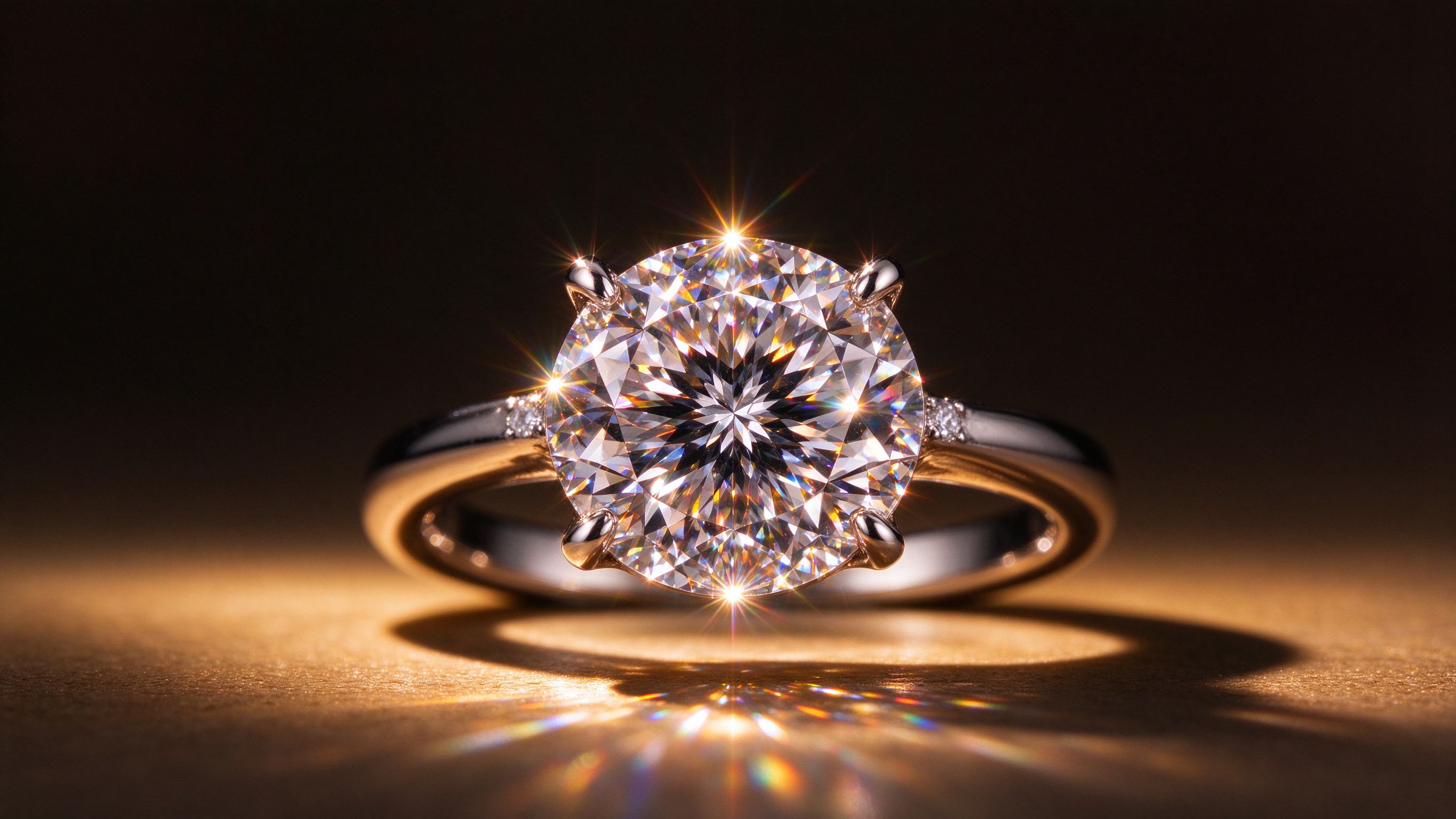
Lab Grown Diamond Inclusion QC: Mapping Rough
Inclusions in lab-grown diamonds are not flaws to hide; they are internal features the planner works around before a single facet is cut. A cutting factory that discovers inclusions during polishing wastes nearly-finished stones. This article explains how we map inclusions on rough lab-grown crystals and plan the cut so the finished stone meets the clarity grade the brand sells.
Why Inclusion Mapping Happens First
Before cutting, the rough crystal is examined under magnification and its inclusions are plotted: where they sit, how large they are, and which direction they point. The planner then chooses the cut orientation that pushes inclusions to hidden positions, such as behind facets or near the girdle.
A stone that is cut without mapping may end up with a prominent inclusion dead center, which drops its clarity grade and its value. Mapping before cutting is what prevents that. It is planning, not inspection.
We document the inclusion map for each parcel, so yield decisions are traceable. A cutting factory that cannot show you where inclusions were is not planning, it is guessing.
Common Inclusion Types
HPHT rough may contain metallic flux inclusions, tiny dark crystals trapped during growth. CVD rough more often shows feather-like internal fractures or growth lines. Each type responds differently to cut placement.
Metallic flux inclusions are usually small and can often be positioned below the girdle, hidden by the setting. Feather inclusions are more directional, and the cut must avoid propagating them during polishing.
We choose the cut orientation per stone based on its inclusion map, rather than applying a generic plan. This is why experienced planners matter: the same rough can yield a much better stone with the right orientation.
Hitting the Clarity Grade
The brand sells a specific clarity grade, such as eye-clean or VS. Our planning targets that grade by positioning inclusions where they are invisible to the naked eye. Stones that cannot reach the target are downgraded rather than forced.
Eye-clean means no inclusions visible without magnification. We check the finished stone face-up under standard lighting, because a stone that looks clean under magnification but shows a dark spot to the eye has not met the grade.
We do not over-promise. If a parcel cannot consistently hit the sold grade, we tell the brand and adjust expectations, rather than shipping stones that fail under customer inspection.
Avoiding Cracks During Polishing
Feather inclusions can propagate into cracks if the stone is polished too aggressively or heated unevenly. Our polishers slow down and adjust pressure on stones known to have feathers, because a cracked stone is a total loss.
The inclusion map tells the polisher where the risky areas are, so they work those areas gently. This is another reason mapping is valuable beyond clarity grading.
We inspect stones between blocking and faceting, because a new crack can appear after the first grinding steps. Catching it early saves the stone rather than wasting the full polishing cycle.
Why This Protects the Brand
A stone that fails its clarity grade under customer inspection is a return and a trust problem. Planning inclusions to the sold grade before cutting is the cheapest way to prevent that.
For matched sets, we map inclusions so no stone has a visible dark spot in a prominent position. A set where one stone shows a black dot reads as defective even if each stone individually graded fine.
Brands that ask how the factory controls clarity learn whether the factory plans inclusions or gambles. The answer determines whether the lab-diamond line is trustworthy.
CVD vs HPHT Rough in Our Cutting Line
The finish on the inside of a setting tells you how a factory treats its junior operators. Rough interiors catch skin and hair and feel cheap the moment the customer puts the piece on. We require every piece to be deburred and polished internally before it moves to plating, even though the customer will rarely inspect that surface consciously. They will feel it.
Reverse logistics are priced into honest quotes. When a factory has never planned for returns, the brand absorbs them invisibly. Our production QC targets a defect rate low enough that returns are exceptions, and we track the return reason codes so that the next batch is improved by the last batch's failures rather than repeated.
Tooling files are archived after a custom run, which is why reorders after a year still match the original sample. We keep the wax patterns, the CNC programs, and the measured stone seats on file so that a reorder does not restart the design process. This is the operational difference between a factory that prototypes and one that produces.
Surface finish consistency across a batch is a measurable target, not a vibe. We compare representative pieces under standardized lighting and magnification, and we reject batches where the rhodium tone shifts warm or matte across units. Inconsistent finish reads as a quality problem even when every individual stone and dimension is correct.
When brands ask us to match a competitor's piece, we reverse-engineer it as a drawing before quoting, because measuring a finished object tells us the result but not the process. Two settings that look identical can require very different production routes, and quoting without that analysis is how orders end up losing money for everyone.
We treat compliance documentation as a production output, not a sales promise. Nickel release test reports, material certifications, and plating thickness certificates are generated from the same batches that ship, so the document matches the goods. A certificate produced after the fact to order is worth less than the paper it is printed on.
The value of a long run is not just lower unit cost. Longer runs let the setter, the polisher, and the plater get into a rhythm, and cycle time drops measurably after the first few dozen units. This is why pricing tiers step down at volume: it is not a volume discount, it is a reflection of a more stable, faster process.
IGI Inspection and Girdle-Laser Control
Every factory has a sweet spot for order size. Too small and the setup cost dominates; too large and inventory risk and working capital dominate. We advise brands on the sweet spot for their specific design rather than always pushing the biggest run, because a brand that ties up cash in unsold stock will not reorder. Sustainable order sizing is how accounts grow year over year.
Hand-finishing and machine-finishing are chosen per piece, not by default. A contour that can be milled consistently should be milled; a delicate prong tip that would snap on a fixture should be finished by hand. Factories that do everything by hand are slow and inconsistent; factories that automate everything lose detail on delicate pieces. The line between is the craft.
Pre-production samples exist to be approved, not to be admired. We expect the first sample to generate revision notes on bail height, post length, or prong visibility. Building that revision loop into the timeline prevents the far more expensive revision that happens after a full run is already cast.
Tracking stones by lot rather than by loose parcel is how we keep matched sets consistent. When a tennis bracelet or a pair of earrings is reordered months later, the new stones come from the same color and cut lot family so the sparkle does not shift. Factories that buy stone parcels order by order cannot promise this continuity.
Our customer's retail margin is our constraint on design choices. A setting that looks incredible but requires a $400 retail price for a $20 factory cost is usually the wrong product for a given market. We price backward from the brand's target price point, not forward from our costs, so the design we build actually has room to sell.
Subcontracting within the factory floor is planned, not improvised. Plating, laser welding, and stone cutting may happen on dedicated benches by specialists, and the routing of each work order is logged so we know where any unit is at any time. This routing discipline is what lets us quote accurate ship dates instead of estimates.
Warranty data feeds the next tooling iteration. A clasp that fails in the field at two percent tells us the spring is underrated; a prong that loosens tells us the seat is too shallow. We feed these findings back into the CAD before re-tooling, which is why our version two of a design is always more durable than version one.
Mixed Moissanite and Lab-Diamond Floor Flow
CVD and HPHT lab-grown diamonds reach the same finished appearance by very different production routes, and the factory implication is in the post-growth treatment. CVD stones commonly need a pressure and color-enhancement step before cutting, while HPHT stones may show metallic flux inclusions. Our cutting bench treats the two growth methods as different inputs rather than interchangeable rough.
IGI grading happens after cutting, which means the cutting factory controls the input that the grader evaluates. A poorly cut stone graded at a lower color or clarity costs the brand more per carat of usable sparkle. We optimize cut to the grade the brand actually sells, rather than maximizing carat weight at the expense of light return.
Certificate matching is a controlled step in our lab-grown diamond line. Each loose stone arrives with a lab report number lasered on its girdle, and we record that number against the work order before the stone is set. At final QC we re-read the girdle laser with magnification so the number on the certificate in the box is the number on the stone in the setting.
Mixing moissanite and lab-grown diamond on the same production floor requires separate tooling and separate inspection because the two stones cut and set differently. Moissanite's higher thermal conductivity and different hardness demand different burrs and different setter pressure. We keep the two lines segregated to avoid cross-contamination in stone trays and finished lots.
The price-per-carat math changes at different size brackets. Lab-grown diamonds under one carat compete aggressively on price, while one-to-two carat stones offer the strongest perceived value for the brand's retail price tier. We advise brands on which size bracket to stock, because buying in the wrong bracket wastes margin even at the same factory cost.
Lab-grown diamond inclusions are mapped before cutting, not discovered during polishing. We plot the rough crystal's inclusions under magnification and plan the cut around them, which raises yield and avoids wasting a nearly-finished stone on a hidden flaw. This planning step is what separates a cutting service from a reseller of finished stock.
Every price we quote as a factory is really three numbers stacked on top of each other: the cost of the rough moissanite, the cost of the metal and findings, and the cost of the labor that turns both into a finished setting. Buyers who compare only the final unit price rarely realize how much of that number is process rather than material. A shop that undercuts by ten percent is usually skipping one of those three layers, and the layer it skips is almost always the labor that controls fit, polish, and stone security.
Yield, Sorting and Carat Economics
Tooling amortization is the quiet number behind any custom order. When we cut a new wax mold or machine a custom die, that cost has to be spread across the first production run. This is why the minimum order quantity exists at all: it is not a hurdle we invented, it is the break-even point on engineering time. Reorders after the first run are dramatically cheaper because the tooling is already paid for and the line is already tuned.
Our quality control bench is where ninety percent of defective units would actually have been caught if the upstream process were perfect, but perfection upstream is expensive. The practical factory model is to inspect at three gates: after casting, after stone setting, and after plating. Each gate catches a different failure mode, and routing a unit backward when a gate fails is far cheaper than catching it after packaging.
Moissanite is harder to set than cubic zirconia, and that difference shows up in the reject rate. The stone is more brittle along its pavilion facets, so a prong pushed too hard will chip the girdle instead of bending. Our setters are trained to seat the stone dry first, check that it rocks evenly, and only then close the prongs with small repeated taps rather than one aggressive squeeze. This discipline is invisible in the final product but it is why our breakage rate stays below one percent.
Capacity planning is the difference between a two-week lead time and a six-week one. A factory that quotes you four weeks when its floor is already full is guessing. When we accept an OEM order, we reserve actual bench slots and plating-bath time against it before we confirm the date. If a slot slips, the customer knows before the shipment date, not after.
Plating thickness is where factories either save you money or cost you a sale later. A one-micron rhodium flash looks perfect on day one and wears through in weeks of retail handling. Our standard retail-grade finish is a measured three to five microns, verified by X-ray fluorescence on sampled pieces from every batch. The cost delta is small per piece; the cost of a return is not.
When a brand asks for private labeling, the work starts long before the first stone is set. We map their packaging, their insert card, their logo placement, and their target retail price against our production cost structure. A price point that looks comfortable at sample stage can become unprofitable at volume once packaging and inspection are added, so we price the full landed kit, not just the loose jewelry.
Grading loose moissanite into the settings we have produced is a matching exercise, not a grab bag. We sort every parcel by color, cut, and light performance before it reaches the setter, and we pair stones so that a matched pair of earrings or a full tennis bracelet reads as one continuous sparkle rather than a set of unrelated stones. This sorting step is labor that discount factories usually skip, which is why their matched sets show obvious stone-to-stone variation.
Frequently Asked Questions
Why is my lab diamond cloudy or included?
Inclusions must be mapped before cutting and hidden behind facets. A factory that cuts without mapping leaves inclusions in visible positions.
What inclusions are common in lab diamonds?
HPHT may show metallic flux; CVD often shows feathers or growth lines. Each is planned around differently.
How do you guarantee eye-clean stones?
We map inclusions, position them hidden, and check the finished stone face-up under standard lighting before it ships.
Can polishing crack a lab diamond?
Feather inclusions can propagate if polished too aggressively. We slow down on stones known to have feathers.
How do you keep a matched set clean?
We map inclusions so no stone in the set has a visible dark spot in a prominent position.
Conclusion
Inclusion control is pre-cut planning, not post-cut inspection. Mapping rough, orienting the cut to hide features, and polishing carefully around feathers is what delivers lab diamonds that hold their sold clarity grade under real customer inspection.