Moissanite vs Cubic Zirconia Value - HOLYCOME
Both moissanite and cubic zirconia look like a diamond in a photo, and both cost a fraction of a real stone. So why does moissanite sell for twenty or thirty times the price of cubic zirconia? As a factory that cuts both materials, we get this question every day, usually from wholesale buyers comparing quotes. The answer is not marketing; it is materials science, manufacturing cost, and longevity. Cubic zirconia is a cheap, soft, disposable stone that clouds and scratches within months. Moissanite is a hard, durable, brilliant stone that lasts for decades. The price gap is real, and it reflects a real difference. This guide explains what that difference is, where the manufacturing cost comes from, and why a moissanite ring is better value even though it costs more upfront. We will not pretend cubic zirconia has no place—it does, for cheap fashion—but we will show you why moissanite is the value choice for a ring you intend to keep.
The short answer is this: cubic zirconia costs a few dollars a stone because it is soft, scratches easily, clouds within a year, and is mass-produced to a low standard. Moissanite costs more because it is nearly as hard as a diamond, refracts more light, never clouds, and requires high-temperature crystal growth and precision cutting that CZ does not. A CZ ring that costs twenty dollars today will look cloudy and scratched within a year. A moissanite ring that costs two hundred will look the same in twenty years. When you divide the cost by years of wear, moissanite is the cheaper option, even though the sticker price is higher. That is the value difference, and it is the one we build for.
We cover the related question of why moissanite is cheaper than a diamond elsewhere, which is about manufacturing scale. This article is specifically about the gap between moissanite and CZ, two look-alike stones that are often confused by shoppers. We also touch on cost per wear, which is the lens that makes the value difference obvious. Read on, and the price gap will stop looking arbitrary.
Hardness: Why CZ Scratches and Moissanite Does Not
The first and biggest difference is hardness. On the Mohs scale, cubic zirconia sits at about 8 to 8.5, which sounds high, but in practice it is soft enough that everyday dust—which is quartz, at 7 on the Mohs scale—scratches it. A CZ ring worn daily picks up micro-scratches within weeks, and within a year the surface is a field of fine lines that scatter light and make the stone look dull. Moissanite, by contrast, scores 9.25 on the Mohs scale, second only to diamond among commonly used gemstones. Dust and grit do not scratch it, and a moissanite ring worn daily stays bright for decades. This is the single biggest reason for the price gap: CZ is a stone that wears out, and moissanite is a stone that does not.
We see this on the bench all the time. A customer brings in a CZ ring that is six months old, and the stone looks like frosted glass, because the surface is covered in micro-scratches. The same customer brings in a moissanite ring that is six years old, and the stone looks brand new, because nothing in daily life is hard enough to scratch it. This is not a subtle difference; it is night and day. We cover the durability side in our guide on whether moissanite can handle daily wear, and the short answer is that it can, because it is nearly as hard as diamond. CZ cannot, because it is soft, and that softness is the whole reason CZ is cheap.
The manufacturing cost reflects this too. A soft stone can be cut on cheap equipment, because it does not require the precision diamond-edged tools that a 9.25-hard stone requires. Moissanite cutting uses diamond-impregnated wheels, controlled heat, and skilled operators, because the material is hard and unforgiving. CZ cutting is faster, cheaper, and automated, because the material is soft and forgiving. So the production cost of moissanite is higher not because of some marketing premium, but because cutting a hard stone is genuinely more expensive than cutting a soft one. This is the honest reason for the price gap: the material is harder, the processing is harder, and the result lasts longer.
Brilliance and Fire: Why Moissanite Sparkles More
Hardness is the longevity story, but brilliance is the beauty story, and here moissanite wins on the numbers. Moissanite has a higher refractive index than diamond, which means it bends light more and returns more sparkle to the eye. It also has higher dispersion, which means it splits light into more color flashes—the fire that people love in a diamond. CZ has a lower refractive index and lower dispersion, so it looks flatter, glassier, and less alive. In a jewelry store, under good light, the difference is obvious: a moissanite stone dances with light, and a CZ stone looks like a piece of glass. This is why moissanite is used in engagement rings, and CZ is used in fast fashion.
The refractive index numbers tell the story. Moissanite sits around 2.65, diamond around 2.42, and CZ around 2.15. The higher the number, the more light the stone returns to the viewer. Moissanite actually out-sparkles diamond by this measure, which is why people who see a good moissanite often cannot believe it is not a diamond. CZ, at 2.15, is closer to glass (1.5) than to diamond, and it shows. Under magnification, a CZ stone has a flat, lifeless look, while a moissanite has the same bright, faceted return as a diamond. This is not a subjective preference; it is a measured optical property, and it is why moissanite costs more.
The cutting matters here too. A well-cut moissanite, like the ones we produce, is cut to maximize that high refractive index, with precise facet angles that return light to the eye. A CZ is cut to a generic, cheap recipe, because the material does not reward precision. We cover the cutting-yield side in our guide on fancy shape premiums and cutting yield, and the principle is the same: a hard, high-value stone justifies precision cutting, because the precision shows. A soft, cheap stone does not, because even a perfect cut will cloud within a year. So moissanite gets the precision cut, CZ gets the quick cut, and the difference in sparkle is the result.
Clouding: Why CZ Turns Foggy
Beyond scratching, CZ has a second failure mode: it absorbs moisture and turns cloudy. CZ is porous at a microscopic level, and over months of wear, skin oils, soap, and lotion work their way into the stone, turning it from clear to foggy. You cannot polish that out, because the clouding is inside the stone, not on the surface. A CZ ring that is a year old often looks milky, no matter how clean you wash it. This is the death of a CZ ring, and it is unavoidable. Moissanite, by contrast, is non-porous. Nothing works its way into it, and it never clouds. A moissanite ring twenty years old is as clear as the day it was cut, because the material does not absorb anything.
This is a huge difference in real ownership. A CZ ring needs to be replaced every year or two, as it clouds and scratches, which makes it a recurring cost. A moissanite ring is bought once, cleaned occasionally, and worn for decades. We cover the cleaning side in our guide on how to clean moissanite at home, and the point is that moissanite cleans up like new because the clouding is never inside it. CZ cannot be saved once it clouds internally, and the only fix is a new stone. This is why we tell buyers that CZ is disposable, and moissanite is permanent.
From the factory side, the clouding is a materials property we cannot fix. CZ is made of cubic zirconium oxide, which is inherently porous, and no amount of sealing stops the moisture eventually. Moissanite is silicon carbide, a hard, dense crystal that is non-porous by nature. This is not a manufacturing difference; it is a chemical difference. We can make CZ, and we can make moissanite, but we cannot make CZ stop clouding, because that is what the material does. So a CZ stone is cheap because it is designed to be disposable, and a moissanite stone costs more because it is designed to last. The price reflects the product life.

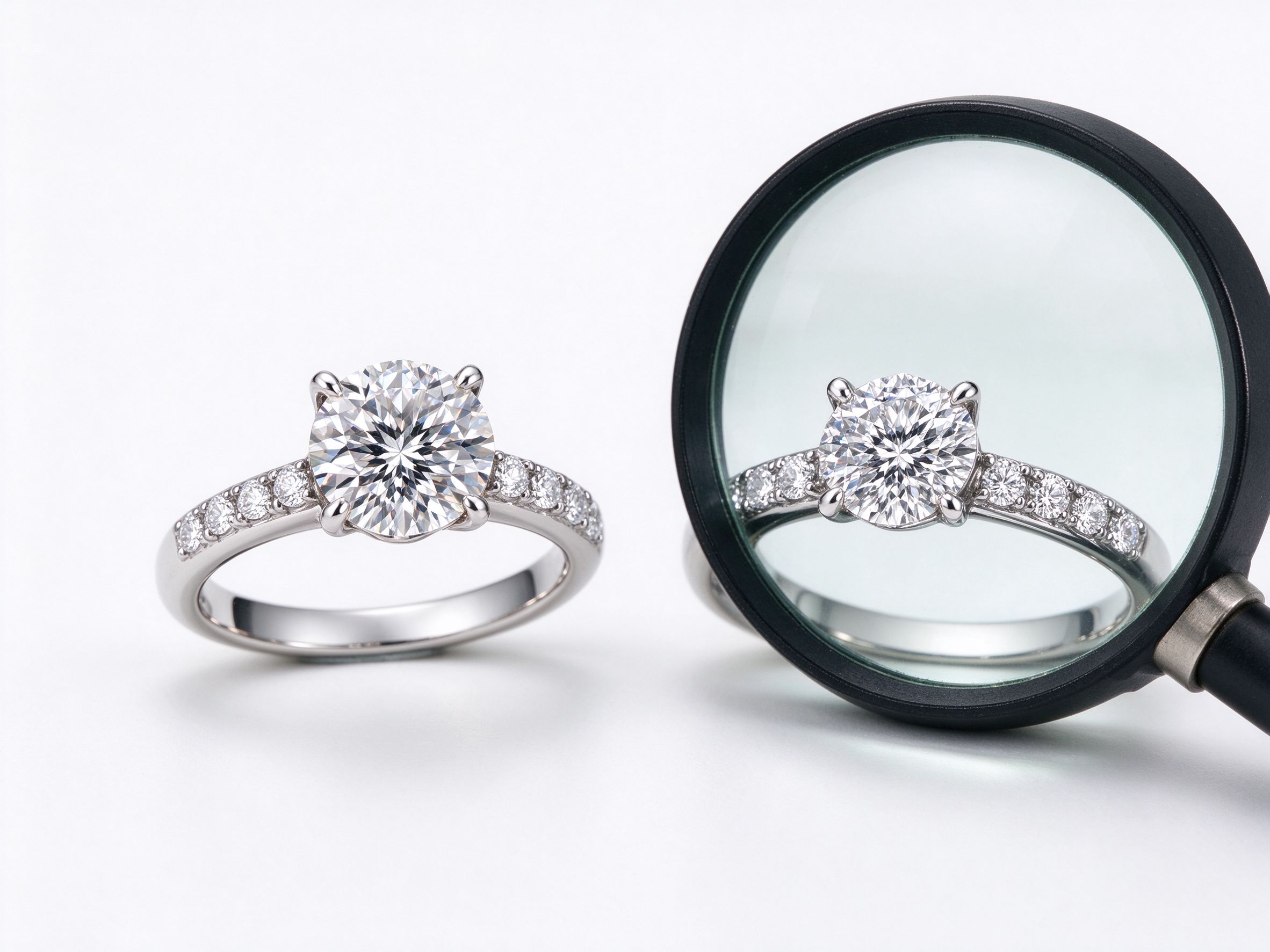
A precision-cut moissanite: high refractive index, non-porous, and scratch-resistant, the opposite of a soft, clouding cubic zirconia.
The Manufacturing Cost Difference
Where does the manufacturing cost actually go? Moissanite starts as a silicon carbide crystal grown in a high-temperature furnace at around 2,500 degrees Celsius, over days. The crystal growth is slow, energy-intensive, and requires controlled conditions, because silicon carbide is a hard material that forms at extreme heat. CZ is melted and cooled in a much simpler, faster process, because zirconium oxide melts at a lower temperature and solidifies into the cubic form quickly. The energy and time to grow a moissanite crystal are far higher than to melt a CZ boule, and that cost shows up in the stone price before cutting even begins.
After the crystal is grown, moissanite has to be cut and polished on diamond-impregnated equipment, because nothing else is hard enough to work it. CZ can be cut on standard equipment, because it is soft. The cutting time per moissanite stone is longer, the tool wear is higher, and the labor is more skilled. We cover the manufacturing economics in our guide on why moissanite is cheaper than a diamond, and the point is that moissanite is cheap relative to diamond but expensive relative to CZ, because the crystal growth and cutting are genuinely more involved. This is not a markup; it is the real cost of making a hard, durable, brilliant stone.
We also grade moissanite for color and clarity, because customers expect a consistent product. Each stone is examined under magnification, sorted by color grade, and paired with a certificate. CZ is not graded, because it is a commodity sold by the carat without individual grading. The grading and certification add cost to moissanite, but they also add value, because the buyer knows what they are getting. A moissanite stone with a certificate is a known quantity; a CZ stone in a tray is a gamble. This quality control is part of the price, and it is part of why moissanite is a better value: you are not guessing at the stone, you are buying a graded product.
The Long-Term Value: Cost Over Years
Now the value math. A CZ engagement ring in silver retails for about twenty to fifty dollars. It looks great for three to six months, then scratches and clouds, and within a year it looks tired. You replace it every year, spending thirty dollars a pop, and over ten years you spend three hundred dollars on ten CZ rings, each of which looked tired by the end of its year. A moissanite ring in silver retails for about one hundred and fifty to three hundred dollars. It looks great on day one, and it looks great on year ten, because it does not scratch and does not cloud. You buy it once, and over ten years you spend one hundred and fifty dollars on one ring, which still looks new. The moissanite ring is half the total cost, and it is beautiful the whole time.
This is the value difference, and it is the one we want every buyer to understand. CZ is cheaper on the sticker, but more expensive over time, because it wears out. Moissanite is more expensive on the sticker, but cheaper over time, because it lasts. We cover this explicitly in our guide on calculating cost per wear, and the math is decisive. A CZ ring worn daily for a year costs thirty dollars and looks bad by month twelve. A moissanite ring worn daily for ten years costs two hundred dollars and looks great the whole time. The per-wear cost of the moissanite is a fraction of the CZ, even though the upfront price is higher. That is the real value story, and it is why we build moissanite, not CZ.
For wholesale brands, this means moissanite is a better product to sell, not just a more expensive one. A CZ brand deals with returns, complaints, and repeat customers who keep coming back because their rings clouded. A moissanite brand deals with happy customers who wear the ring for years and recommend it to friends. We work with brands that sell both, and the moissanite line always has the lower return rate and the higher customer satisfaction, because the product lasts. The price gap is not a barrier; it is a promise, and the promise is that the ring will still look good in a decade. That is worth charging for, and customers are willing to pay it.
When CZ Still Makes Sense
We are not here to tell you CZ is worthless. It has its place. CZ is the right choice for a cheap fashion ring you will wear for one season and then discard, or for a costume piece for a photoshoot, or for a teenager's first jewelry that will probably be lost within a year. For these uses, spending thirty dollars on a disposable CZ ring makes sense, because you do not need it to last. We produce CZ for these customers too, and we are honest about what it is. The mistake is buying a CZ ring thinking it will be a lifelong engagement ring, because it will not. CZ is for short-term, disposable fashion; moissanite is for long-term, keep-forever jewelry.
The line is clear. If you will wear the ring for less than a year, buy CZ. If you will wear it for more than a year, buy moissanite. If it is an engagement ring, a wedding band, or a family piece, buy moissanite, because you want it to last. If it is a trend piece for a season, buy CZ, because you will not care when it clouds. This is the decision framework we give every customer, and it works. It keeps people from overspending on CZ for a lifelong ring, and it keeps people from underspending on a disposable piece that deserves a cheap stone.
For wholesale brands, this means carrying both lines, clearly labeled. A CZ fashion line for impulse buys, and a moissanite fine line for commitment pieces. We supply both, and we help brands position each one honestly. A customer who buys a thirty-dollar CZ ring for a holiday party is happy. A customer who buys a two-hundred-dollar moissanite ring for an engagement is happy. The unhappiness comes when someone buys a CZ engagement ring expecting it to last, and it clouds within a year. Honest labeling prevents that, and it is how we build trust in both materials.
Conclusion: The Price Gap Is Honest
When you look at the whole picture, the price gap between moissanite and cubic zirconia stops looking like a marketing premium and starts looking like an honest reflection of two different products. CZ is a soft, porous, disposable stone, melted quickly and cut cheaply, designed for short fashion lives. Moissanite is a hard, dense, brilliant crystal, grown at extreme heat and cut with diamond tools, designed to last for decades. The sticker price is higher, but the cost per year of wearing is lower, and the result looks better the whole time. We make both, and we are happy to supply either, but we will always tell a customer who wants an engagement ring to buy moissanite, because we know what CZ looks like after a year, and we would not wish that on a real commitment piece.
Frequently Asked Questions
Why is moissanite so much more expensive than cubic zirconia?
Because moissanite is a hard, durable, non-porous stone that lasts for decades, while cubic zirconia is soft, scratches easily, and clouds within a year. The manufacturing cost is also higher: moissanite requires high-temperature crystal growth and diamond-tool cutting, while CZ is melted quickly and cut on cheap equipment. The price gap reflects a real difference in materials and lifespan.
Can you tell CZ and moissanite apart by eye?
In a photo, often not. In person, under good light, yes. Moissanite has higher refractive index and dispersion, so it sparkles more and shows more color fire. CZ looks flatter, glassier, and duller. Over time, the difference becomes obvious, as CZ scratches and clouds while moissanite stays bright.
Is cubic zirconia a bad choice?
No, it is a choice for a different use. CZ is fine for cheap fashion jewelry you will wear for a season and discard. It is a bad choice for an engagement ring or a piece you want to keep, because it will scratch and cloud within a year. Match the stone to the intended lifespan, and you will be happy with either.
Which is better value over time?
Moissanite, by a wide margin. A CZ ring replaced every year costs more over a decade than a single moissanite ring bought once. Moissanite also stays brilliant the whole time, while CZ looks tired within months. On a cost-per-wear basis, moissanite is the cheaper option, despite the higher sticker price.
Choose the Stone That Lasts
We cut and set both moissanite and cubic zirconia, and we will tell you honestly which one fits your order. If you are building a fashion line for cheap, disposable pieces, CZ is the right material. If you are building a fine jewelry line meant to last for years, moissanite is the right one, and the price gap is justified by the difference in material and life. Contact us at service@holycome.com with your product idea, and we will quote you on the right stone for the job. We are a factory, so we know the real cost, and we will price you honestly. Choose the stone that fits the wearing time, and you will never overpay.