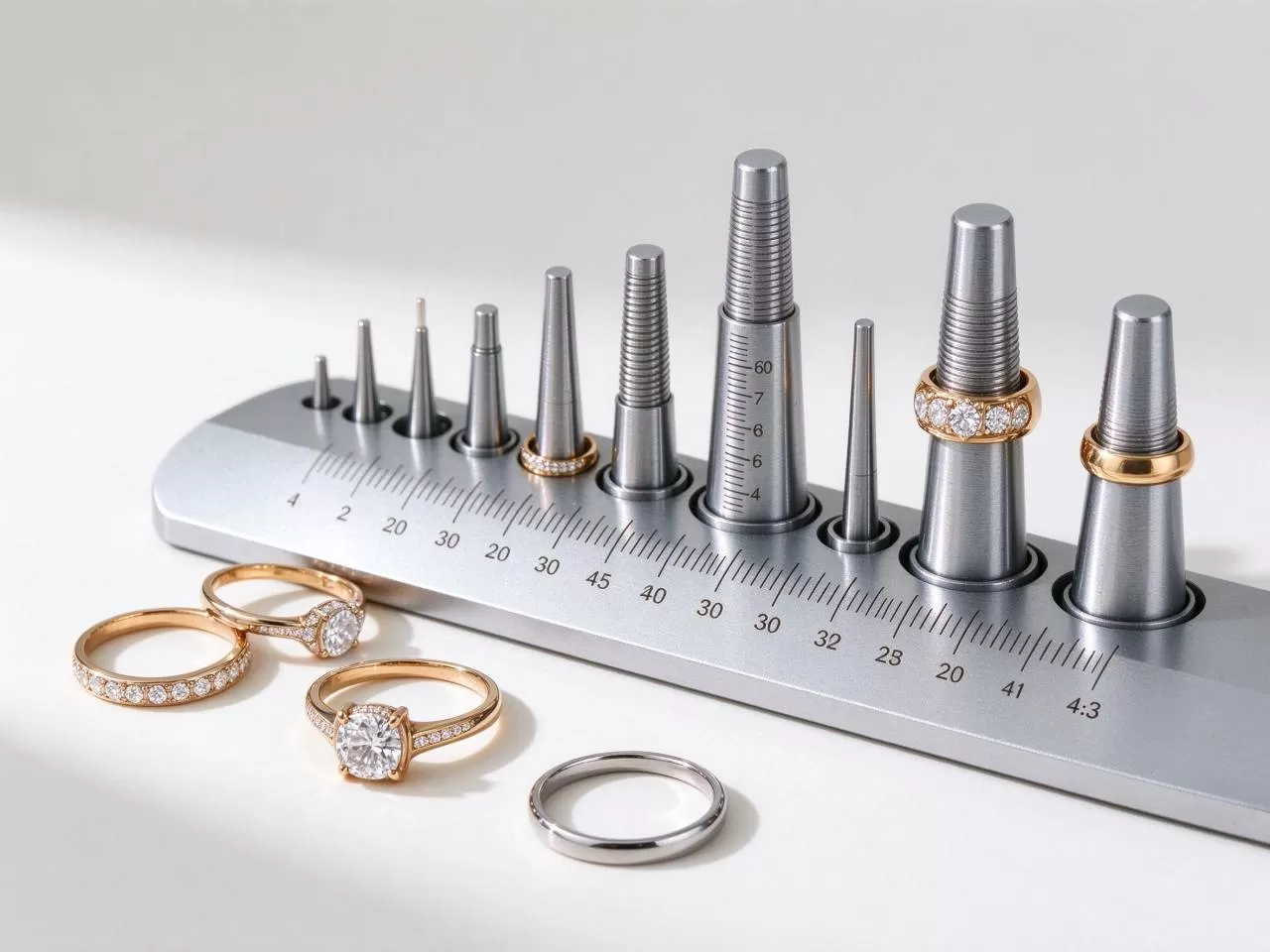
01Why size spread decides your sell-through before design does
I have watched a lot of buyer catalogs come across my QC bench. The designs are usually fine. What sinks the reorder is the size curve behind the design. You can carry the prettiest tennis bracelet in the market, but if it only ships in 7 inch, half your customers cannot wear it and the other half will not pay a premium for a length they have to resize.
In other jewelry wholesale, size coverage is not a detail you fix at the end. It is the first decision, because it sets your MOQ math, your display space and your return rate. I am going to walk you through what moves in the sizes and what just sits there, based on what we actually cut and ship from our line every week.
02The four size categories that behave completely differently
Not all size coverage is equal. Treat these as four separate buying problems, because they have four separate demand curves.
- Rings: the widest spread and the highest risk. A 5 to 9 run covers most US retail, but the tails matter more than buyers expect.
- Bracelets and bangles: length is the whole product. 6.5 to 8 inch is the working range, and 7 inch is the volume anchor.
- Chains and necklaces: 16, 18, 20 and 24 inch are the four that earn their slot; anything between 20 and 24 is usually dead weight.
- Earrings and body jewelry: gauge and post length, not diameter, drive repeat orders.
Each one needs its own line on your purchase order. Blend them into one "assorted sizes" SKU and you will never learn which curve is working.
Not all size coverage is equal. Treat these as four separate buying problems, because they have four separate demand curves.
03Rings: where the curve is fat and where it thins out
US size 7 is the statistical center of mass, and size 6 through 8 is where roughly two thirds of your units will land. That is not an opinion, that is what our packing sheets show quarter after quarter. So build the core first: 6, 7, 8 at full depth.
Then look at the edges. Size 5 and size 9 sell, but slowly, and they sell in singles rather than pairs. Size 4 and size 10 are specialty stock. Carry them if you have a customer base that skews petite or plus, otherwise let a made-to-order path handle them.
Half sizes and the resize problem
Half sizes are where wholesale buyers get stuck. A 7.5 does not sit on a shelf next to a 7 and sell itself; it needs a reason to exist. My advice is to skip half sizes in stock and offer them as custom, because a customer who needs a 7.5 will happily wait 12 to 18 days for a correct fit. That is cheaper for you than carrying a size that turns over twice a year.
One more thing about rings: width changes fit. A 3mm band in size 7 and a 6mm band in size 7 do not feel the same on the finger. If your assortment mixes widths, note the width on the size chart or you will field sizing complaints that are really width complaints.
04Bracelets: length is the product, clasp is the fit
For other jewelry wholesale, bracelets are the category where size mistakes cost the most, because a bracelet that does not fit is not adjustable by the wearer. The volume anchor is 7 inch. Below that, 6.5 inch serves a real petite segment. Above it, 8 inch is the men's and plus-size workhorse.
What sits? 7.25 and 7.75. Buyers order them thinking they are filling a gap, and then they sit. If you want coverage between 7 and 8, use an extender chain instead of a new SKU. Adjustable is a size, and it sells better than a fixed odd length.
Cuffs, bangles and the no-clasp problem
Bangles and cuffs are sized by inner diameter, and that number is not intuitive for retail customers. A 60mm bangle and a 65mm bangle look identical in a photo. Put the diameter in millimeters on the tag, and you cut returns. For cuffs, an opening of about 25 to 30mm covers most wrists; narrower openings look elegant and then do not go on.
Half the sizing complaints I see are not sizing at all. They are a missing number on a hang tag.
05Chains and necklaces: four lengths, no more
Chains are simpler than rings and bracelets because the market has already agreed on the lengths. 16 inch is the choker and layering staple. 18 inch is the single best-selling necklace length in the US and EU. 20 inch is the men's and layered default. 24 inch is the statement length.
Lengths at 17, 19, 21 and 22 inch exist, and some buyers love them, but they do not earn shelf space in a wholesale assortment. They fragment your stock and confuse the customer standing at a display. Pick four, go deep, and add a 2 inch extender if you want flexibility.
Chain width and the fit illusion
A 1mm box chain at 18 inch and a 3mm curb at 18 inch are the same length and completely different products. Width drives perceived value far more than length does. When you build a chain program, vary width across your price tiers and keep length constant. That way your size coverage stays simple and your price ladder stays clear.
06Earrings and body jewelry: gauge and post length
Earrings look like a size-free category until you get into body jewelry. There, gauge and post length are the entire fit question. Standard lobe posts run about 0.8 to 0.9mm (roughly 20G), and 18G is the common step up for comfort and durability.
For cartilage, helix and nostril pieces, 18G and 16G dominate, and post length of 6mm to 8mm covers most piercings. Flat-back labrets in 16G with a 6mm post are a strong stock item because they suit both new and healed piercings. Threadless and internally threaded styles cost more but reduce irritation complaints, which protects your reviews.
Huggies and small hoops are sized by inner diameter. 8mm to 12mm is the sellable band; 6mm is for second and third holes; anything over 15mm starts to read as a statement hoop and moves slower.
07A working stock matrix for a first order
Here is how I would lay out a starter size spread if a buyer asked me to build one from scratch. These are unit ratios, not absolute quantities, so scale them to your budget.
| Category | Core sizes | Ratio | Edge sizes | Ratio |
|---|---|---|---|---|
| Rings | 6, 7, 8 | 70% | 5, 9 | 30% |
| Bracelets | 7 inch | 60% | 6.5, 8 inch | 40% |
| Necklaces | 18, 20 inch | 65% | 16, 24 inch | 35% |
| Body jewelry | 16G, 6mm post | 55% | 18G, 8mm post | 45% |
Notice that the core always takes the majority. Buyers who invert that ratio, loading up on unusual sizes because they feel distinctive, end up with a beautiful assortment and a slow inventory turn.
08How we handle size coverage on the factory side
We keep stock sizes on the shelf for immediate pick: MOQ 1 pc on stock items, so you can test a size curve without committing to a full run. Custom sizing and custom widths run at MOQ 30 pcs per size combination, with 12 to 18 day production.
Every order goes through three QC stages: incoming stone check, in-process inspection during setting and polishing, and a pre-ship AQL sample pull. Stones ship with GRA and IGI certificates where applicable. Payment is T/T 30% deposit with balance before shipment, or PayPal for samples. DDP delivery runs 5 to 8 days to US and EU addresses.
Our cost, speed and yield run about 20% better than typical trading companies, and the reason is boring: we cut and set in-house, so there is no middle layer adding margin and no reseller adding a week of handling time to your size run.
09Frequently Asked Questions
What is the minimum order if I only want to test a few ring sizes?
Stock sizes ship at MOQ 1 pc per size, so you can order a small curve and see what moves. Custom sizes or non-stock widths go to MOQ 30 pcs per size combination, with 12 to 18 day production. Pricing is quoted per piece and scales with stone grade and metal choice.
How long does a custom size run take, and how is it priced?
Custom sizing runs 12 to 18 days from artwork approval and deposit, and price is quoted per piece based on the 925 silver or gold setting plus stone grade. T/T 30% deposit starts the run, and PayPal is available if you want a sample first. DDP delivery adds 5 to 8 days.
Can you ship mixed sizes in one carton for other jewelry wholesale orders?
Yes. We pack by SKU and size with individual labels, so a mixed carton is normal for us. Send your size matrix and we will confirm stock availability per size before you commit, usually within one business day.
Send your size matrix or a photo of the styles you are considering to service@holycome.com or WhatsApp +86 133 7744 7107, and I will come back with a quote, stock availability per size, and a sample plan you can test before you commit to a full run.