
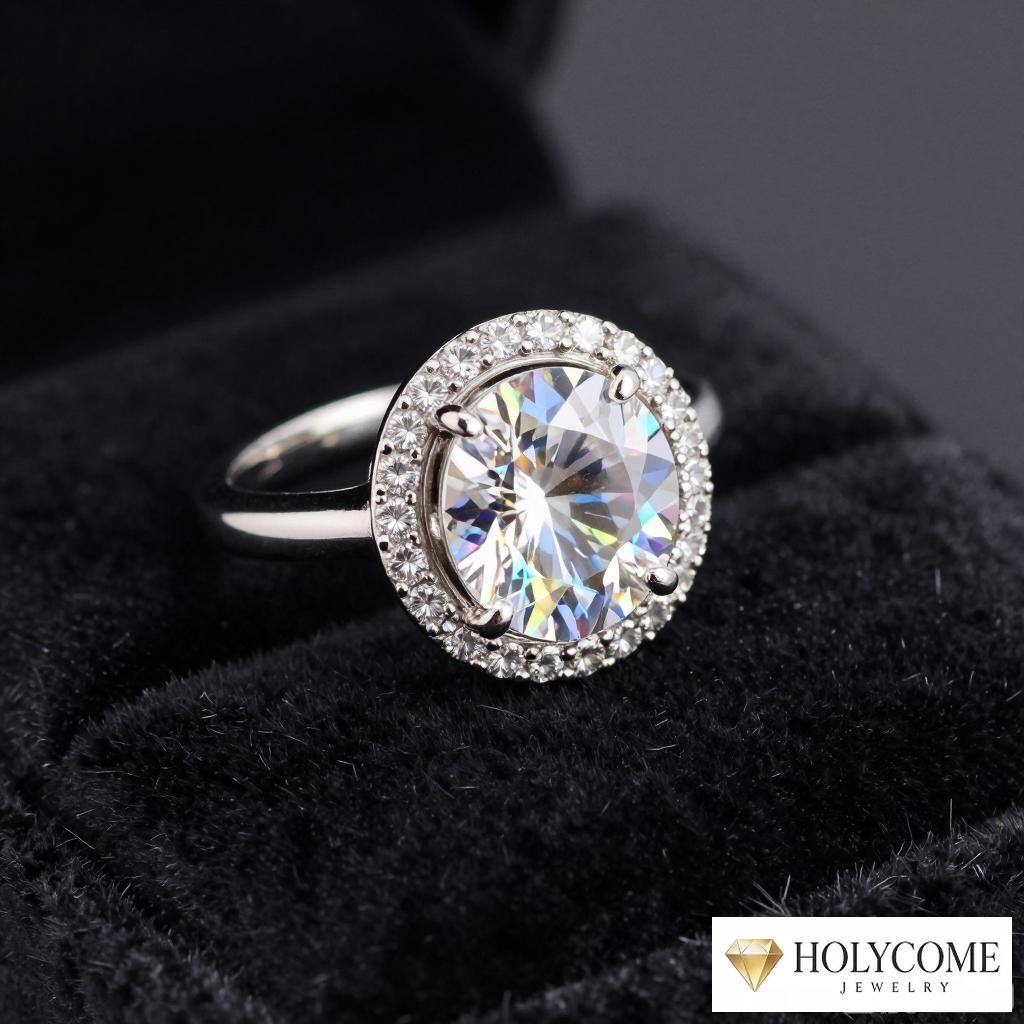
Halo settings have been the fastest-growing engagement ring silhouette for over a decade, and moissanite halo rings take that trend to a natural conclusion. A halo ring surrounds the center stone with a ring of small melee stones, creating a frame that makes the center appear larger, adds an extra layer of sparkle, and covers more surface area on the finger for a bolder look. Paired with moissanite—which out-sparkles diamond per carat and costs a fraction per stone—the halo design delivers dramatic visual presence at a price point that has made it a top-seller for moissanite brands worldwide.
At HOLYCOME, halo designs make up 28% of our finished moissanite engagement ring production, second only to solitaires, and demand continues to grow as customers discover how much sparkle a halo can deliver at accessible price points. This guide covers the design variations, production considerations, quality standards, and ordering details that jewelry brands need to build a successful moissanite halo ring line.
01What Makes a Halo Setting Work for Moissanite
The halo design does three things particularly well with moissanite. First, the melee frame creates an optical illusion that makes the center stone look 1–2mm larger than its actual size. A 6.5mm (1ct) center surrounded by a 1.5mm halo visually reads closer to 8mm (2ct) on the finger—a difference that would cost thousands extra in a larger center stone. That visual magnification is one of the biggest reasons customers choose halos, and it works even better with moissanite because the melee stones deliver the same fire as the center, creating a unified field of sparkle rather than a visible contrast between center and accents.
Second, halos add sparkle area. A solitaire sparkle comes from one stone; a halo delivers sparkle from the center plus 20–40 melee stones around it, and in most cases additional melee down the band as well. That extra surface area of faceted gem creates more light return overall, and under direct sunlight the effect is spectacular—exactly the bold, eye-catching look many moissanite customers actively want.
Third, halos protect the center stone. The metal rim holding the melee sits slightly higher than the center stone's girdle, creating a buffer that absorbs knocks from the side instead of the impact hitting the center stone's girdle edge. This subtle protective effect reduces chipping risk, especially for fancy-shape centers with corners.
| Halo Variation | Melee Count (typical 1ct center) | Visual Character | Best For |
|---|---|---|---|
| Classic single halo | 28–36 melee stones | Center looks ~20% larger; balanced sparkle | Core bridal collection, all customer types |
| Double halo | 50–65 melee stones | Dramatic oversized look; maximum sparkle | Statement pieces, customers wanting big look |
| Hidden halo | 20–24 melee set under the head, visible from side | Clean face-up look with sparkle from profile | Modern minimalist customers who like subtle details |
| Petite / micro halo | 20–26 smaller 1.0–1.2mm melee | Delicate frame that doesn't overpower center | Vintage-inspired and dainty collections |
| Floating halo | 28–34 melee set slightly offset from center | Center appears to "float" within a ring of light | Contemporary designs, modern bridal |
| Halo with pavé band | 30–40 halo + 30–60 band melee | Maximum sparkle from every angle; maximum coverage | High-sparkle collections, statement bridal |
The halo design as we know it today was popularized in the Art Deco period of the 1920s and 1930s, but the modern micro-pavé halo exploded in popularity around 2010 and has remained a bridal staple ever since. Wikipedia's engagement ring history notes that halo settings consistently rank among the top three bridal styles in North American markets across gemstone types. For moissanite specifically, the halo's popularity has grown even faster because of how well the material's high fire complements the multi-stone sparkle of the design.
02Design Variations in Moissanite Halo Rings
A "halo ring" is not one design—it is a category that includes everything from delicate single-halo solitaires to dramatic double-halo statement pieces. Offering the right mix of halo variations covers a wide range of customer aesthetics.
Center Stone Shapes
While round center stones remain the most popular choice for halos, fancy-shape halos are a major growth category for moissanite. Cushion cut centers with cushion halos (a halo that follows the cushion outline rather than being round) are the most popular fancy-shape halo, followed by oval centers (which look dramatically larger with a halo because of their elongated spread), pear, and radiant cuts. Princess cut centers with square halos also sell well for modern geometric collections.
One design rule worth following: the halo shape should match the center shape for a cohesive look. A round halo around a cushion center looks awkward and misaligned; a cushion-cut halo around a cushion center creates a clean, intentional frame. This sounds obvious, but some budget suppliers use round halos for all shapes to reduce SKU count, and the result looks visibly off.
Melee Size and Quality Matching
Melee size in the halo dramatically changes the look. Standard halos use 1.3–1.5mm diameter melee; petite micro-halos use 1.0–1.2mm melee for a delicate frame; larger statement halos use 1.7–2.0mm melee for a more prominent border. The most common mistake brands make when sourcing halo rings is under-specifying melee quality. A D-VVS1 center surrounded by H-I clarity melee shows visible color difference in direct sunlight, and that mismatch cheapens the entire piece.
HOLYCOME's standard specification for halo melee is F color or better, VVS2 clarity minimum for white gold and platinum pieces. For yellow and rose gold, G-H melee is acceptable because the warm metal masks color differences. For premium collections, matching melee exactly to center color (within half a grade) eliminates any risk of visible mismatch, and the small material premium pays for itself in reduced customer returns.
Band Styles
Halo rings pair with a wide range of band styles. Plain polished bands keep focus on the halo head and create a clean, classic look. Pavé bands (melee set all the way down the shank) extend the sparkle to the entire ring and are the highest-selling halo band style overall. Split shank bands (where the band divides as it approaches the head) add visual complexity and a vintage feel. Twisted and vine bands add romantic detailing for vintage-inspired collections. For stackability, a thin straight band allows a standard wedding band to sit flush against the engagement ring; pavé bands with low settings often require a contour wedding band for a no-gap fit.
Double Halos and Hidden Halos
Double halos add a second outer ring of melee for extreme visual size and sparkle, but they divide customers—some love the bold look, others find it too much. We recommend offering one double halo SKU in a collection as a statement option without making it the core of the line. Hidden halos (melee set into the side of the head, visible only from the profile or when tilted) have grown steadily in popularity since 2022. They deliver a "secret sparkle" detail that appeals to customers who prefer a clean face-up look but appreciate subtle sparkle visible to the wearer. Hidden halos add 15–20% to production cost with no visible change from the top, which means you can offer them as a premium upsell.
A "halo ring" is not one design—it is a category that includes everything from delicate single-halo solitaires to dramatic double-halo statement pieces. Offering the right mix of halo variations covers a wide range of customer aesthetics.
03Production and Manufacturing Standards
Halo rings are more complex to manufacture than solitaires because they involve setting dozens of small melee stones, and quality differences between suppliers show up immediately in the finished product. Loose melee, uneven spacing, and mis-matched stone sizes are the most common defects in cheaply made halo rings.
Setting Quality Standards
- Melee seating: Every melee stone is individually seated in a drilled seat (not just glued into a channel), secured with tiny prongs or beads, and burnished flush with the metal surface. We never use bead-setting techniques that leave stones loose after a few months of wear.
- Spacing and alignment: Melee stones are evenly spaced with consistent gaps between girdles of less than 0.1mm; misaligned stones are reset during QC. Visible gaps or crooked melee are automatic rejection criteria.
- Halo frame construction: The halo rim is cast or milled as a single piece with the head (not soldered on afterward), which prevents the halo from coming loose or warping with wear.
- Center stone security: Center stones in halo settings are held with 4 or 6 prongs inside the halo frame, with the prongs sized and positioned so they do not cover any melee stones.
- Metal thickness: Minimum 1.2mm shank wall thickness; pavé sections are reinforced to prevent bending despite the material removed for stone seats.
Melee Quality Control
Consistent melee quality is the single most important factor in a high-quality halo ring. Even one dark or obviously included stone in a halo of 36 stones catches the eye and looks like a defect. HOLYCOME sorts melee through a dedicated process for halo production:
- Melee is sorted to within 0.02mm diameter tolerance (tighter than the 0.05mm standard for other uses) to ensure even spacing
- Color-matched to within half a grade across all melee in a single ring
- Clarity sorted to VVS2 minimum for white gold/platinum; every stone examined under 10x loupe for visible dark inclusions
- Pre-polished before setting (melee cannot be effectively polished after being set into the halo)
Melee defect rates on our finished halo rings average under 0.3% per ring (fewer than one stone per 333 melee has any visible defect post-setting), which means most rings ship with perfectly matched melee out of the box.
MOQ, Lead Times, and Wholesale Pricing
- In-stock halo designs: 5 pieces per SKU MOQ; 15–20 days for silver, 18–25 days for 14k/18k gold
- Custom halo designs: 30 pieces per SKU MOQ; 35–50 days from CAD approval to bulk delivery; one-time tooling fees $300–$800 depending on complexity
- Stone specification default: D-VVS1 center stone, F-VVS2 melee, Excellent cut; upgrade to H&A cut for premium collections
- Wholesale pricing (finished 14k white gold classic halo, 1ct center with pavé band): $280–$380 per piece in quantity, depending on melee count and band complexity
- Sizes: US 3–12 in half sizes, with quarter sizes available on request; size 8+ pieces use slightly heavier shanks for structural integrity
- Pass rate: 98.7% of finished halo rings pass final QC (slightly lower than solitaires due to melee complexity; rejected rings are reworked before shipping)
04FAQ: Moissanite Halo Rings
Do melee stones fall out of halo rings easily?
Well-made halo rings with properly burnished prong/bead settings do not lose melee stones under normal wear. The cheap halo rings that develop missing stones typically use glued settings or poorly cut seats that leave stones loose from day one. HOLYCOME halo rings have a melee loss rate of under 0.4% of pieces over five years of wear based on our brand partners' warranty data, and any stones that come loose within the warranty period are replaced free of charge.
Can you resize a moissanite halo ring?
Halo rings with pavé bands can be resized up or down by about one size without major issues, but resizing more than 1.5 sizes risks disturbing pavé melee on the band—particularly on the side being adjusted. We recommend ordering accurate half sizes for bridal customers to avoid post-sale resizing complications. For customers needing non-standard sizes, custom production to exact size is available with no added lead time for most designs.
Does a halo make the center stone look larger?
Yes—typically by about 20% visually, which means a 6.5mm (1ct) center with a halo looks closer to 7.5–8mm (1.5–2ct) face-up. This is one of the core reasons customers choose halos: they get the visual presence of a much larger center stone for a fraction of the cost.
Can halo rings be worn every day without damage?
Yes, with common-sense care. Moissanite itself handles daily wear beautifully at 9.25 Mohs, and the halo rim provides extra protection to the center stone. We recommend customers remove rings for heavy lifting, weight training, or aggressive cleaning with abrasives, but normal daily wear—office work, washing dishes, showering—does not damage halo rings.
How do you clean a moissanite halo ring to keep it sparkling?
Warm water, mild dish soap, and a soft baby toothbrush are all you need. Gently brush around the back of the halo and under the center stone, where soap residue and skin oils accumulate. Ultrasonic cleaners are safe for moissanite and solid gold settings, but avoid steam cleaning on pieces with heavy melee or when rhodium plating is due for refresh. Professional cleaning once a year by a jeweler includes checking all prongs and tightening any loose melee.
05Merchandising Your Halo Collection
Halo rings convert best when customers can see the extra sparkle. Product video showing the ring rotating in natural daylight is even more important for halos than for solitaires, because the way the melee catches light across the entire ring face is the core selling point. We also recommend offering a side-by-side photo of the same size center in solitaire vs. halo to show the visual size difference—that image is one of the highest-converting visuals on our top partners' product pages.
For your core halo SKU, offer the classic single-halo pavé band in round center first—it is the best-selling halo design by a wide margin. Add cushion, oval, and hidden halo SKUs as secondary options, and offer one double halo as a statement piece for customers who want maximum presence.
Browse our full moissanite rings catalog for available halo designs in stock, or contact us via our custom OEM page to develop proprietary halo designs exclusive to your brand. Pair halo engagement rings with matching moissanite tennis bracelets and stud earrings for coordinated bridal sets that increase average order value.
Moissanite halo rings deliver a level of sparkle and visual size that would cost thousands more in diamond, making them one of the most compelling value propositions in bridal jewelry. The key to a quality halo ring is in the melee: well-matched, precisely set, evenly spaced small stones are what separate a premium halo from a cheap-looking piece. Working with a manufacturer that sorts melee to tight color and size tolerances, individually seats every stone, and inspects every ring after setting gives you halo rings that hold up to daily wear, keep their sparkle, and generate the kind of customer reviews that drive repeat business.
06Frequently Asked Questions
Is moissanite a viable diamond alternative for retail?
Yes for price-sensitive buyers who want brilliance and hardness. It ranks 9.25 on the Mohs scale and costs a fraction of a natural diamond of the same size, so it turns fast in bridal and fashion lines.
What is the minimum order?
MOQ starts at 50 pieces per design for stock items; custom cuts and private-label settings start at 100 to 300 pieces.
Are certificates included?
Yes. Every parcel ships with GRA or IGI documentation listing carat weight, color grade and cut.
What are the lead times?
Samples 3 to 5 days. Bulk 15 to 20 days under 500 pieces, 25 to 30 days for custom work.