
Clarity is one of the 4 Cs that defines gemstone quality, and moissanite clarity works a bit differently than diamond clarity thanks to how the material is grown. Unlike natural diamonds, which form deep underground with random mineral inclusions trapped during formation, lab-created moissanite grows in controlled conditions that produce far fewer internal characteristics. That difference changes the calculus for buyers—paying a premium for the absolute highest clarity grade in moissanite does not always buy you a visibly better stone, and brands that overspend on clarity end up with unnecessarily high material costs with no customer-facing benefit.
At HOLYCOME, every moissanite we cut goes through clarity grading at 10x magnification by trained gemologists following standards adapted from GIA diamond clarity grading. We sort more than 50,000 carats per month into clarity grades, and our data gives a clear picture of which grades deliver visible quality differences to customers and which grades only matter for lab reports.
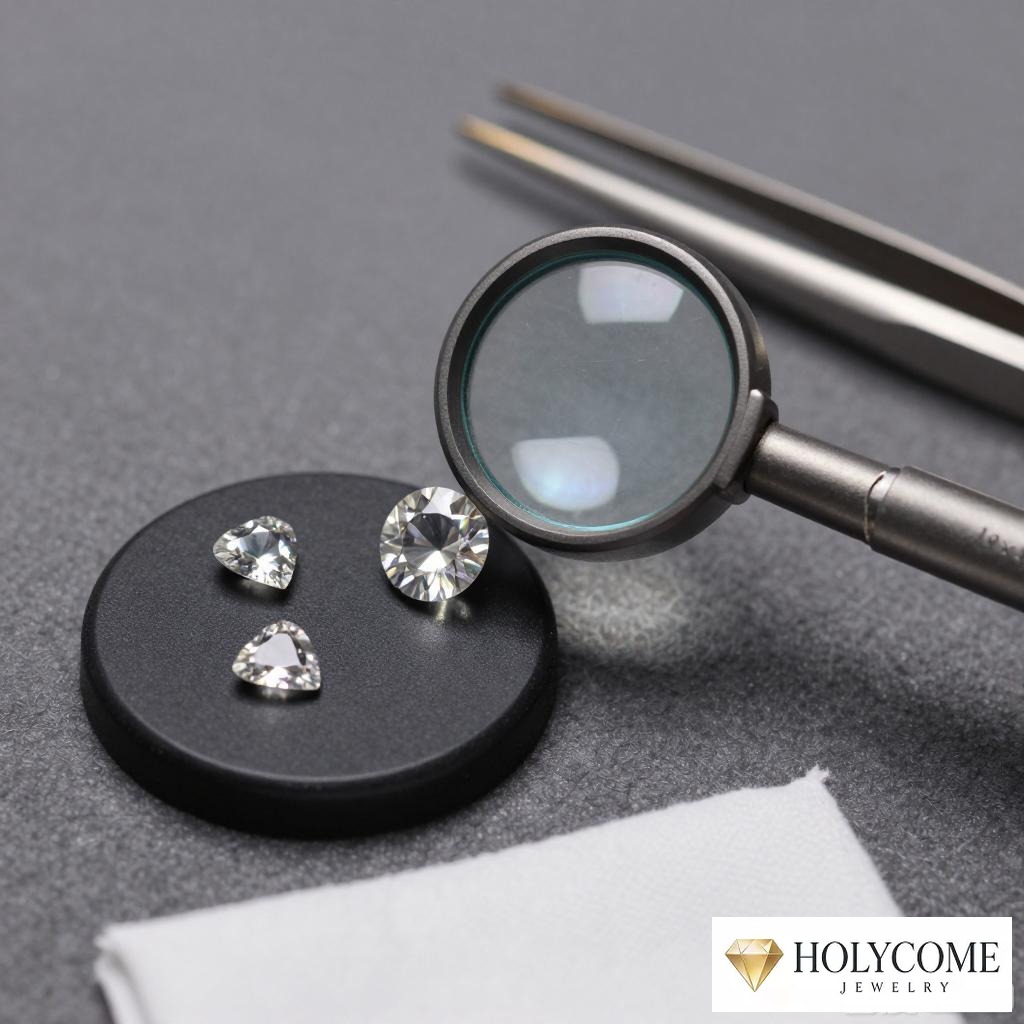
01How Moissanite Clarity Grades Work
Moissanite clarity uses the same grade categories as diamond clarity—FL, IF, VVS1, VVS2, VS1, VS2, SI1, SI2, I1, I2, I3—but the distribution is completely different. Because moissanite is grown in a lab rather than mined, almost all commercial-grade moissanite falls in the VVS to VS range. Inclusions severe enough to land a stone in SI or I grades are rare, and stones in those grades are typically removed during production rather than sold. The table below shows the typical grade distribution from our production runs and what each grade means visually.
| Clarity Grade | Inclusions at 10x | Visible to Naked Eye | Share of HOLYCOME Production | Typical Use |
|---|---|---|---|---|
| FL / IF (Flawless / Internally Flawless) | None whatsoever | No | ~2% | Collector pieces, high jewelry, certificate stones |
| VVS1 (Very Very Slightly Included 1) | Extremely tiny pinpoint or needle inclusions; extremely difficult for trained grader to locate | No | ~45% | Premium bridal, large center stones, solitaire rings |
| VVS2 | Minute pinpoint/needle/feather inclusions; difficult for grader to locate | No | ~35% | Mid-to-premium bridal, standard production grade |
| VS1 (Very Slightly Included 1) | Minor inclusions visible with effort at 10x; typically small crystals or clouds | No | ~14% | Side stones, melee, fashion jewelry |
| VS2 | Minor inclusions somewhat easily visible at 10x | Rarely in large stones over 8mm | ~3.5% | Budget lines, small melee, yellow gold settings |
| SI1 and below | Obvious inclusions at 10x | Yes in stones over 4mm | ~0.5% | Not sold as jewelry grade; recycled into industrial material |
Compare that distribution to natural diamonds, where only about 5% of mined production grades VS1 or better and the bulk of commercial jewelry uses SI grades, and you see one of moissanite's core advantages: the baseline clarity is already extremely high. Over 96% of our production is VVS or better, meaning inclusions are not visible to the naked eye even to people with trained vision. For comparison, GIA's diamond clarity guide notes that SI-clarity diamonds make up the majority of commercial diamond jewelry, where inclusions may be visible with effort to the naked eye.
Types of Inclusions in Lab-Grown Moissanite
Because moissanite is synthetic, its inclusions look different from natural diamond inclusions. You will not see the mineral crystals, natural feathers, or garnet inclusions common in mined diamonds. The characteristics that do appear are growth-related features from the crystal manufacturing process:
- Pinpoints: Tiny white or black dot-like inclusions, usually micro-voids or silicon metal droplets trapped during crystal growth. The most common inclusion type in VVS-grade moissanite, and invisible to the naked eye.
- Needles: Thin, hair-like growth lines running through the crystal. Extremely rare in well-controlled modern production; visible under 10x if present.
- Clouds: Groups of extremely tiny pinpoints clustered together, creating a hazy area. Visible at 10x if large, almost never visible to the naked eye in VVS and VS grades.
- Growth tubes: Hollow tubes running parallel to the crystal growth axis. Extremely rare in modern production; stones with these are sorted out of jewelry grades.
- Polish marks: Surface scratches or drag marks from the polishing process, not internal inclusions. These are removed during our final polish QC step and never appear on shipped stones.
Why "Eye Clean" Is What Actually Matters
For 99% of retail customers, the only clarity distinction that matters is whether any inclusions are visible to the naked eye at normal viewing distance (about 30–40cm, under typical indoor lighting). Any stone that looks completely clean in that scenario delivers the same visual experience regardless of whether it grades VVS1 or VS1 under a microscope. That means paying extra for FL/IF or even VVS1 vs VVS2 rarely delivers a perceptible difference to the end customer.
The exception is large center stones. As carat size increases, the table area grows, and inclusions become potentially visible to the naked eye at lower clarity grades. For stones over 8mm (roughly 2ct equivalent), VS-grade stones can occasionally show faint clouding or a pinpoint visible in certain lighting if you are looking for it. For stones under 6.5mm (1ct equivalent), VVS and VS grades are completely indistinguishable without a loupe.
02Choosing the Right Clarity Grade for Your Line
Over-specifying clarity wastes margin; under-specifying risks visible inclusions in large stones. Here is how we recommend approaching clarity grade selection across different product types.
Engagement Ring Center Stones (6.5mm+ / 1ct+)
For solitaire and halo engagement rings where the center stone is the focal point, VVS1 is our recommended default. At VVS1, there is zero risk of any visible inclusion to the naked eye even in 12–15mm stones, and customers paying bridal-level prices expect a "clean" looking stone. The price premium for VVS1 over VVS2 is modest (about 5–8% per carat), and it eliminates any risk of a customer noticing a tiny inclusion under bright sunlight or LED lighting. IF/FL stones are available but carry a 30–40% premium over VVS1 with no visible difference, so they only make sense for ultra-high-end pieces or collectors who will receive a grading certificate.
Side Stones and Melee (under 3mm)
For small accent stones in halos, pavé bands, and side-stone rings, VS1 clarity is more than sufficient. Inclusions in sub-3mm stones are completely invisible to the naked eye even with deliberate inspection, and the savings compared to VVS melee run 15–20% on material cost. The only caveat: if you are setting VVS1 center stones, match the melee to at least VVS2. A VS melee stone will not show its inclusions, but mixing grades does not create a visual problem—the savings are real with no downside.
Fashion Jewelry and Everyday Pieces
For stackable bands, stud earrings, pendants, and fashion rings not positioned as "bridal," VVS2 or even VS1 works perfectly. Customers buying fashion pieces are generally not inspecting stones under loupes, and the price difference lets you hit lower retail price points while still delivering stones that are completely eye-clean.
Step Cuts (Emerald, Asscher)
Step cuts have large, open tables that act like windows into the stone, making inclusions more visible than they would be in a brilliant cut of the same clarity grade. For emerald and Asscher cuts over 5mm, we recommend VVS1 minimum. In brilliant cuts, the faceting pattern breaks up light and hides inclusions; step cuts do not, so a VS1 emerald cut may show inclusions that would be invisible in a VS1 round.
Over-specifying clarity wastes margin; under-specifying risks visible inclusions in large stones. Here is how we recommend approaching clarity grade selection across different product types.
03Factory Clarity Grading and Quality Control
Consistent clarity grading requires trained graders, standardized lighting, and clear master stones for comparison. At HOLYCOME, our clarity grading process follows a strict protocol to ensure consistency across graders and production batches.
Grading Protocol
Every stone goes through clarity grading after final polishing and before color sorting. Graders work in a dedicated darkroom with 6500K daylight-equivalent grading lamps, using 10x triplet loupes and stereo microscopes. Each stone is examined table-up, table-down, and through the pavilion and crown sides. Graders document the type, position, size, and number of inclusions, then assign a clarity grade using our master comparison stone set. Stones over 5mm receive a second grading pass from a senior grader to confirm accuracy.
Clarity Enhancement: What Buyers Should Know
Unlike natural diamonds (which are commonly fracture-filled or laser-drilled to improve apparent clarity), moissanite almost never requires clarity treatment because the material grows with so few inclusions in the first place. Some low-cost suppliers do use laser drilling to remove dark pinpoint inclusions in VS-SI grade stones, but we do not perform or sell clarity-enhanced moissanite at HOLYCOME. Any stone that would require enhancement to reach VVS grade is simply sorted out of jewelry production and recycled into industrial silicon carbide material.
Buyers should be aware of a different issue: some suppliers sell white-coated or "clarity-enhanced" moissanite that is actually lower-clarity material with a surface filler applied to hide surface-reaching inclusions. These coatings can wear off after cleaning or repair work, revealing inclusions that were previously hidden. We never use coatings or fillers of any kind on our stones, and every parcel ships with a written disclosure of any treatments applied (none, for all our standard colorless lines).
Production Specifications for Clarity-Graded Moissanite
- Available grades: IF, VVS1, VVS2, VS1 (FL and VS2/SI available on special request)
- Default grade for wholesale: VVS1 for center stones, VVS2 for melee/accents unless otherwise specified
- Grading accuracy: Inter-grader agreement rate of 97% within one grade; senior grader confirmation on all VVS2/VS1 boundary stones
- Eye-clean guarantee: All VVS1 and VVS2 stones are guaranteed 100% eye-clean to normal vision at 30cm; any stone showing visible inclusions to the naked eye is replaced at no charge
- MOQ: 10 pieces per size/clarity for rounds; 20 pieces per size/clarity for fancy shapes
- Treatments: None. No fracture filling, laser drilling, coating, or color/clarity enhancement on any standard jewelry-grade stones.
- Lead time: 7–10 days for in-stock VVS1/VVS2 rounds; 15–20 days for special grade requests or fancy shapes
- Pass rate: 99.5% of stones meet their labeled clarity grade; borderline stones are downgraded to the next lower clarity tier rather than over-graded
04Grading Reports and Certificates
Brands selling premium moissanite often request third-party grading reports to give customers confidence in the stated quality. HOLYCOME works with two international gemological labs for moissanite grading reports:
- IGI (International Gemological Institute): The most widely recognized lab for moissanite reports. IGI issues full reports for loose moissanite that document carat weight, color grade, clarity grade, cut grade, measurements, and finish. IGI reports are available for any stone 3mm and up, with a 5–7 business day turnaround and a per-stone report fee of $8–15 depending on size.
- GIA Research Reports: GIA does not issue full grading reports for synthetic moissanite the way it does for diamonds, but it offers identification reports that confirm the material as silicon carbide and provide basic measurements and color/clarity descriptions.
For bulk orders over 500 pieces where individual reports are cost-prohibitive, we provide internal HOLYCOME factory grading reports that list the parcel's average color, clarity, cut, dimensions, and weight tolerances, signed by our head gemologist. IGI's gemological services are widely recognized by US and international jewelry retailers and customers.
05FAQ: Moissanite Clarity Grades
Is there a visible difference between VVS1 and VVS2 moissanite?
No, not to the naked eye under any normal lighting or viewing condition. The difference between VVS1 and VVS2 is visible only to a trained grader using a 10x loupe with deliberate effort, and it has zero impact on the stone's face-up appearance or sparkle. We recommend VVS1 as a default primarily because it gives brands a marketing talking point and eliminates the remote possibility of visible inclusions in very large stones. VVS2 offers identical visual performance at a 5–8% cost savings.
Can inclusions in moissanite get worse over time?
No. Unlike natural feathers in diamonds (which can sometimes expand if the stone takes a hard knock), moissanite inclusions are growth features locked into the crystal structure during manufacture. They do not grow, expand, change position, or become more visible with time, wear, heat, or cleaning. A moissanite that grades VVS1 when purchased will still grade VVS1 decades later.
Should I pay extra for FL/IF (flawless) moissanite?
For 99% of jewelry applications, no. FL/IF stones carry a large premium for a clarity distinction that is entirely invisible without a microscope. The only cases where FL/IF makes sense are ultra-high-end collector pieces, stones being sold at auction, or pieces where the customer is specifically requesting a "perfect" graded stone with a certificate for collectibility reasons. For standard bridal and fashion retail, VVS1 provides the same visual experience at a significantly lower cost.
Do black spot inclusions mean the moissanite is low quality?
Tiny dark pinpoints are the most common inclusion in moissanite. In VVS1 stones, these pinpoints are so small and positioned so deep in the pavilion that they are completely invisible from the face-up view even under magnification. A single pinpoint does not make a stone low quality; the overall grade takes size, position, and number of inclusions into account. That said, any stone with a black inclusion visible face-up to the naked eye is graded SI or below and does not ship as jewelry grade from our facility.
Can I see moissanite clarity differences in a jewelry store display?
Under typical retail lighting (bright overhead spotlights in a glass case), VVS and VS moissanite look identical. The only time you might perceive a clarity difference is if you have a VS2 or SI stone with a larger cloud inclusion and you examine it very closely under bright direct light. In normal retail conditions, no customer will pick out clarity differences between VVS1, VVS2, and VS1 stones of the same cut and color.
06Practical Ordering Recommendations
For most wholesale buyers, VVS1 is the sweet spot: it guarantees eye-clean stones in every size, carries a strong marketing story, and the premium over VVS2 is small enough that it does not meaningfully affect margins. Use this breakdown as your default starting point:
- Premium bridal (center stones over 1ct in white gold/platinum): VVS1, D-E-F color, Excellent cut
- Standard bridal and all center stones under 1ct: VVS2, E-F color, Excellent/Very Good cut
- Melee and accent stones (under 3mm): VS1 or VVS2, F-G color, Very Good cut (great value, perfect for accents)
- Fashion jewelry, yellow gold pieces, everyday wear: VVS2 or VS1, G-H color, Very Good cut
- Step cuts (emerald/Asscher over 5mm): VVS1 minimum, because open tables show inclusions more readily
You can view available clarity-graded inventory and request sample stones through our loose moissanite catalog. For OEM brands developing proprietary grading standards or custom certificate programs, reach out via our custom manufacturing page to discuss how we can label and document stones to your specifications. We also carry pre-set pieces in rings, earrings, and pendants using our standard VVS1 premium grade.
Moissanite clarity is an area where buyers often overspend chasing grades that offer no real-world benefit. With 96% of production landing at VVS or better and inclusions completely invisible to the naked eye in anything VVS2 and above, the material delivers exceptional baseline clarity without paying premium prices. Working with a manufacturer that grades consistently, avoids coated or treated stones, and guarantees eye-clean quality in every VVS-labeled parcel means you get stones that look perfect to your customers without paying for microscope-level distinctions no one will ever see.
07Frequently Asked Questions
Is moissanite a viable diamond alternative for retail?
Yes for price-sensitive buyers who want brilliance and hardness. It ranks 9.25 on the Mohs scale and costs a fraction of a natural diamond of the same size, so it turns fast in bridal and fashion lines.
What is the minimum order?
MOQ starts at 50 pieces per design for stock items; custom cuts and private-label settings start at 100 to 300 pieces.
Are certificates included?
Yes. Every parcel ships with GRA or IGI documentation listing carat weight, color grade and cut.
What are the lead times?
Samples 3 to 5 days. Bulk 15 to 20 days under 500 pieces, 25 to 30 days for custom work.