How a Moissanite Factory Measures and Sorts Ring Sizes for Wholesale
Bulk sizing is not ten thousand individual guesses; it is a controlled production and sorting system. This guide walks through how our factory measures rings, sorts them into size runs, and plans the size distribution of a wholesale order so retailers receive the mix they actually sell.
The Tools: Mandrels, Ring Bars and Calipers
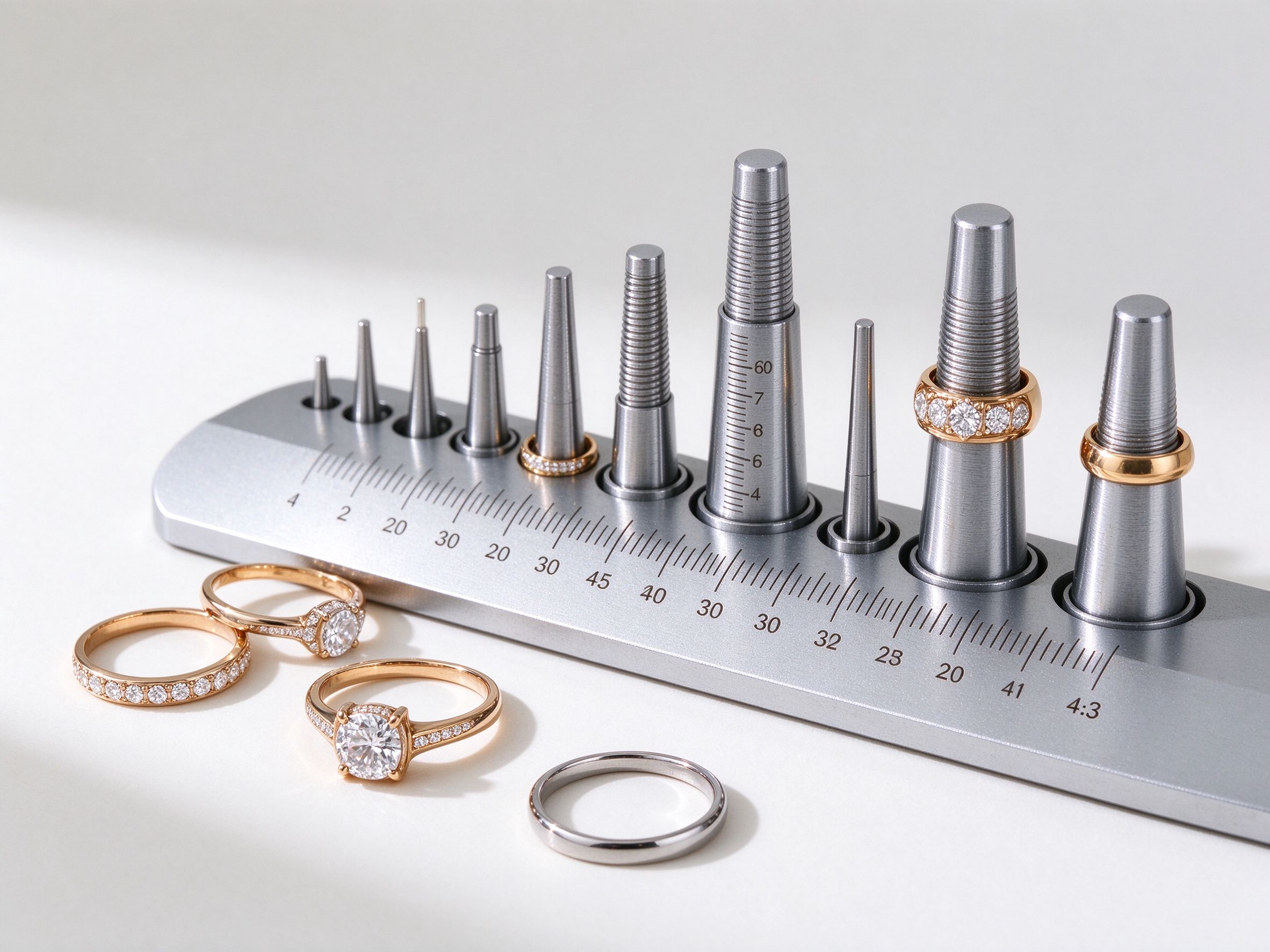
Our sizing bench uses three instruments. A tapered steel mandrel with marked sizes lets us slide a ring on and read its position; a flat ring bar with drilled holes of known diameter gives a yes-or-no check; and digital calipers confirm the exact internal measurement on sampled units. Each tool is calibrated against the others, because relying on one instrument alone hides drift. A ring bar is fast for sorting a thousand rings; calipers are slow but authoritative. We use the bar for bulk sorting and the calipers for QC sampling.
Comfort fit changes the measured size. A domed, comfort-fit band sits looser on the finger than a flat band of the same number, so our size charts always note the fit profile. A retailer selling comfort-fit rings should measure customers over a similar profile, otherwise the printed size and the on-hand feel will not match and the ring will be returned.
Wide bands need a half-size up. A band wider than about six millimetres grips more of the finger and feels tighter than a narrow band of the same diameter, so our sizing tables add a half size for wide designs. Building this correction into production means the size stamped on the inside matches the way the ring actually feels, not just the diameter.
Custom resizing on factory work is governed by the setting. A plain band can be opened and closed reliably, but a pav or channel-set eternity ring cannot be resized because stretching the shank shifts every stone seat. Our quoting process flags which designs are resizable before the order is confirmed, so retailers never promise a customer a resize the construction will not allow.
Measurement standards differ by country. The US uses numerical sizes, the EU uses a circumference in millimetres, the UK uses letters, and Asia uses yet another set of internal diameters. Our factory produces to whichever standard the buyer specifies and stamps the shank accordingly, and we supply a conversion chart so retail staff never have to approximate between systems.
Reusable ring sizers are a wholesale tool, not a gimmick. We ship a plastic circumference gauge and a set of metal mandrels to retail partners so their staff can measure customers accurately rather than guessing from a ring already on a finger. Accurate measurement at the point of sale is the single biggest driver of low ring-size return rates.
Temperature and time of day change finger size. Fingers swell in heat, after exercise, and late in the day, so our guidance to retailers is to measure when the finger is relaxed and at room temperature, and to measure the finger that will actually wear the ring. A good sizer slides on with gentle resistance and comes off over the knuckle without forcing.
Sorting a Production Run Into Sizes
When a run of identical rings comes off the line in mixed sizes, our team sorts them on the ring bar, confirming each size before it goes into a labelled bin. The bins then feed the finishing and engraving stations, so a size-6 ring never gets stamped size 7 by mistake. Sorting happens early, before the size stamp, because a stamp applied before sorting would lock in the error. This sequence - measure, sort, stamp, verify - is the standard order on our floor and it is why mis-stamped sizes are nearly absent from our shipments.
Inner finishing matters as much as the size number. A correctly sized band with a rough interior shank will catch on skin and feel smaller than it is, which is why every ring we ship is polished on the inside until the edge is rounded. Size is not just a diameter; it is the whole sensory experience the customer feels sliding the band on.
Bulk size runs are planned around demand data. Retailers tell us which sizes move, and we bias production runs toward those sizes while still covering the long tail. This is why factory-direct wholesale rings are available in the sizes you actually sell, rather than a one-size-fits-all handful that forces every customer to resize later.
We keep master rings for every common size so a production run can be checked against a known reference, not a guessed number. When a buyer questions a measurement, we measure against the master set together, which resolves the dispute in minutes. Reference equipment like this is what turns sizing from an argument into a measurement.
Sizing is one of the few areas where small staff habits cause big returns. A sizer kept on the wrong finger, or used on a cold morning, will mislead even a careful assistant. We give retail teams a short measuring protocol that takes seconds and removes the most common errors. Consistency at the counter prevents the inconsistency that ends in the post.
For rings sold online, a printable size guide and a physical trial-ring sample dramatically reduce size returns. Customers who measure themselves against a real, wide trial ring choose correctly far more often than those who guess. We supply these tools because an accurate measurement at home is the closest thing to being in the shop.
The size stamped inside a ring is a promise we stand behind. If a batch measures outside our tolerance, we replace it rather than argue. Buyers learn quickly that our sizes are reliable, which is why they reorder without re-checking every unit. Trust in the size label is built one verified shipment at a time.
Planning the Size Mix of a Wholesale Order
Retailers rarely want equal numbers of every size. Most sales cluster in the middle of the range, with a long tail at the extremes. Our order form lets buyers specify the size distribution they want: typically heavier on sizes 6 to 9 for women and 9 to 12 for men, lighter on the edges. We bias production accordingly while still covering the full range so a customer with an uncommon size is not turned away. Buyers who share their sell-through data get a size mix tuned to their actual customers, which reduces dead stock at the edges.
Wide and comfort-fit designs are where sizing tables earn their keep, because the correction is built into production rather than improvised at sale. A customer who orders a wide band in the corrected size gets a ring that fits the first time. That attention to profile detail is what separates a precise factory from a generic wholesaler.
Ring sizing on an industrial line is a tolerance problem, not a guessing problem. Each size is machined to a target inside diameter with a controlled plus-or-minus band, because a ring that measures halfway between labels will feel wrong on the customer and trigger a return. Our gauges are calibrated weekly against master rings traceable to a standard, so every batch measures the same way.
Mass production favours the whole, half and quarter sizes that sell. We stock tooling for the highest-volume sizes and hold them ready, while less common sizes are produced by adjusting the shank during the finishing pass. This is why a factory can offer dozens of sizes at scale without tooling up a new die for every single one.
Comfort fit changes the measured size. A domed, comfort-fit band sits looser on the finger than a flat band of the same number, so our size charts always note the fit profile. A retailer selling comfort-fit rings should measure customers over a similar profile, otherwise the printed size and the on-hand feel will not match and the ring will be returned.
Wide bands need a half-size up. A band wider than about six millimetres grips more of the finger and feels tighter than a narrow band of the same diameter, so our sizing tables add a half size for wide designs. Building this correction into production means the size stamped on the inside matches the way the ring actually feels, not just the diameter.
Custom resizing on factory work is governed by the setting. A plain band can be opened and closed reliably, but a pav or channel-set eternity ring cannot be resized because stretching the shank shifts every stone seat. Our quoting process flags which designs are resizable before the order is confirmed, so retailers never promise a customer a resize the construction will not allow.
Half and Quarter Sizes at Scale
Full sizes sell the most, but half sizes close the fit gap and reduce returns. We tool and produce the common half sizes alongside wholes, and quarter sizes on request for premium lines. Producing half sizes at scale is cheap for us because the shank adjustment happens during finishing, not by opening a new mould. For a retailer, stocking the half sizes between your best-selling wholes is the highest-return size expansion you can make, because it is where most returns originate.
Measurement standards differ by country. The US uses numerical sizes, the EU uses a circumference in millimetres, the UK uses letters, and Asia uses yet another set of internal diameters. Our factory produces to whichever standard the buyer specifies and stamps the shank accordingly, and we supply a conversion chart so retail staff never have to approximate between systems.
Reusable ring sizers are a wholesale tool, not a gimmick. We ship a plastic circumference gauge and a set of metal mandrels to retail partners so their staff can measure customers accurately rather than guessing from a ring already on a finger. Accurate measurement at the point of sale is the single biggest driver of low ring-size return rates.
Temperature and time of day change finger size. Fingers swell in heat, after exercise, and late in the day, so our guidance to retailers is to measure when the finger is relaxed and at room temperature, and to measure the finger that will actually wear the ring. A good sizer slides on with gentle resistance and comes off over the knuckle without forcing.
Inner finishing matters as much as the size number. A correctly sized band with a rough interior shank will catch on skin and feel smaller than it is, which is why every ring we ship is polished on the inside until the edge is rounded. Size is not just a diameter; it is the whole sensory experience the customer feels sliding the band on.
Bulk size runs are planned around demand data. Retailers tell us which sizes move, and we bias production runs toward those sizes while still covering the long tail. This is why factory-direct wholesale rings are available in the sizes you actually sell, rather than a one-size-fits-all handful that forces every customer to resize later.
We keep master rings for every common size so a production run can be checked against a known reference, not a guessed number. When a buyer questions a measurement, we measure against the master set together, which resolves the dispute in minutes. Reference equipment like this is what turns sizing from an argument into a measurement.
International Size Conversion in the Factory
A size requested in US numbers is not the same physical ring as the same number in another system. Our order system converts between US, EU, UK and Asian diameter standards automatically, and stamps the shank in the standard the buyer specifies. We supply a printed conversion chart with each shipment so retail staff can move between systems without mental math. The most common mistake we see from buyers is ordering a UK size stamped on a US-sized mandrel; our order confirmation restates the converted millimetre diameter so this mismatch is caught before production.
Sizing is one of the few areas where small staff habits cause big returns. A sizer kept on the wrong finger, or used on a cold morning, will mislead even a careful assistant. We give retail teams a short measuring protocol that takes seconds and removes the most common errors. Consistency at the counter prevents the inconsistency that ends in the post.
For rings sold online, a printable size guide and a physical trial-ring sample dramatically reduce size returns. Customers who measure themselves against a real, wide trial ring choose correctly far more often than those who guess. We supply these tools because an accurate measurement at home is the closest thing to being in the shop.
The size stamped inside a ring is a promise we stand behind. If a batch measures outside our tolerance, we replace it rather than argue. Buyers learn quickly that our sizes are reliable, which is why they reorder without re-checking every unit. Trust in the size label is built one verified shipment at a time.
Wide and comfort-fit designs are where sizing tables earn their keep, because the correction is built into production rather than improvised at sale. A customer who orders a wide band in the corrected size gets a ring that fits the first time. That attention to profile detail is what separates a precise factory from a generic wholesaler.
Ring sizing on an industrial line is a tolerance problem, not a guessing problem. Each size is machined to a target inside diameter with a controlled plus-or-minus band, because a ring that measures halfway between labels will feel wrong on the customer and trigger a return. Our gauges are calibrated weekly against master rings traceable to a standard, so every batch measures the same way.
Mass production favours the whole, half and quarter sizes that sell. We stock tooling for the highest-volume sizes and hold them ready, while less common sizes are produced by adjusting the shank during the finishing pass. This is why a factory can offer dozens of sizes at scale without tooling up a new die for every single one.
Verifying the Size Mix Before Carton Seal
Before an order ships, we count the size bins and reconcile them against the purchase order. If a buyer asked for forty percent size 7, we confirm the carton actually contains that proportion. This reconciliation catches production drift - for example, a run that skewed slightly larger as tooling warmed - before the carton leaves the building. Retailers receive a packing slip listing the quantity by size, so receiving staff can verify the mix in seconds. Size-level packing lists are a small detail that prevents the frustrating 'where are my size 8 rings' phone call.
Comfort fit changes the measured size. A domed, comfort-fit band sits looser on the finger than a flat band of the same number, so our size charts always note the fit profile. A retailer selling comfort-fit rings should measure customers over a similar profile, otherwise the printed size and the on-hand feel will not match and the ring will be returned.
Wide bands need a half-size up. A band wider than about six millimetres grips more of the finger and feels tighter than a narrow band of the same diameter, so our sizing tables add a half size for wide designs. Building this correction into production means the size stamped on the inside matches the way the ring actually feels, not just the diameter.
Custom resizing on factory work is governed by the setting. A plain band can be opened and closed reliably, but a pav or channel-set eternity ring cannot be resized because stretching the shank shifts every stone seat. Our quoting process flags which designs are resizable before the order is confirmed, so retailers never promise a customer a resize the construction will not allow.
Measurement standards differ by country. The US uses numerical sizes, the EU uses a circumference in millimetres, the UK uses letters, and Asia uses yet another set of internal diameters. Our factory produces to whichever standard the buyer specifies and stamps the shank accordingly, and we supply a conversion chart so retail staff never have to approximate between systems.
Reusable ring sizers are a wholesale tool, not a gimmick. We ship a plastic circumference gauge and a set of metal mandrels to retail partners so their staff can measure customers accurately rather than guessing from a ring already on a finger. Accurate measurement at the point of sale is the single biggest driver of low ring-size return rates.
Temperature and time of day change finger size. Fingers swell in heat, after exercise, and late in the day, so our guidance to retailers is to measure when the finger is relaxed and at room temperature, and to measure the finger that will actually wear the ring. A good sizer slides on with gentle resistance and comes off over the knuckle without forcing.
Frequently Asked Questions
How do you sort thousands of rings by size?
We slide rings onto a calibrated ring bar to confirm each size, sort into labelled bins, then stamp and re-verify. Sorting happens before stamping so mis-stamps cannot lock in errors.
Can I request a specific size mix in my wholesale order?
Yes. Most buyers skew toward middle sizes (women 6-9, men 9-12). Share your sell-through data and we tune the mix while still covering the long tail.
Do you produce half sizes?
Yes. Common half sizes are standard; quarter sizes are available for premium lines. Half sizes between your best sellers reduce returns most of all.
Which sizing standard do you stamp?
Whichever you specify - US, EU, UK or Asian. We convert automatically and restate the millimetre diameter on the order confirmation to avoid mismatches.
How do I know the carton has the sizes I ordered?
Every shipment includes a size-level packing slip, and we reconcile the size mix against your purchase order before sealing the carton.
Conclusion
Bulk sizing is a system, not a talent. Calibrated mandrels, early sorting, planned size mixes, half-size coverage and a verified packing slip together ensure a wholesale order arrives in the proportions and sizes your customers actually wear. Measure first, sort early, verify at the end.