01Why returns on earrings wholesale start before the customer wears them
Most return tickets I see on earrings do not come from a design the buyer got wrong. They come from a clasp that loosened in transit, a post that bent in the tray, or a rhodium layer that dulled after two weeks of daily wear. By the time the shopper complains, the cost has already moved down the chain.
So we treat care and repair as a production discipline, not a card that ships in the box. Every earring order that leaves our floor has passed a loop built to prevent the three failure modes that drive most returns: tarnish, mechanical fatigue, and stone loss.
This is article 10 in our series, so instead of another selection guide I am walking you through the loop itself, in the order the work actually happens.
02The three return drivers we track on earrings
We log returns by cause, not by SKU, because the same defect shows up across studs, hoops and drops. Three categories cover roughly nine out of ten claims we see come back through trade buyers.
- Surface change: plating dulling, silver tarnish, or a milky haze on moissanite after contact with perfume or sunscreen.
- Mechanical failure: bent posts, loose butterfly backs, hinge fatigue on hoops, weak solder at the drop joint.
- Stone security: a prong that opened after a knock, or a pave stone lifted by a cardigan sleeve.
Each one has a factory-side fix and a wearer-side fix. You need both, because a perfect prong still fails if the shopper sleeps in the earrings for a month.
We log returns by cause, not by SKU, because the same defect shows up across studs, hoops and drops. Three categories cover roughly nine out of ten claims we see come back through trade buyers.
03Incoming stone check: where the loop actually begins
Our first QC gate is the stone tray, before anything is set. Moissanite arrives with GRA paperwork per stone, and on request we pull IGI certification for larger goods. We check color consistency across the parcel, look for internal feathers under a 10x loupe, and confirm the millimeter size matches the PO.
This gate matters for care because a stone with a surface-reaching inclusion near the girdle is a stone that chips at the prong seat later. Catching it here costs us a stone. Catching it in a return costs you the customer.
Buyers often ask why our cost and yield run about 20% better than typical trading companies. The honest answer is that we buy and inspect at the stone tray, not at the finished-piece stage, so we are not paying to set and polish defective goods.
04In-process controls that decide whether an earring survives daily wear
The middle of the loop is where mechanical failures get designed out. Two controls do most of the work.
Post and hinge torque
For 925 silver studs we spec a minimum post diameter and check bend resistance on a sample from each batch. For hoops we open and close the hinge a set number of cycles and reject any piece with a soft snap. A hinge that feels fine on day one is often the one that comes back on day ninety.
Plating thickness and adhesion
Rhodium and gold plating on silver is where tarnish complaints come from. We verify plating thickness on a coupon from each lot and run an adhesion tape test. Thin, poorly bonded plating looks perfect at packing and goes dull in a humid bathroom, which is exactly where earrings live.
This is also the stage where we set the care instructions we will ship with the goods, because the spec and the advice should match. If the plating is 0.5 micron, the card should not promise lifetime shine.
05Pre-ship AQL: the last gate before the carton closes
Before packing we run an AQL sample inspection on the finished order: function, finish, stone security, pairing symmetry, and back closure fit. Earrings are sold in pairs, so we check pairs against each other, not just piece by piece. A mismatched pair is a guaranteed return and an easy one to miss.
Standard production runs 12-18 days after deposit and artwork approval. Stock items ship from 1 pc. Custom work starts at 30 pcs. Terms are T/T 30% deposit with balance against documents, and we take PayPal for samples so you can test the loop before committing to a run.
| Loop stage | What we check | Return driver it blocks | Buyer action |
|---|---|---|---|
| Incoming stone | Color match, loupe clarity, size vs PO, GRA/IGI papers | Stone loss, chipping at prong | Request certificate copies with the PO |
| In-process | Post bend, hinge cycles, plating thickness, adhesion | Bent posts, dull finish, tarnish | Approve plating spec in writing |
| Pre-ship AQL | Pair symmetry, closure fit, stone security, polish | Mismatched pairs, loose backs | Ask for the AQL report |
| After-sale | Care card, cleaning guidance, repair path | User-caused tarnish and damage | Print the card in your own branding |
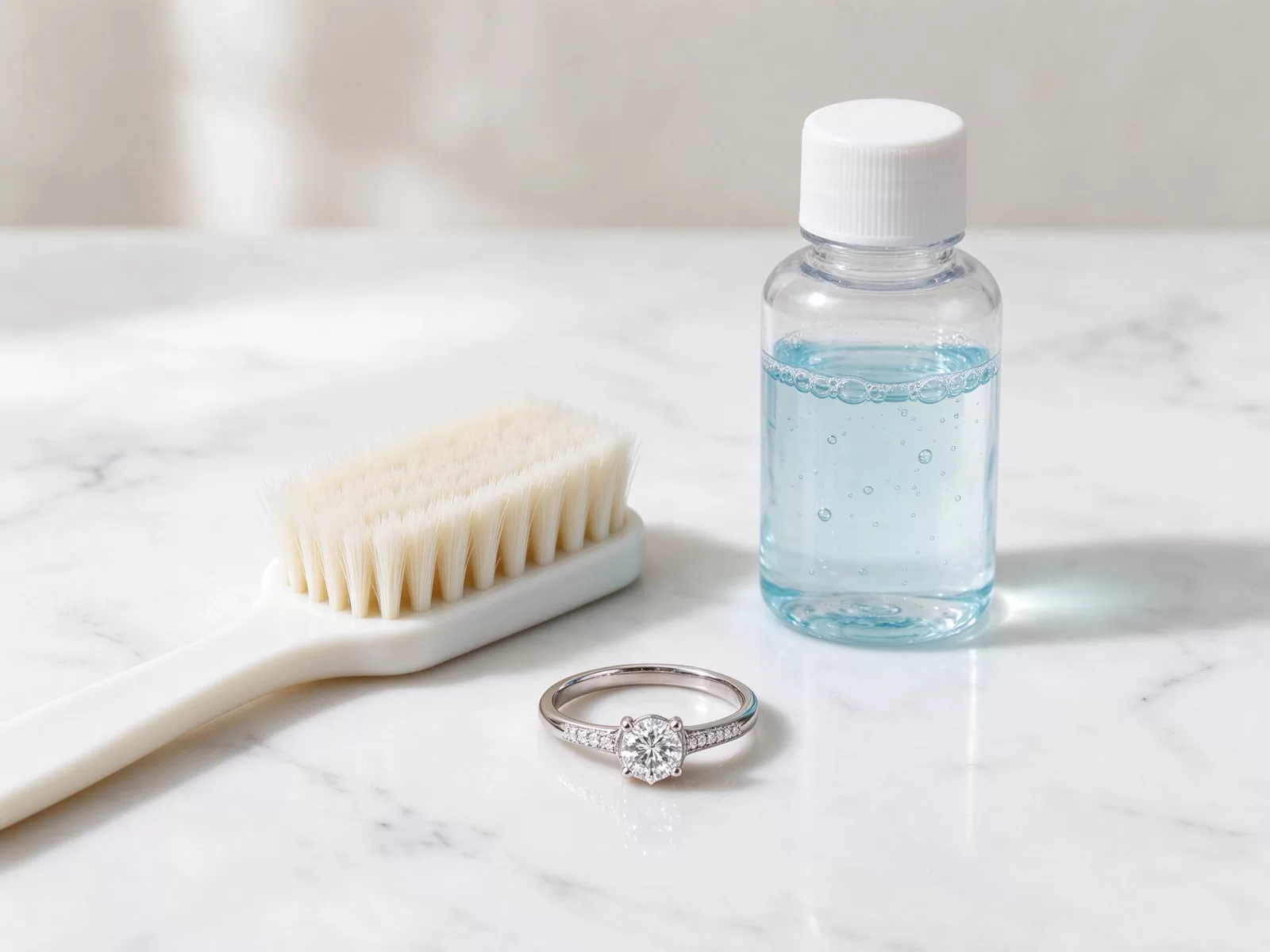
06Cleaning guidance you can put on the card
The wearer-side half of the loop is a short, blunt instruction set. Long care copy does not get read; four lines do.
- Put earrings on last and take them off first, after perfume, hairspray and lotion have dried.
- Wipe with a dry soft cloth after each wear; wash silver in lukewarm water with a drop of mild soap, then dry fully before storing.
- Keep pairs in a sealed pouch or lined box, not loose in a bathroom drawer.
- Do not swim, shower or sleep in plated or silver earrings.
- Bring loose stones or opened prongs to a jeweler rather than tightening them at home.
A care card is cheap. A returned pair plus reverse shipping plus a marketplace defect flag is not.
We print these cards unbranded by default and can run your logo on them for custom orders.
07Repair path: what happens after a claim
Even a tight loop leaks. When a claim comes in, the fastest resolution is a defined path rather than a negotiation. For trade buyers we replace defective units inside the agreed window, and we ask for the failed piece back so we can trace it to the batch and the QC gate that missed it.
That trace is the part most suppliers skip. It is also the only way the loop improves, because a prong failure traced to a specific solder operator is a training note, not a mystery.
For end wearers, the practical repair advice is simple: re-tipping a prong or replacing a butterfly back is inexpensive at any local bench, while a snapped hinge on a hollow hoop is usually not worth repairing. Tell your customers that up front and half the angry emails never happen.
08Frequently Asked Questions
What is the minimum order for earrings wholesale?
Stock earrings ship from 1 pc, so you can order samples or top up a bestseller without a full run. Custom designs with your own stone mix or plating spec start at 30 pcs per style. Price is quoted per piece, FOB, with stone grade and plating thickness stated in the quote.
How long does production and delivery take?
Standard production is 12-18 days after deposit and approval, with pre-ship AQL before the carton closes. DDP delivery to US and EU addresses runs 5-8 days after dispatch. Rush schedules are possible on stock goods; ask before you commit to a launch date.
Do you supply certificates and care materials with the order?
Moissanite ships with GRA certificates per stone, and IGI certification is available on request for larger goods. Care cards, pouches and branded packaging can be included in custom runs. Samples are payable by PayPal; production orders run on T/T 30% deposit.
If you want to test the loop before placing a production order, send your style list and target price to service@holycome.com or message WhatsApp +86 133 7744 7107 and we will quote per piece with plating spec, stone grade and lead time, plus a sample pair you can put through real wear.