01Why returns start in the warehouse, not the customer's hands
Twelve years on the floor taught me one thing about sterling silver: the metal is almost never the problem. I have seen maybe a dozen genuine alloy failures in that time. What I have seen thousands of times is a chain that tarnished in the box, a rhodium layer that rubbed off after two weeks, or a clasp that failed because nobody told the buyer how to open it.
So when a trade buyer asks about 925 sterling silver wholesale, I do not start with price per gram. I start with what happens on day 31, when the return window is still open and the customer is holding a grey piece of jewelry. That is the moment your margin is decided.
This piece walks through the care, cleaning and repair loop we build into every order. It is the same loop our own QC team runs before a box leaves the factory, and it is the reason we run about 20% better on cost, speed and yield than typical trading companies. The reason is simple: we own the polishing line, the plating tanks and the QC bench, so nothing gets lost in a middleman handoff.
02The three failure points that drive sterling returns
Almost every return I have investigated in a decade falls into one of three buckets. Fixing them at the factory costs cents. Fixing them after the sale costs you the piece plus shipping plus the customer.
- Tarnish in transit or on the shelf. Silver reacts with sulfur compounds in air, cardboard and some foam inserts. A piece packed wet or packed in the wrong bag can be grey before it is even unboxed.
- Plating wear at contact points. Rhodium or e-coat over silver fails first at the clasp, the jump ring and the back of a stud. Those are the spots that touch skin and fabric all day.
- Mechanical failure. A spring ring that opens too easily, a prong that was never properly closed, a chain link with a hairline crack from a worn draw plate.
Notice that none of these are chemistry problems with 925 itself. Sterling is 92.5% silver with copper and a touch of something harder. It is a good, workable alloy. It just needs to be finished and packed like someone cares.
Almost every return I have investigated in a decade falls into one of three buckets. Fixing them at the factory costs cents. Fixing them after the sale costs you the piece plus shipping plus the customer.
03What we do at the bench before plating
Care starts upstream. A piece that goes into the plating tank with polishing compound residue in the crevices will fail adhesion, and no amount of customer education will save it.
Our line runs a three-stage QC that catches this. Incoming stone check covers every parcel of moissanite or lab-grown before it touches metal, including GRA and IGI certificate matching. In-process inspection happens after setting and again after polishing, where a bench lead looks at the same piece twice under different light. Pre-ship AQL is the last gate, sampling to AQL 2.5 on cosmetic defects and 1.0 on functional ones like clasp tension.
Between those gates we do two things that matter for returns. First, every piece gets a clean-and-neutralize bath after polishing, then a full dry before it goes near a bag. Second, the plating spec is written down per SKU, not guessed. Standard rhodium over 925 runs 0.03 to 0.05 micron; e-coat over colored pieces runs thicker where the wear point is.
04Packing specs that stop tarnish before it starts
This is the cheapest return-prevention tool you have and most buyers ignore it. Anti-tarnish bags with a copper-ion liner cost a few cents each. Used properly, they buy you 12 to 18 months of shelf life.
We pack each piece in an individual zip bag with the air pressed out, then a silica sachet per outer box, not per piece. Cardboard display cards get a coated face, because raw kraft paper is a sulfur source. If you are selling on a marketplace where the item may sit in a warehouse for months, ask for the heavier liner. It is worth the upcharge.
One more thing: never pack a piece that has just come off the polishing wheel. Give it 24 hours in a dry room. I have watched a whole carton go grey because someone rushed a Friday shipment.
05What to put in the box for the end customer
Your customer will not read a care page. They will read a card. So make the card short, specific and honest about what they bought.
We include a care insert with every wholesale order at no charge, printed with your logo if you send artwork. It covers four instructions and nothing else: put jewelry on last and take it off first, keep it away from perfume and chlorine, wipe with the dry cloth provided, store in the bag it came in. That is it. Four lines beat four paragraphs every time.
We also suggest a small polishing cloth in the box for orders above a certain volume. It costs little, it gets used, and it turns a complaint into a five-star review more often than any discount code.
06Cleaning and repair guidance you can hand to a buyer
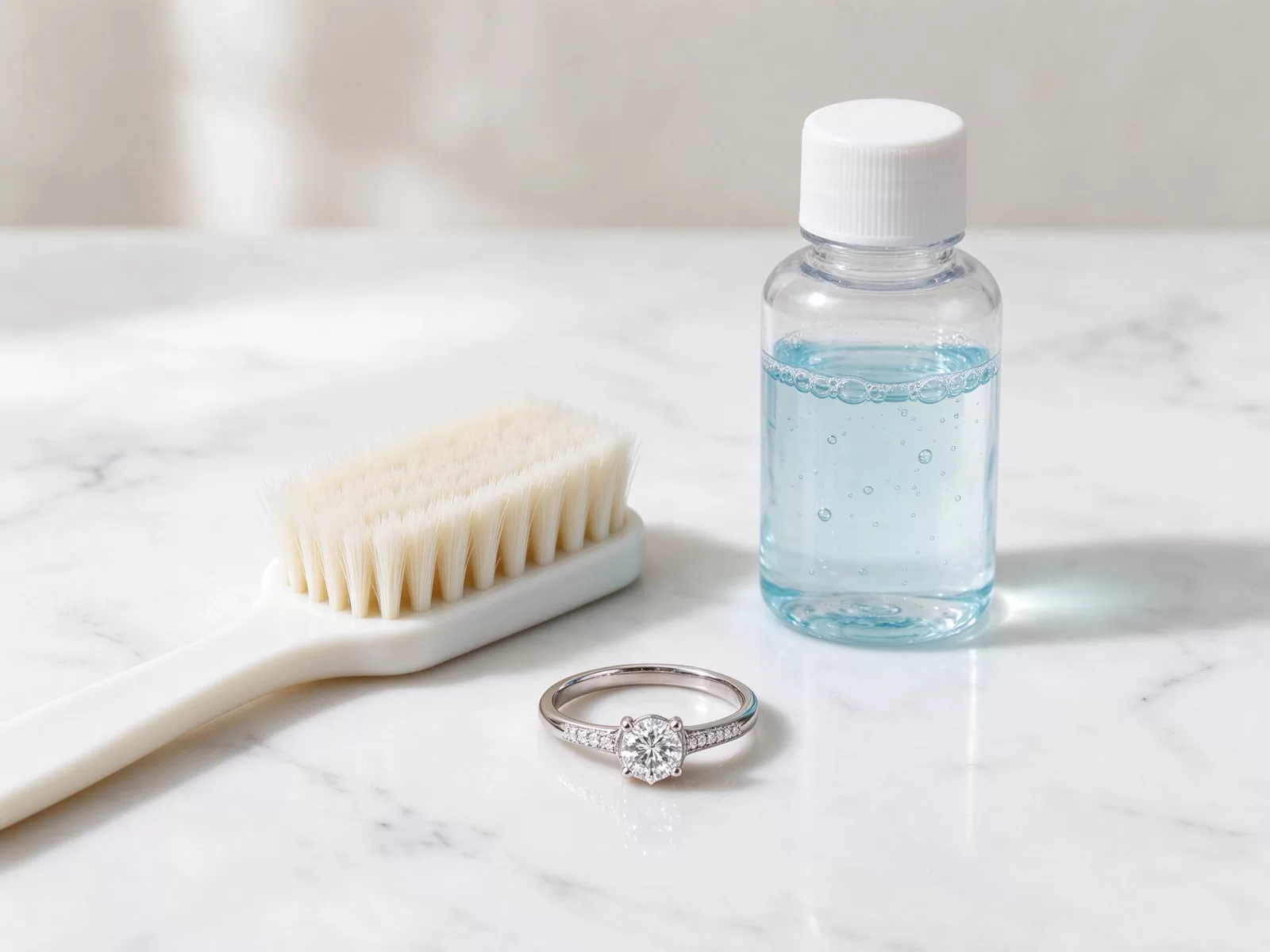
There is a real gap between what jewelers know and what consumers do. A buyer who scrubs a rhodium-plated pendant with a toothpaste-and-brush routine will be back in your inbox in a week.
For plain 925 with no plating, warm water with a drop of mild dish soap and a soft brush is fine, followed by a thorough dry. For rhodium or e-coat, skip the brush on plated surfaces and use a microfiber cloth only. No ultrasonic, no silver dip, no baking soda paste. Those three will strip plating or leave a hazy etch that cannot be polished out without removing metal.
On the repair side, keep it simple for the customer. A spring ring clasp is a two-dollar part and a five-minute swap at any local jeweler. A re-plating job typically runs a modest fee and restores a piece for another year or two. Tell your customer this up front and a broken clasp becomes a service moment instead of a refund.
07How the loop maps to a wholesale order
| Stage | What happens | Who owns it | Return risk addressed |
|---|---|---|---|
| Incoming | Stone grading and certificate match, metal assay spot check | Factory QC | Wrong grade, wrong stone |
| In-process | Setting check, polish check, clasp tension test | Bench lead | Mechanical failure |
| Finishing | Plating thickness per SKU spec, dry room hold | Plating line | Plating wear, adhesion fail |
| Pre-ship | AQL 2.5 cosmetic, 1.0 functional sampling | Factory QC | Batch-level defects |
| Packing | Anti-tarnish bag, coated card, care insert, silica | Packing team | Tarnish on shelf |
For stock items the minimum is one piece, so you can test a care program on a small run before committing. Custom designs start at 30 pieces per style. Production runs 12 to 18 days depending on plating and setting complexity, and DDP delivery adds 5 to 8 days to the US or EU. Terms are T/T with 30% deposit, and PayPal works for samples.
If a buyer tells me their return rate is over 4% on silver, I ask two questions first: what bag did you pack in, and what did your care card say. Nine times out of ten the answer is in those two places, not in the alloy.
08Frequently Asked Questions
What is the minimum order for a 925 sterling silver wholesale program?
Stock designs ship from one piece, which lets you test packing and care inserts on a real order before scaling. Custom styles require 30 pieces per design, and production takes 12 to 18 days after deposit and sample approval.
How is pricing set for sterling silver with moissanite or lab-grown stones?
Price is built from silver weight at the current spot rate, stone cost by size and grade, plus plating and labor. We quote per SKU with the breakdown shown, so you can see where the cost sits rather than working from a single lump number.
Do you provide certificates and repair support for wholesale orders?
Every stone order ships with GRA and IGI certificates matched to the parcel. We also supply care inserts, polishing cloths and replacement clasp parts on request, and our team answers repair questions by WhatsApp at +86 133 7744 7107 or service@holycome.com.
If you want to see how this loop works on your own assortment, send us your SKU list and target retail price and we will quote it with the packing and care spec included. Sample orders are the fastest way to check the finish, the plating and the bag before you commit to a production run.