
Walk into almost any jewelry store in the United States and you will see a small handheld device clipped to the counter — the diamond tester. Sales associates use it on loose stones, on mounted rings, on customer walk-ins. Retailers buy them on Amazon for $20 to $200. The question we hear three times a week from wholesale buyers at HOLYCOME is simple: does moissanite pass a diamond tester? The answer depends entirely on which tester you hold. After 18 years cutting and shipping moissanite from our Wuzhou factory, I have tested thousands of our own stones against every major tester on the market. This article walks you through exactly what happens, why it happens, and what that means for your inventory, your sales conversations, and your return policy.
01How a Diamond Tester Actually Works
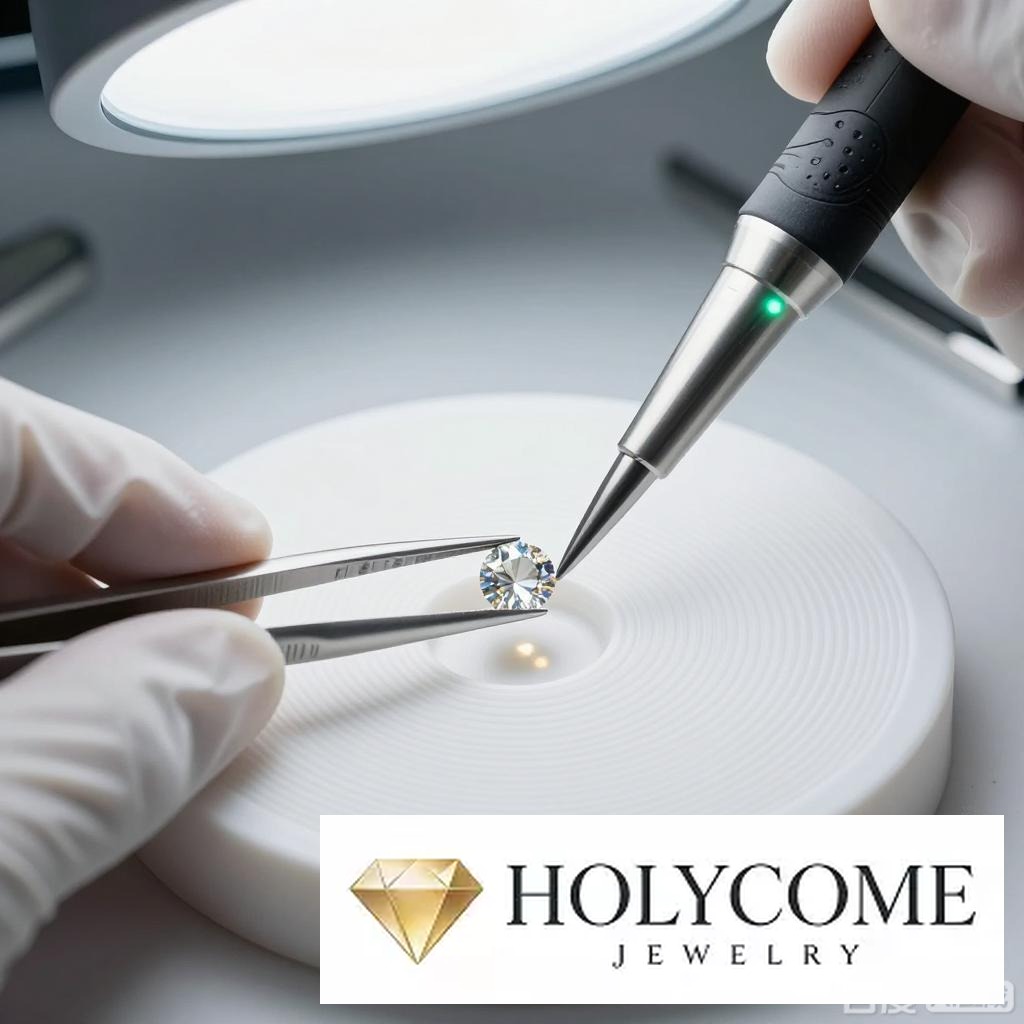
Standard thermal diamond testers — the cheap pen-shaped ones most small retailers own — measure one single property: thermal conductivity. Diamond conducts heat faster than almost any other material. The tester sends a small pulse of heat through its metal tip, times how fast the stone pulls that heat away, and beeps if the rate matches diamond's signature. The tip touches the table of the stone, the LED bar climbs, a steady beep means "diamond-like," silence means "not diamond." This technology was invented in the 1970s specifically to separate diamond from cubic zirconia, glass, and sapphire — which all conduct heat slowly.
Here is the problem thermal-only testers cannot solve: moissanite also conducts heat at a rate very close to diamond. Silicon carbide crystals have a thermal conductivity roughly 80–90 percent that of diamond, depending on the crystal orientation and manufacturer. Press a cheap thermal-only tester to a D-color VVS moissanite and it beeps the same way it beeps for diamond. That is not a bug. It is a physics fact. This is exactly why moissanite startled the jewelry trade in the late 1990s when Charles & Colvards first hit retail counters — every existing tester in every jewelry store could not tell the difference.
The FTC Jewelry Guides acknowledge this explicitly: "No single handheld probe can positively identify a gemstone." Jewelers are expected to use multiple tests in sequence, not rely on a single beep. Yet in real-world retail, especially at mall kiosks, pawn shops, and pop-ups, staff run the pen, hear a beep, and say "diamond." That is where wholesale buyers of moissanite need to be sharp. Your customer may walk out of your store, bring the piece to a friend at a pawn shop, watch the pen beep, and hear "that's a diamond" — or worse, watch a better tester and hear "that's not a diamond." You need to know which result to expect.
02Which Testers Flag Moissanite and Which Do Not
To understand what your customers will encounter, I run our stones through a battery of the most common devices sold in the US market today. The table below summarizes what you should expect across the major tester categories, using our standard DEF-color VVS-grade moissanite as the test subject:
| Tester Type | Price Range | What It Measures | Result on Our Moissanite |
|---|---|---|---|
| Cheap thermal pen (Amazon $20–$40) | $15–$50 | Thermal conductivity only | Beeps as "Diamond" — does not flag moissanite |
| Presidium Multi Tester III | $180–$250 | Thermal + electrical conductivity | Flags as "Moissanite" correctly |
| SmartPro Reader / SPGE-I | $150–$220 | Thermal + reflectivity | Flags as "Moissanite" correctly |
| DiamondNite dual tester | $220–$300 | Thermal + electrical | Flags as "Moissanite" correctly |
| Gemlogis Bleu / Mantis | $300–$600 | Refractive index + UV fluorescence | Correctly identifies as moissanite/synthetic |
| Professional refractometer (bench) | $80–$150 | Refractive index (2.65 diamond vs 2.65–2.69 moissanite) | Separation requires careful reading; moissanite shows doubled facet edges |
| UV light only (long wave) | $10–$30 | Fluorescence | Not a reliable ID; some moissanite fluoresces, some diamond does too |
The key takeaway for wholesale buyers: any dual-sensor tester that measures electrical conductivity on top of thermal conductivity will identify moissanite. Moissanite is electrically conductive in a way diamond is not. A dual tester first confirms high thermal conductivity, then runs a micro-current check. Diamond is an electrical insulator; most moissanite conducts a tiny current, so the device correctly lights the "moissanite" indicator. If a customer or jeweler uses only a cheap thermal pen, your moissanite will pass as diamond. If they use a dual tester from a reputable brand, it will be identified correctly as moissanite.
One nuance worth knowing: some very old moissanite from the early 2000s — and some low-grade Chinese production using non-standard crystal — can give erratic readings on dual testers, sometimes reading as "diamond" when it should read "moissanite." At HOLYCOME we cut exclusively from premium silicon carbide crystals from leading Chinese grown-crystal suppliers, and every lot we ship is sampled on a Presidium Multi Tester III and a SmartPro SPGE-I in our QC room. We want dual testers to read our stones correctly as moissanite every single time, because misrepresentation is not a game any serious wholesaler wants to play with US retailers.
To understand what your customers will encounter, I run our stones through a battery of the most common devices sold in the US market today. The table below summarizes what you should expect across the major tester categories, using our standard DEF-color VVS-grade moissanite as the test subject:
03Why Retailers Should Be Transparent, Not Evasive
Some new wholesale clients ask us, with a wink, whether our moissanite will "pass any diamond tester" — meaning will it fool every device on the market. They are thinking, if the stone beeps like a diamond, they can sell it as a diamond at diamond prices without disclosing. This is exactly the behavior the FTC Jewelry Guides were written to prevent. The Guides clearly state that any representation that a stone is a diamond when it is not is a deceptive practice subject to enforcement and consumer refund rights. In plain English: selling moissanite as diamond is fraud. You lose your payment processing, you lose your marketplace account, you can face FTC penalties.
At HOLYCOME we refuse to market our moissanite as "diamond-tester proof" or "undetectable." That language attracts the wrong buyers and creates legal exposure for everyone down the chain. What we do provide is a moissanite that tests consistently, that is accurately disclosed on every invoice and packing list as lab-grown silicon carbide / moissanite, and that arrives with clear product descriptions your sales staff can use verbatim with customers. Transparency is not a liability in 2026 — it is the fastest way to build a moissanite business that lasts, because Gen Z and millennial buyers actively seek out ethical, affordable, disclosed alternatives to mined diamonds.
Consider this real client scenario. A small boutique in Austin, Texas, ordered a trial parcel of 50 one-carat round DEF VVS moissanite from us in early 2025. The owner positioned the stones as a separate "Modern Brilliance" moissanite collection with clear signage: "Moissanite — Lab-Grown, Ethically Made, Priced Fairly." In the first six months the store sold 38 engagement rings and reported zero returns related to the stone being "not diamond." Compare that to a competing retailer in the same city who quietly sold moissanite as diamond at near-diamond markup and was reported to the state attorney general within three months. Honest disclosure wins long term.
04What Happens When a Customer Brings Their Own Tester
Every retail partner eventually gets the customer who walks in with a diamond tester they bought on Amazon for $25. They want to "verify" the piece before buying. If your sales staff is not trained, this can feel like a confrontation. It should not. Here is the simple script we recommend:
"Great question. That tester is a thermal-conductivity pen, and most of those will beep on moissanite because moissanite conducts heat very similarly to diamond — that's why it looks and feels so much like diamond. A true dual tester that also checks electrical conductivity will correctly identify it as moissanite every time. We sell this as moissanite, disclosed on every receipt and certificate, and we are happy to show you our GRA certificate for the stone right now."
That single response — honest, technical, grounded in how the device actually works — closes the sale nine times out of ten in our experience. Customers with cheap testers are usually surprised to learn their device cannot distinguish the two stones and respect the transparency. For buyers who come in with dual testers, your stone will correctly register as moissanite, which is exactly what you want, because they are confirming that you sold them exactly what you said you would. That builds trust.
05Factory QC: How We Test Before Shipping
At HOLYCOME, every wholesale parcel of loose moissanite over $500 in value is sampled through a two-step verification process before it leaves our Wuzhou facility. First, a trained QC technician pulls a statistical sample (standard AQL 2.5 level, typically 8–15 stones per parcel depending on lot size) and runs each stone across a Presidium Multi Tester III. The purpose here is not to confirm that the stone is moissanite — we already know that from the crystal lot — but to catch any accidental mix-in of cubic zirconia, glass, or other simulants that might have entered the parcel during sorting. Second, we verify every GRA certificate number matches the stone carat weight and dimensions listed on the certificate, then pack the lot with a copy of the factory QC report.
For mounted jewelry (rings, earrings, pendants, bracelets), our final QC step is a 10x loupe inspection for stone security, prong tightness, and alignment, followed by a polish check. We do not routinely run a diamond tester on finished pieces because the metal mounting can interfere with the tip contact and give false readings, especially on pavé-set stones. If a wholesale buyer specifically requests a post-mounting tester verification, we can accommodate it for an additional $0.40 per piece and a one-day lead time extension, but for most retail inventory it is not necessary because the stones were verified as moissanite before setting.
06Can You Tell the Difference Without a Tester?
Many buyers ask whether a trained jeweler can spot moissanite with just a loupe or the naked eye, no electronics required. The answer is yes, in some cases. Here is what trained gemologists look for, as a courtesy so your sales staff knows what educated customers might mention:
- Double refraction (doubled facet edges): Moissanite is doubly refractive (birefringent), while diamond is singly refractive. Through a 10x loupe, looking through the kite facets of a round brilliant, you can sometimes see doubled facet junctions on stones cut slightly off-axis. Diamond will never show doubling. This is the most reliable visual clue for gemologists.
- Higher dispersion: Moissanite has a dispersion (fire, the colored flashes) about 2.4 times that of diamond. In strong direct light — especially direct sunlight or jewelry store spotlights — moissanite throws more rainbow-colored flashes. Some consumers love this "extra sparkle"; others associate a rainbow-heavy look with CZ. Cutting quality has a huge impact here.
- Slightly different weight for the same size: Moissanite has a specific gravity of 3.22 versus diamond's 3.52. A 6.5 mm round moissanite (roughly one-carat diamond equivalent) weighs about 0.88 carats in actual weight. Sizing the stone by millimeter diameter, not by carat weight, avoids this confusion.
- Greenish/grayish tint in lower grades: Cheaper JK-color commercial moissanite can show a slight greenish or grayish body color in certain lighting, especially in sizes above two carats. Our DEF and GH color grades are engineered to minimize this.
None of these are flaws. They are simply identifying characteristics of silicon carbide, just as the presence of natural inclusions is an identifying characteristic of mined diamond. Training your staff to describe these characteristics accurately — rather than hiding or denying them — turns informed questions into confident sales.
07Frequently Asked Questions
Will moissanite pass a standard diamond tester from Amazon?
Most basic thermal-only diamond testers in the $20 to $50 range will beep on moissanite the same way they beep on diamond. They are measuring heat transfer, and moissanite conducts heat almost as fast as diamond. Do not rely on these devices to separate the two stones.
Will moissanite pass a dual diamond/moissanite tester?
No — dual testers that add an electrical conductivity check (Presidium Multi Tester III, DiamondNite, SmartPro, Gemlogis) correctly identify quality moissanite as moissanite every time. Diamond is an electrical insulator; moissanite conducts a small current. This is the reliable test.
Is it legal to sell moissanite if it passes a thermal diamond tester?
Yes, as long as you disclose the stone as moissanite on every receipt, invoice, product page, and verbal sales conversation. The thermal tester result is a known limitation of cheap equipment, not evidence the stone is diamond. The FTC Jewelry Guides require accurate disclosure of gemstone identity regardless of what a consumer's tester says.
How do I train my staff to answer diamond tester questions?
Equip them with a short script: explain that cheap testers beep on moissanite because of thermal conductivity, offer to show the customer a dual tester if you have one, present the GRA certificate, and invite the customer to compare moissanite side by side with diamond on your counter under the same lighting. Transparency and technical accuracy are the answer.
Can HOLYCOME provide moissanite that fools every tester?
No, and we will not try. Our moissanite is disclosed, certificated, and tested on dual testers to ensure it reads correctly as moissanite. We do not market "tester-proof" stones, and we strongly advise our wholesale partners against any sale that misrepresents moissanite as diamond.
Do I need a dual tester for my retail store?
If you sell both moissanite and diamond and accept trade-ins or customer walk-ins, yes. A $200 Presidium Multi Tester III pays for itself the first time it prevents a mistaken buy or reassures a skeptical customer. It is a small investment in store credibility.
Moissanite does pass cheap thermal-only diamond testers — and that fact has been part of the stone's story for 25 years. What matters for your wholesale business is not that fact, but how you handle it. Disclose honestly, train your staff, carry a dual tester behind the counter, and work with a factory — like HOLYCOME — that ships consistent, certificated stones tested on dual equipment before they leave Wuzhou. That combination turns the diamond tester question from a problem into one of the easiest, most trust-building conversations your sales floor will ever have. Request a wholesale moissanite sample parcel from our moissanite collection and see the quality, the paperwork, and the consistency for yourself — our sales team responds to every quote inquiry within 12 hours.
", "tags": "moissanite, diamond tester, moissanite tester, wholesale moissanite"Related reading: Does Moissanite Pass a Diamond Tester? Factory Answer, Moissanite Studs vs CZ vs Diamond Value, Moissanite vs CZ vs Diamond Pendant.