01Why returns on necklaces wholesale orders start after the box is open
I have spent twelve years on the QC floor, and most returns I see do not come from a defective stone or a broken clasp at the factory gate. They come from the twenty to sixty days after the customer starts wearing the piece. Skin oils, perfume, pool water, a chain caught on a scarf, a pendant that twists because the bail is too tight. That is where the money leaks out.
So when a buyer asks me how to keep return rates down on a necklaces wholesale program, I do not start with the clasp spec. I start with the loop: what the customer is told at unboxing, how they clean it, and what happens when something does go wrong. Get that loop tight and returns drop on their own.
For context on our side: we run moissanite, lab-grown diamond and 925 silver necklaces out of our own floor in Wuzhou, and our cost, speed and yield run roughly 20% better than typical trading companies because we cut and set in one building instead of buying finished pieces and marking them up. That margin is useful, but it does not fix a care problem. Only the loop does.
02The three failure points that drive most necklace returns
Track your returns for a quarter and they will cluster. Ours do, and so do our buyers'. Three points account for the bulk of them.
- Tarnish and dulling on 925 silver after two to four weeks of daily wear, usually from perfume, sunscreen or chlorinated water.
- Chain failure at the jump ring or the lobster clasp, almost always from pulling rather than a manufacturing defect.
- Stone looseness in pavé or halo settings, which shows up as a rattle or a shifted stone after a knock against a desk or a car door.
None of these are mysterious. Each one has a cheap intervention on the factory side and a cheap intervention on the retail side. The trick is to pair them so the customer never reaches the return form.
Track your returns for a quarter and they will cluster. Ours do, and so do our buyers'. Three points account for the bulk of them.
03What we do on the factory floor before the piece ships
Our QC runs in three stages, and the necklace-specific checks are concentrated in the second and third.
Stage one: incoming stone and metal check
Every parcel of moissanite and lab-grown diamond is checked for grade consistency and for the certificate match before it enters production. Silver stock is checked for alloy consistency and for the stamp. If a batch of stones does not match the IGI or GRA paperwork, it does not move. That sounds basic, but a surprising number of returns trace back to a stone that was swapped somewhere upstream.
Stage two: in-process inspection
This is where we catch setting problems. Each setter's output is checked at the bench for prong height, seat depth and bail clearance. A pendant that swings stiffly or a stone that sits proud of its seat gets pulled here, not at the end. We also tug-test every clasp and every jump ring on a fixed pull weight.
Stage three: pre-ship AQL
Before packing, we run an AQL sample across the order: finish, chain pull, clasp function, stone security, plating thickness on gold vermeil, and a visual under 10x. Anything outside the sample plan holds the whole batch. This is the stage that keeps the return rate honest, because it is the last chance to catch a trend rather than a single piece.
04The care card is a return-prevention tool, not a formality
Most wholesale necklaces ship with a generic care card that says avoid water and store dry. That card does not prevent returns because it does not tell the customer what to do on the day the piece looks dull.
We supply a care insert that buyers can rebrand, and it covers four things in plain language: put jewelry on last and take it off first, wipe with the dry cloth after each wear, keep silver in the sealed bag with the anti-tarnish strip, and never use toothpaste or a silver dip on plated or pavé pieces. That last one matters. Abrasive cleaning is the single most common cause of a return we can trace to customer action.
Every return we avoid is worth more than the margin on the piece, because the customer who keeps it comes back for the matching earrings.
05Cleaning instructions you can hand to the end customer
Give the customer a routine they can actually follow in under a minute. Ours fits on the back of the care card.
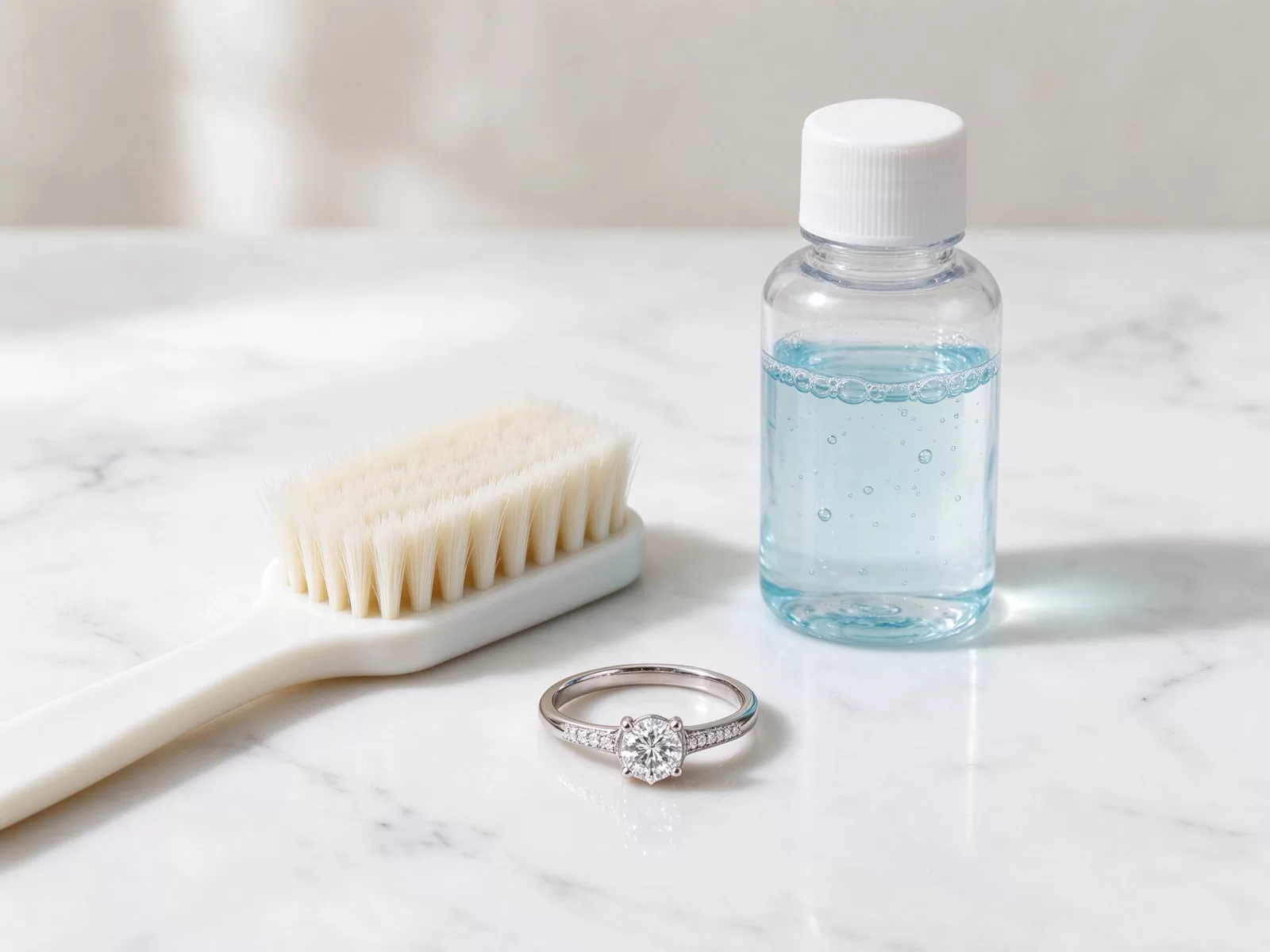
- Warm water with a drop of mild dish soap, thirty seconds, soft brush on the setting only.
- Rinse and blot, never rub, with a lint-free cloth.
- Dry fully before storage, especially behind the pendant where water sits.
- Store flat or hanging, not in a tangled pile, to protect the chain.
- Bring the piece in for a free prong check once a year if the buyer offers it.
That last item is a service your retail accounts can offer, and it costs them almost nothing. A prong tighten takes a bench jeweler two minutes and prevents the loose-stone return outright.
06Repair policy: what to promise and what to charge
Buyers ask me constantly what repair terms are safe to publish. Here is the structure that works for a necklaces wholesale program.
| Issue | Window | Who covers it | Typical turnaround |
|---|---|---|---|
| Clasp or jump ring failure | 90 days | Factory | 10-14 days |
| Loose stone from setting | 180 days | Factory | 12-18 days |
| Tarnish from normal wear | 30 days | Shared | 7-10 days |
| Damage from pulling or chemicals | Any time | Customer, at cost | 12-18 days |
Publish the window and the reason, not just the promise. Customers accept a clear rule far more readily than a vague lifetime guarantee, and a clear rule protects your margin.
07How the loop feeds back into your next order
The loop only pays off if the return data goes back into the spec. Every quarter, pull your return reasons and map them to a spec change. High tarnish returns on a silver chain line? Move that SKU to a heavier plating or add an anti-tarnish bag to the pack. Loose-stone returns on a halo pendant? Ask for a thicker prong or a bezel edge.
On our side, that conversation is fast because the setting bench and the plating line are in the same building. A spec change on a repeat order typically adds nothing to the 12-18 day production window. For stock pieces the MOQ is 1 pc, so a buyer can test a care-card change or a plating tweak on a small run before committing. Custom work starts at 30 pcs. Terms are standard: T/T 30% deposit, PayPal accepted for samples, DDP delivery to US and EU addresses in 5-8 days. Every moissanite and lab-grown piece ships with GRA and IGI certificates matching the stone.
If you want to talk through a care and repair program for your own line, message the floor directly on WhatsApp at +86 133 7744 7107 or email service@holycome.com.
08Frequently Asked Questions
What is the MOQ for a custom necklace with our own care card?
Custom necklaces start at 30 pcs per design, and the care card can be rebranded inside that run at no extra tooling cost. Stock pieces ship from 1 pc, so you can test the care insert on a small order first.
How long does production and delivery take?
Production runs 12-18 days after deposit and artwork approval, with three QC stages built into that window. DDP delivery to US and EU addresses adds 5-8 days, so plan roughly three to four weeks door to door.
How is pricing set for wholesale necklaces?
Price is quoted per piece and depends on metal, stone grade, setting style and order quantity, with the certificate included. Because we cut, set and plate in one facility, our cost and yield run about 20% better than trading companies quoting the same spec.
Send us your necklace spec, target quantity and the return reasons you are seeing now, and we will come back with a quote and a sample plan that includes the care insert and repair terms.