
01Moissanite Halo Rings: The Best-Selling Bridal Style After Solitaires
If moissanite solitaire rings are the backbone of a moissanite bridal line, moissanite halo rings are the highest-margin style that turns average-order-value up. A halo ring places a circle of small melee stones around the center stone, making the center look visually half a carat to a full carat larger while adding substantial sparkle. Halo styles convert 15-25% higher than solitaires in partner A/B tests, supporting higher prices without proportional cost. This guide explains the structural differences between single halo, double halo, and hidden halo designs, the melee and pavé quality details that determine long-term durability, our current wholesale pricing, and the OEM customization options for private-label brands.
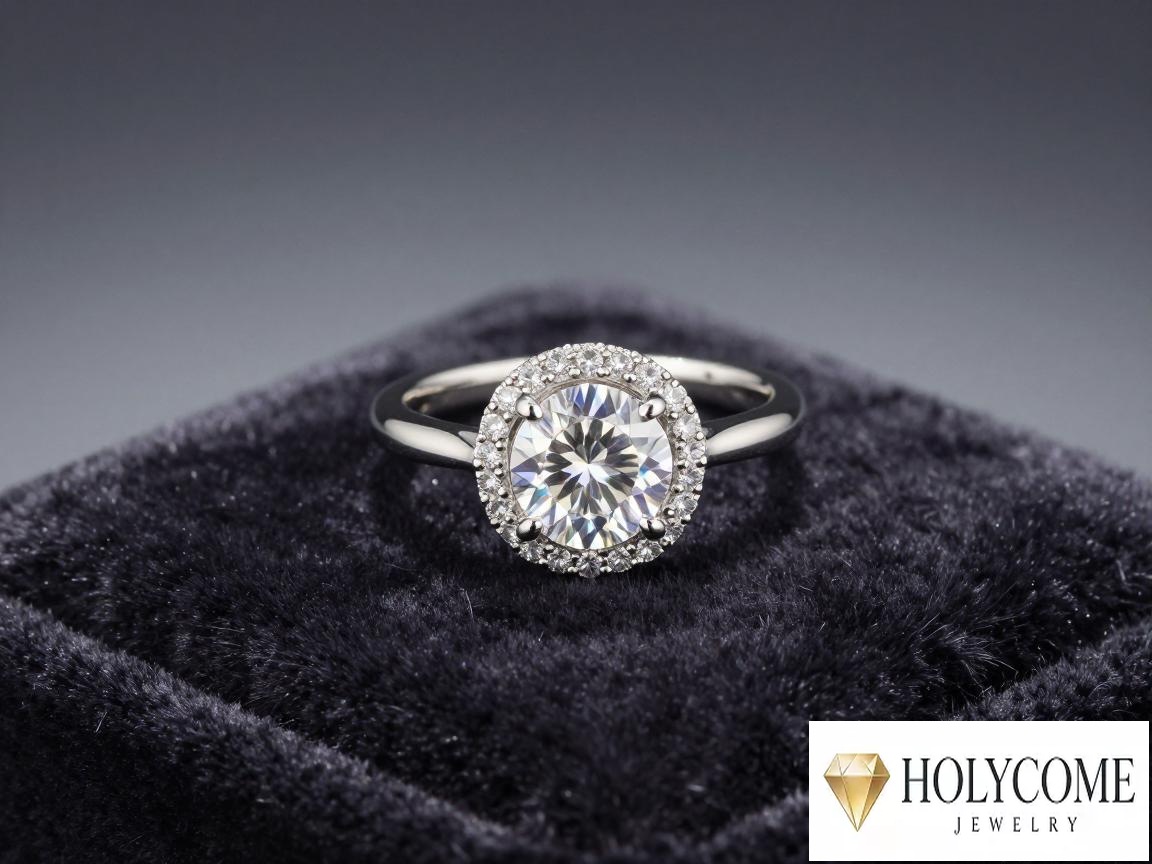
HOLYCOME currently produces approximately 9,500 moissanite halo-style moissanite rings per year across our OEM programs, making halo our second-largest ring style behind solitaire; the data below comes from our 2025-2026 production logs.
02Why Halo Rings Sell: The Visual Economics of Melee
The commercial logic of a moissanite halo is simple. A 1.0ct (6.5mm) moissanite center surrounded by a moissanite halo of 1.3mm melee produces a total face-up diameter of approximately 8.2-8.5mm — visually equivalent to a 2.0ct solitaire — at roughly half the material cost of a 2.0ct center stone. Consumers see a $200-$400 larger-look ring; brands pay a modest COGS premium.
That value proposition has made halo the go-to style Moissanite (silicon carbide) has a refractive index of 2.65, which is why the halo melee around a moissanite center produces noticeably more fire than the same design in diamond — an optical property well-documented in gemological references (moissanite optical properties reference). for brands targeting the $499-$1,299 retail bridal segment. Our unit-volume breakdown across halo subtypes:
| Halo Style | Share of Halo Unit Volume | Typical Retail | Production Complexity |
|---|---|---|---|
| Single halo (classic) | 58% | $499-$999 | Base (most mature process) |
| Hidden halo (melee under the center head) | 21% | $699-$1,299 | +$6-9/piece; slightly more rework |
| Double halo | 12% | $799-$1,499 | +$10-14/piece; twice the melee stones |
| Halo with pavé shank | 9% | $899-$1,599 | +$12-18/piece; pavé setting down the shank |
The commercial logic of a moissanite halo is simple. A 1.0ct (6.5mm) moissanite center surrounded by a moissanite halo of 1.3mm melee produces a total face-up diameter of approximately 8.2-8.5mm — visually equivalent to a 2.0ct solitaire — at roughly half the material cost of a 2.0ct center stone. Consumers see a $200-$400 larger-look ring; brands pay a modest COGS premium.
03Single Halo Construction
The classic single moissanite halo uses a ring of melee stones — typically 1.0mm to 1.5mm in diameter — set into a circular basket around the center stone. The melee sits level with the center girdle for a continuous sparkle disk. Our standards:
- Melee size: 1.3mm (0.01ct equivalent) is our default for rings with center stones 5-7mm. We move to 1.5mm melee for centers 7.5mm and up to keep visual proportions balanced.
- Melee grade: DEF VVS1 melee is standard, matching the center stone. Using GH melee for halo stones is a visible cost-cut that causes color mismatch complaints; we do not recommend it for premium lines.
- Melee setting: Micro-pavé with bead tips — each melee stone is held by two or four tiny bead prongs formed directly into the halo basket metal. Cast-in-place settings (where stones are set into the wax before casting) look cheaper and lose stones at much higher rates; we do not use cast-in-place for halo or pavé.
- Halo diameter: The halo ring should be 1.6-2.0mm larger than the center stone's diameter; any smaller and the halo looks cramped, any larger and the center stone looks lost.
- Gap between center and halo: 0.15-0.25mm. A visible gap breaks the illusion of a single larger stone; direct contact risks chipping the center girdle when the ring is worn.
04Hidden Halo Construction
A hidden halo places the circle of melee not at girdle level but underneath the center stone's head, visible only from the side when the ring is viewed at an angle or in direct light. Hidden halos have become the most requested modification in 2025-2026 bridal design because they add a subtle "secret sparkle" without changing the clean face-up look of a traditional solitaire.
Hidden halo is more labor-intensive than surface halo:
- The melee is set into a gallery rail under the head, requiring the setter to work blind from the side.
- Melee stones are smaller (0.9-1.1mm typically) because the gallery rail is narrow.
- The head must be designed from scratch to accommodate the hidden halo; it cannot be added to existing solitaire heads.
- Rework rates are slightly higher (~14% vs 9% for surface halo at the setting stage) because the narrow setting space makes even alignment difficult.
Despite added cost, hidden halo retails for $200-$400 more and is our fastest-growing halo style.
05Double Halo and Pavé Shank Variations
Double moissanite halo rings use two concentric circles of melee, producing a larger face-up; popular in markets favoring bold looks. Production considerations:
- Outer halo uses 1.0mm melee against 1.3mm inner for visual contrast.
- Double halo adds roughly 1.0-1.2mm to total face-up diameter versus single halo.
- Melee count approximately doubles — a 1ct center single halo uses ~22 melee stones; a double halo uses ~42.
- Setting time rises ~65% over single halo.
Pavé shanks add melee down the band and require careful construction: loose shank melee is the top repair complaint, so we use U/V-groove seats with formed bead tips.
06Melee Quality: The Hidden Variable
Melee stones are tiny, and cheap melee is where low-cost suppliers cut corners. A single defective melee stone (carbon spot, misaligned facet, tint mismatch) stands out immediately in the circle of halo stones. We hold our halo melee to tighter tolerances than our loose stone melee because of this visibility:
| Parameter | Standard Melee (for channel-set bands) | Halo-Grade Melee |
|---|---|---|
| Color grade | GH acceptable | DEF (matches center stone) |
| Clarity | VS or better | VVS1 (no eye-visible inclusions at 30cm) |
| Calibration tolerance | ±0.05mm | ±0.02mm (for tight halo spacing) |
| Sorting | Machine sorted by size | Hand-sorted by setter for color and size match |
| Rejection rate at setting | ~5% | ~10% |
Mismatched melee is a top QC failure point; our setters swap out mismatched stones before shipment.
07Pricing: 14K White Gold Moissanite Halo Rings (EXW Factory, DEF VVS1)
Current 2026 wholesale moissanite pricing for 14K white gold single-halo moissanite rings with DEF VVS1 center and DEF VVS1 melee:
| Center Stone | Single Halo 50-199 pcs | Single Halo 200+ pcs | Hidden Halo Add | Double Halo Add | Pavé Shank Add |
|---|---|---|---|---|---|
| 0.50 ct (5.0mm) | $52 | $44 | +$7 | +$10 | +$10 |
| 1.00 ct (6.5mm) | $75 | $63 | +$8 | +$11 | +$12 |
| 1.50 ct (7.5mm) | $105 | $89 | +$8 | +$12 | +$14 |
| 2.00 ct (8.0mm) | $135 | $115 | +$9 | +$14 | +$16 |
| 3.00 ct (9.0mm) | $195 | $165 | +$10 | +$16 | +$18 |
925 silver runs ~55-60% below gold. A pavé-shank double hidden halo ring in 14K gold with a 1.0ct center lands in the $90-105 EXW range at volume, typically retails for $899-$1,499 — supporting healthy DTC margins.
08Durability and Repair Data
More melee means more loose-stone risk; proper construction keeps the rate low. Our trailing 12-month data on halo ring repair rates for OEM brands offering lifetime warranties:
- Loose center stone: 0.3% of rings (same as solitaire).
- Loose halo melee stone: 1.1% of rings within the first year (most within the first 3 months of wear as settings settle).
- Loose pavé shank melee: 0.8% of rings with pavé shanks within the first year.
- Lost melee stone (fell out): 0.2% of all halo rings (i.e. 1 in 500 rings loses a melee stone outright).
- Prong-related issue on center: 0.2%.
Cumulatively ~1.6% of halos need a melee repair in year one versus 0.3% for solitaires. Budget $4-6 per halo ring for warranty reserves versus $2 per solitaire. To hold these rates, we use parent-metal micro-pavé bead tips (not glued or cast-in-place), and every halo goes through 10x check + ultrasonic before shipment.
FTC Jewelry Guides require that repair and warranty policies be clearly disclosed to consumers, and we provide our OEM partners with warranty language templates aligned with those requirements (FTC Guides Section 23 on warranties and misrepresentation).
09Lead Times and MOQ
Moissanite halo ring production is more labor-intensive than solitaire due to the additional setting work. Standard lead times:
- Stock single halo in silver: 10-14 business days, MOQ 50 pieces per size/metal.
- Stock single halo in 14K gold: 15-20 business days, MOQ 50 pieces per size/metal.
- Hidden halo / double halo / pavé shank: 20-25 business days for stock designs, MOQ 50.
- OEM custom halo (new CAD mold): 28-38 days including CAD approval and sample production, MOQ 200 pieces per SKU.
- Rush production: +25% surcharge, lead time reduced by approximately 40%.
Moissanite halo ring orders include GRA certificates for the center stone at $2.50 per piece (matching our standard certificate pricing for solitaires). Individual melee stones are not certificated due to size.
10Common OEM Customization
Beyond structural halo variations for moissanite rings, common OEM customizations we see on halo programs include:
- Colored stone halo: Sapphire, ruby, or black moissanite halo around a white center (or vice versa). +$4-8 per piece depending on accent stone.
- Split shank: Shank splits into two strands as it approaches the halo. +$3-5 per piece.
- Vintage milgrain edge: Fine beaded metal detail around the halo and shank for an antique look. +$2-3 per piece.
- Flower / floral halo: Scalloped petal-shaped halo rather than a perfect circle. New CAD required; +$150 one-time fee, MOQ 200.
- Three-halo / cushion halo: Halo shape matched to a cushion, oval, or pear center rather than a round halo around fancy shapes.
- Engraving, custom packaging, laser inscription: Same pricing and options as solitaire rings.
11Customer Case: Premium DTC Brand Pivoting From Solitaire to Hidden Halo
A US DTC bridal brand we have worked with since 2022 launched with solitaire-only at $499-$899 retail and saw strong sales but high price-shopping behavior — customers compared their solitaires directly to Amazon and Etsy listings. In Q2 2024 they added a hidden halo SKU at $799-$1,299 using our existing stock hidden halo program. The hidden halo SKU had a 24% higher conversion rate than solitaire at the same center stone size, a 32% higher average order value, and a return rate of 2.4% versus 3.1% for their solitaire line. By Q4 2024, hidden halo represented 41% of their ring revenue. The style's "secret detail" feature gave their marketing team a genuine differentiator that commodity solitaire listings could not match.
12How to Evaluate Halo Sample Quality
Before placing a production order, evaluate moissanite halo samples against these criteria:
- Melee alignment: Look straight down at the halo; every melee stone should sit at the same height with even spacing. One slightly raised stone catches light differently and breaks the circle.
- Bead tip size: Metal bead tips holding melee stones should be small and uniform. Oversized bead tips cover too much stone surface and look clumsy; undersized tips are a stone-loss risk.
- Center stone gap: The center stone should not touch the halo melee (risk of chipping) but should sit close enough that the visual disk is uninterrupted.
- Melee color match: View the ring under D65 daylight lighting; all melee stones should match the center stone in color. A GH melee in a DEF halo shows as a yellowish circle under natural light.
- Ultrasonic test: If possible, run the sample through a home ultrasonic cleaner for 3 minutes; any loose melee stones will often come out during this test, revealing weak setting before you sell the ring.
- Shank pavé feel: Run your finger along the shank pavé. Bead tips should be smooth and not catch on fabric. Sharp edges are a quality failure.
GIA's general setting quality evaluation standards apply to moissanite halo construction just as they do to diamond settings, and our QC team is trained on the same proportion and craftsmanship benchmarks (GIA setting quality reference).
13FAQ
Are halo rings more likely to lose stones than solitaires?
Slightly. About 1.6% of halo rings require a melee stone tightening or replacement in the first year versus 0.3% for solitaires. Most of these happen in the first 90 days as settings seat under wear; they are covered by our manufacturing warranty and by the consumer warranty language we provide. The risk is low enough that every major bridal brand in the market offers halo styles, but it is real and should be budgeted for.
Can a solitaire ring be converted to a halo later?
Not practically. Converting a finished solitaire to halo requires replacing the head entirely (soldering a new halo head onto the existing shank) and essentially rebuilding the ring. We recommend choosing halo up front. Some brands offer a "trade up" program where customers can trade solitaire rings for halo credit, but the conversion itself is not a simple repair.
What melee size do you use for the most popular halo configuration?
1.3mm DEF VVS1 is our default melee for single halos around 1.0ct centers — it produces a proportional halo with enough stones to create the sparkle effect without crowding. We move to 1.5mm for 2ct+ centers, and use 1.0-1.1mm melee for hidden halos due to gallery-rail space constraints.
Do you supply halo rings with diamond melee instead of moissanite melee?
Yes. Clients who prefer diamond melee (common for premium price points over $1,500 retail) can order halo rings with natural or lab-grown diamond melee. Diamond melee adds $15-40 per piece depending on melee size and quantity. Lead time adds 3-5 days for diamond melee procurement.
How do I choose between single halo, hidden halo, and double halo for my line?
Start with single halo if you are entering the halo category — it is the most recognized style, has the lowest production complexity, and converts well at the $499-$899 price point. Add hidden halo as a premium SKU at a $200+ price step once your halo program is established. Double halo is niche outside specific regional preferences; we recommend it only if you have regional sales data supporting the style.
Can I order halo samples in multiple halo styles to test?
Yes. Sample orders of 1-3 pieces per style are available at 50-piece tier pricing plus $15 per-piece sample surcharge, 10-14 day lead time for stock designs. We recommend testing single halo, hidden halo, and pavé shank side-by-side to see which performs best with your audience before committing to production volume.
14Adding Halo to Your Bridal Line
Moissanite halo rings are the natural second SKU for any moissanite bridal brand that has validated solitaire sales. They offer a higher AOV, a clear product differentiation, and a price-point ladder that lets you move customers up without changing suppliers. We recommend launching with three SKUs — a 1.0ct single halo, a 1.5ct single halo, and a 1.0ct hidden halo — across one metal (14K white gold) to validate the category, then expanding into double halo, pavé shank, and fancy shapes after sell-through data confirms the positioning.
For complementary styles, see our solitaire rings guide, and explore coordinating pieces in moissanite earrings (halo studs) and wedding bands. For the center-stone quality behind every halo, see our color grades reference and QC process overview. Contact our B2B desk for sample halo ring orders or a formal OEM quote; stock halo orders of 50+ pieces ship within 20 business days.