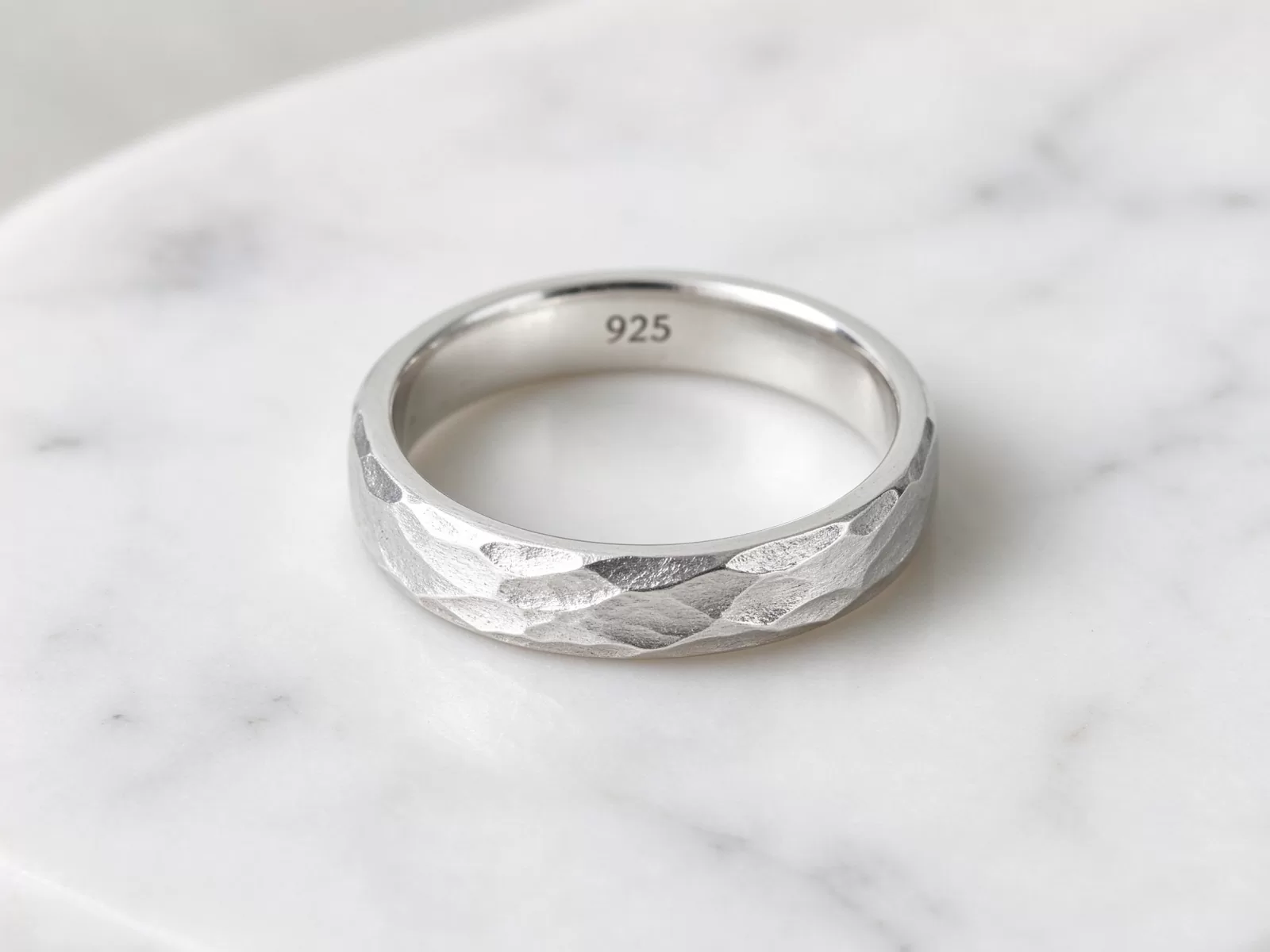
A 925 sterling silver programme turns on one choice made before any setting is cut: which of three white stones the piece will carry. Moissanite, lab grown diamond and cubic zirconia photograph alike, sit alike in a four-claw head and read alike across a counter. What separates them is a short list of measurable features, because the stone sets the price band and the customer's expectation.
01Why a silver programme reads three stones before it reads a single setting
Silver is the least expensive part of a finished piece and the stone is the most visible, so the stone carries the whole positioning of the item. The metal side is settled at the bench: sterling means 92.5 percent silver, and the release reading is taken at the contact point against 0.5 microgram per square centimetre per week under EN 1811 in the EU REACH framework.
The metal is fixed, the stone is the variable
Two pieces can share one casting, one plating bath and one box and still sit three price bands apart, because of a stone that weighs the same and measures the same. Write the metal specification and leave the stone to the workshop, and the price decision has been delegated downward.
Three stones, three sets of readings
Moissanite is silicon carbide, near 2.65 in refractive index, near 3.22 in density and near 9.25 on the Mohs scale. Lab grown diamond sits near 2.42, near 3.52 and at 10. Cubic zirconia sits near 2.16, between 5.6 and 6.0 in density and between 8 and 8.5 in hardness.
What each stone does after the sale
Cubic zirconia clouds and scratches inside a season of daily wear, which is a warranty conversation. Moissanite holds its polish for years, which becomes a colour conversation when the customer compares it to a friend's diamond. Lab grown diamond raises origin and disclosure questions rather than appearance ones.
02What the selection sheet has to fix before the first silver order
Once the stone is chosen, the sheet has to say enough that two workshops would cut the identical piece from it.
Name the stone in full
The invoice description should carry the material name, not a trade nickname. Write silicon carbide or laboratory-grown diamond, with the growth method where a diamond is involved. A nickname that suits one market may misdescribe the stone in another.
Size in millimetres first, carat equivalent second
Stones trade by diameter in millimetres and are invoiced by the diamond weight that diameter suggests. Write the diameter to 0.01 mm and put the carat equivalent in a separate column. A seat cut to a bare number rather than to the stone ordered is the most common miss in a silver programme.
Colour and light as a pair
A grade means nothing without the light it was read in. Record the colour against a master set under a named light between 5,000 and 6,500 K, because a warm light flatters every white stone.
The setting and its depth budget
Seat depth belongs on the sheet in millimetres against the stone ordered, not against the size number. Silver is soft, so the claws must hold without deforming, and a shallow seat lets the stone sit proud where a knock can reach it. Write the base wall as a minimum at the seat.
The invoice description should carry the material name, not a trade nickname. Write silicon carbide or laboratory-grown diamond, with the growth method where a diamond is involved. A nickname that suits one market may misdescribe the stone in another.
03How to separate the three stones at goods-in without a laboratory
A loupe, a micrometer and a set of scales settle most parcels, and none of the readings needs expensive equipment.
The loupe and the doubling test
Under a ten-power loupe, turn the stone and watch the facet edges. Silicon carbide is birefringent, so every edge doubles when viewed off the axis, which is the fastest field separation from diamond. Diamond stays single in every direction.
The heft and the dimensions
Cubic zirconia is roughly half again as heavy as diamond of the same size, and that difference shows on a balance rather than in the hand. Take the diameter at the girdle, not across the table, because a table reading flatters a shallow cut.
The thermal reading and what it proves
A thermal tester separates diamond from the two simulants but does not separate moissanite from cubic zirconia, since both read as non-diamond. Treat the result as one line of evidence and pair it with the doubling test and the weight.
| Field | What it must state | What fails without it |
|---|---|---|
| Stone name | Full material name, such as silicon carbide or laboratory-grown diamond | A stone described by a trade nickname in one market |
| Size | Diameter in millimetres to 0.01 mm, with carat equivalent in a second column | A seat cut to a number rather than to the stone |
| Colour and light | Grade against a master set under a named light between 5,000 and 6,500 K | A grade that shifts with the lamp and the room |
| Setting depth | Seat depth in millimetres against the stone ordered, with a base wall minimum | A stone proud of the claws or sunk below them |
| Metal mark | Quality mark and maker's mark, at 92.5 percent silver | A piece that cannot be traced to the party that made it |
| Disclosure line | The exact wording that will print on the card and the invoice | A claim argued from memory at the returns desk |
Read across the table and each line is a field the buyer can write into the order before the first casting is poured. Read down the last column and each line is a failure that would otherwise reach the customer rather than the page, in a piece whose metal was never the problem.
04Why one stone reads differently once it is set in silver
A parcel is judged on a white tray, one stone at a time, but setting changes what the eye has to work with. Polished silver throws light back through the stone, so a stone that read one step on its own can read a step warmer in a closed back. The buyer sells what the customer sees through the metal, not the loose reading.
What the mounting does to the reading
A four-claw basket lets light pass the girdle and holds a stone bright; a closed back shuts that path and warms the face a step. Two mountings of one stone, side by side, are a colour difference the parcel never showed, so what has to match is the stone and its seat.
Why two seats of one stone do not read alike
Seat depth moves the table against the wearer's line of sight. Too high, the stone catches the room and reads bright in every photograph; too low, the silver shades the crown and the same stone reads flat. Seat depth in millimetres, cut for the stone ordered, keeps a repeat order reading on the finger as it did on the tray.
05How the order splits the three stones onto separate lines
One line reading "stone" collapses silicon carbide, lab grown diamond and cubic zirconia into one field, and the three share neither a price nor a seat nor a wear pattern. Split them and each line carries its own readings; merge them and every difference is argued again at the returns desk.
One line per material
Three materials, three lines. Each names the material in full, states the diameter to 0.01 mm at the girdle with the diamond equivalent on a sub-line, and states colour with the lamp in kelvin and the master set. Cubic zirconia adds one figure: density around 5.6 to 6.0 grams per cubic centimetre, the reading a balance confirms.
The fields each line has to carry
Metal and stone sit on separate lines, seat depth on its own, and one disclosure sentence prints the same on card, invoice and listing. The metal row does not move between stones: sterling is 92.5 percent silver, balance copper, with the contact release read to EN 1811 under EU REACH at 0.5 microgram per square centimetre per week.
| Line | What the line states | What a gap costs |
|---|---|---|
| Material line | Material by full name, never a trade alias | A claim argued on appearance |
| Diameter line | Millimetres at the girdle to 0.01 mm | A seat cut to a number, not a stone |
| Colour line | Grade with lamp in kelvin and master set | One parcel read warm, the next cold |
| Seat depth line | Depth in millimetres and minimum wall thickness | A stone that shades or lifts on the piece |
| Metal line | Alloy proportion and the contact release figure | A skin reaction blamed on the stone |
| Disclosure line | The one sentence on card, invoice and listing | A wording that shifts and reads as a promise |
06What to record so a second parcel can be compared with the first
A parcel checked once is an opinion; a parcel checked against a file is a specification. The file has to be small enough to fill in at the bench and complete enough that the second order is read against the first, not against a memory of it.
Readings filed per line
Each line leaves four marks: date, sample count, method, and the lamp or master set. A diameter filed to 0.01 mm means the next parcel is measured the same way; a colour filed with its lamp means the next run is judged in the same light.
Why the third parcel is where the record pays
The first parcel sets the fields, the second tests them, and the third shows whether a supplier holds a reading or drifts. A drift of one band is invisible on two orders and obvious across three, and a programme that reads three stones is kept honest by one page written at goods-in.
07Order Terms for Wholesale Buyers
MOQ is 1 piece for stock styles and 30 pieces for custom work, and loose stones are sold by the carat. Sampling takes 7 to 10 days, and bulk production runs 15 to 25 days after the sample is approved. Pricing is quoted per piece or per carat depending on the item. Payment is T/T with a 30% deposit and the 70% balance before shipment, and PayPal is accepted for sample orders.
08Frequently Asked Questions
Why does one stone read differently in silver than in gold?
Silver throws back white light and gold warms it, so a stone read loose has to be re-read in the metal it will be sold in. The stone has not moved; the path of the light has.
Can one order line cover all three stones?
Not if the reorder is to repeat. One line hides a price, a seat and a wear pattern that differ between silicon carbide, lab grown diamond and cubic zirconia.
What is the field most often left blank?
The lamp. Colour is read in a room and a room has a light; filing the colour temperature and the master set is what makes a grade transferable between two benches.
How long should the record be kept?
Long enough to cover the supplier dispute and the first wear claim on the same order, which usually means the life of the programme rather than the life of the parcel.
Written into the order before the first casting is poured, these fields turn a three-stone selection from a question of taste into a file a buyer can defend.
The fuller reference set behind this sheet lives in the technical notes on stone and metal selection, the standards this reading is measured against are set out on the house page for how the programme is run, and the wording that travels with every parcel is held under the terms that govern how it is kept.
Moissanite is a lab-created diamond alternative, not a natural diamond; listings and customer-facing copy should describe it that way.
Sources: Grading references: GIA gem education and GIA laboratory information.